Recent tech outages raise concerns over how agencies, businesses maintain critical systems
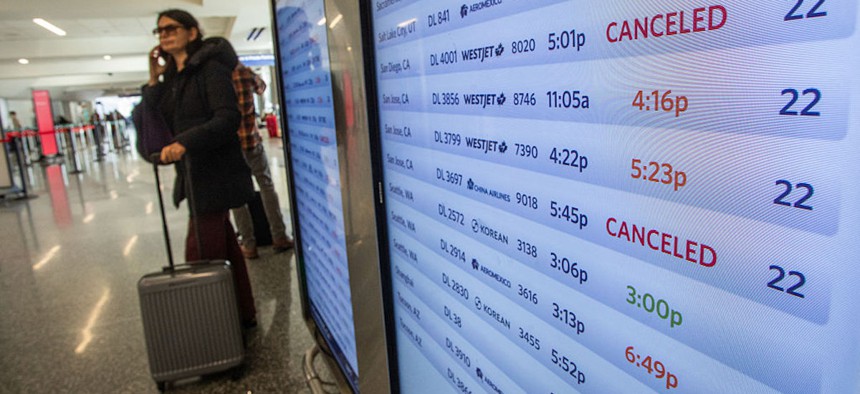
A passenger talks on a mobile phone beside flight information displays showing cancellations at Terminal 7 of Los Angeles International Airport in Los Angeles on November 13, 2026. U.S. aviation regulators issued an extremely rare ground stop of all flights across the country November 13 after a major communications outage which the Department of Homeland Security said did not appear to be the result of any "nefarious attack." Apu GOMES / AFP via Getty Images


Former security officials and others warn that pressure to quickly fix software flaws can increase the risk of downtime if practitioners are not careful.
A series of technology outages has drawn warnings from former federal cybersecurity officials and experts that organizations need stronger testing and backup plans as they repair software and replace aging equipment.
The disruptions have slowed intelligence work, grounded flights and interrupted banking and email services over the past two weeks. Administration officials have told Congress they found no evidence of a coordinated cyberattack, attributing the failures to technical problems and maintenance. Those assessments align with accounts current and former officials and technology industry sources shared with Nextgov/FCW.
The outages come as artificial intelligence helps researchers identify software flaws faster, putting pressure on agencies and companies to install fixes before hackers exploit them. But those updates can disrupt other parts of a system, especially when teams rush testing, sources say. The interruptions also raise questions about how well agencies and businesses can keep essential services running when an update goes wrong.
“We’ve become incredibly dependent on a small number of technology providers and interconnected systems,” said Matt Hartman, a former deputy cyber chief at the Cybersecurity and Infrastructure Security Agency who now serves as chief strategy officer at Merlin Group.
AI-assisted vulnerability discovery puts organizations under growing pressure to install fixes, sometimes without enough time or resources to test them thoroughly, he added.
“The irony is that the race to make systems more secure can inadvertently make them less reliable,” Hartman said.
The National Security Agency resumed normal operations Friday after a three-day disruption to NSANet, its classified communications network. The outage slowed analysts’ work and forced employees to stagger their arrivals, though critical intelligence capabilities remained operational.
Director of National Intelligence Jay Clayton linked the failure to efforts to patch PHP, software that helps run websites and applications. People familiar with the matter told Nextgov/FCW that his account was generally accurate.
The NSA had joined other agencies last month in urging organizations to repair serious PHP vulnerabilities or disconnect systems they could not secure promptly. Researchers used AI to help uncover the flaws, which could let hackers take control of affected servers without logging in.
Other outages involved different maintenance problems. The Federal Aviation Administration’s Nov. 13 nationwide ground stop followed work to replace older telecommunications connections. Officials said network equipment became overloaded with data, disrupting communications and radar feeds and forcing the agency to halt departures for hours.
Microsoft, meanwhile, said a software flaw introduced months earlier caused its outage when heavier traffic overwhelmed affected servers. Its systems automatically shifted traffic to other servers with the same flaw, spreading the disruption.
Louis Eichenbaum, the former chief information security officer at the Interior Department and now federal chief technology officer at ColorTokens, said organizations need to test their own repairs and introduce them in stages.
“We cannot solve this problem simply by patching faster,” he said.
Testing also needs to account for the services people actually use, said Patrick Harr, CEO of DataVisor. A repair to a bank’s sign-in system, for instance, could close a security hole, but leave customers unable to connect through its mobile app, he suggested.
“AI can find a flaw in minutes. It can take much longer to understand what happens to every service that depends on the software you’re about to change,” Harr added.
Frank Cilluffo, a former homeland security adviser to President George W. Bush who now leads Auburn University’s McCrary Institute, said organizations also need to explain disruptions promptly. Even when attackers play no role in an initial failure, they can exploit confusion or public uncertainty, he added.
“We may not have all the answers immediately, but impacted organizations must be transparent about what we know, what we don’t know and what we’re doing about it,” Cilluffo said.
Lawmakers have begun pushing for stronger scrutiny of technology failures. Reps. Morgan Luttrell, R-Texas, and Ritchie Torres, D-N.Y., introduced legislation last week to create a board within CISA that would investigate major cyber incidents and recommend ways to prevent repeat failures. Its reviews could cover faulty updates and other accidental disruptions, though national security systems such as NSANet would fall outside its authority.
Sens. Maria Cantwell, D-Wash., and Mike Rounds, R-S.D., have also urged the White House to help organizations deploy AI tools that find vulnerabilities and test repairs, while establishing safeguards for those tools.
“Even when fixes are available, testing and installing patches across interconnected systems can take weeks or months, potentially disrupting essential services,” they wrote in a Nov. 17 letter to Clayton.