
Security officials tell Congress tech outages are not malicious
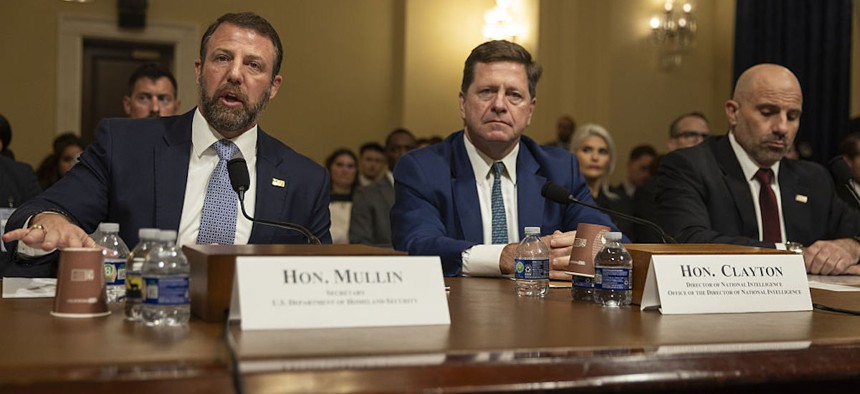
Secretary of Homeland Security Markwayne Mullin testifies alongside Director of National Intelligence Jay Clayton and Deputy Director of the Federal Bureau of Investigation Christopher Raia during a House Homeland Security Committee hearing on threats to the homeland, in the Cannon House Office Building in Washington, D.C, on November 18, 2026. Nathan Posner/Anadolu via Getty Images





Homeland Security and intelligence leaders assured the House Homeland Security Committee that nationwide digital disruptions were tied to routine maintenance and patching rather than cyberattacks.
Officials on Wednesday sought to assuage fears about foreign adversaries accessing various digital platforms amid a series of major tech outages that affected online services over the last week.
Homeland Security Secretary Markwayne Mullin, Director of National Intelligence Jay Clayton and FBI Deputy Director Christopher Raia testified before the House Homeland Security Committee on Wednesday to discuss worldwide threats to the nation, where digital outages reported over the last week were a predominant concern from lawmakers.
The high-profile disruptions have included nationwide flight groundings, Microsoft service outages and banking disruptions. Routine technical issues have been linked as the cause of those events.
This week, the NSA’s “NSANet” platform used for classified communications went down, forcing employees to stagger arrivals for work. The network was still facing issues Wednesday, though staff are working through fixes, multiple people familiar say. Employees are continuing to receive guidance on when to report for duty, added a separate person.
On Tuesday, Clayton told Fox Business that the NSA incident is linked to patching efforts in PHP, the popular open-source software used to run websites, after major vulnerabilities in the software were identified last month. Two people familiar with the matter said those remarks are generally accurate.
Most of the broader outages across digital platforms over the last week appear to be linked to efforts to rapidly patch vulnerabilities with AI, both people added.
“Patching, upgrading, replacing hardware, doing those things — anytime you are going to do those things, you take systems down, you bring them back up,” Clayton told lawmakers during Wednesday’s hearing. “We are in an environment where the rate of patching, the rate of upgrading of systems is increasing,” he later added.
His remarks undergird concerns over rapid advancements in artificial intelligence models with significant cybersecurity capabilities, which risk augmenting the digital intrusion prowess of foreign adversaries and criminal hackers. Officials and industry leaders have also pointed to the widespread availability of low-cost, open-source AI models and scanning tools that accelerate these threats.
Cybersecurity experts have concurred with officials’ findings that outage events of the last week are not related to foreign hackers, but they stress that the incidents have publicly highlighted many of the ways in which U.S. digital infrastructure is vulnerable.
“None of these failures appear to have resulted from an attack or intentional disruption, but each one showed how a small piece can bring down a large system. That is cause for deep concern, because what a contractor did by accident, an adversary will certainly try to do on purpose,” Brett Goldstein, a former Pentagon technology official now with Vanderbilt University, wrote in a Washington Post op-ed Wednesday.
In response to the wave of outages, Mullin noted that DHS was “convening a phone call with industry,” but he did not specify when this call would occur or who would attend.
He suggested that private sector companies performing massive software patches should start proactively notifying customers before taking systems offline to prevent public panic.
“We’re not pressuring the industry to do it,” Mullin said. “We just want to have a conversation and say maybe we should start communicating.”
AI models are now removing many barriers to entry for emerging hackers, said Dave Gerry, CEO of BugCrowd, which runs a cybersecurity platform that connects organizations with vetted hackers to find and fix security flaws.
“You see very unsophisticated attackers that are launching sophisticated attacks, so it is getting harder to figure out which is which,” he told Nextgov/FCW, referring to efforts to distinguish cybercriminal groups and hackers in nation-state intelligence services.