
Bipartisan bill would create cyber and AI review board amid series of tech outages
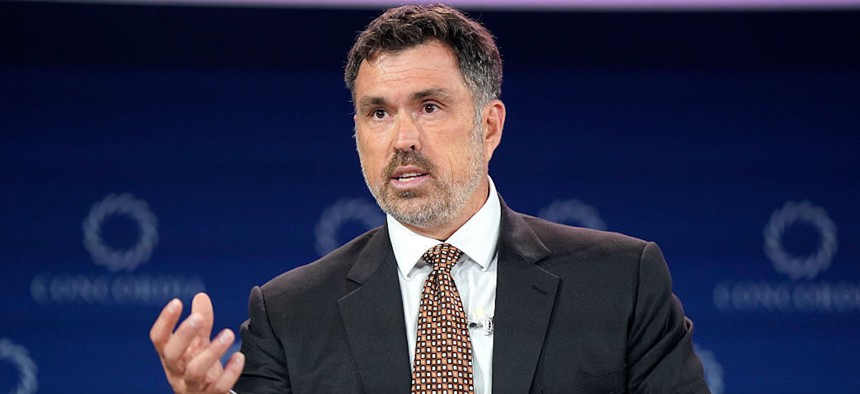
Rep. Morgan Luttrell (R-TX) speaks during the 2026 Concordia Annual Summit at Sheraton New York Times Square on September 21, 2026 in New York City. Leigh Vogel/Getty Images for Concordia Summit



Lawmakers are also proposing safeguards for federal AI agents and stronger coordination between CISA and technology providers.
House lawmakers introduced a bipartisan bill Wednesday to create a federal board that would investigate major cyberattacks, artificial intelligence-related incidents and technology failures, following outages that disrupted air travel, workplace software and operations at the National Security Agency over the last week.
Rep. Morgan Luttrell, R-Texas, introduced the ROOT CAUSE Act with Democratic cosponsor Rep. Ritchie Torres of New York. It would establish a National Cyber and AI Investigations Board in the Cybersecurity and Infrastructure Security Agency to determine why significant incidents happened and recommend ways to prevent them from recurring.
The legislation, shared first with Nextgov/FCW, accompanies two other proposals from House Homeland Security Republicans aimed at federal AI agents and CISA’s work with technology companies.
The board proposal comes nearly two years after the Trump administration emptied DHS’ Cyber Safety Review Board during its investigation of China’s Salt Typhoon telecom intrusions. The board, stood up in the Biden era, had previously faulted Microsoft for security failures that allowed Chinese hackers to access senior U.S. officials’ emails.
The new bill would prevent the executive branch from abolishing, suspending or consolidating the proposed board without another act of Congress. Officials outside the board could not alter or suppress its findings. Per the proposed measure, investigators could examine serious disruptions caused by faulty updates, configuration errors or AI failures, even without evidence of an attack.
Friday’s nationwide FAA ground stop delayed more than 10,000 flights, while a separate Microsoft outage disrupted email and other workplace tools. Officials have not identified a cyberattack as the cause of either event.
An outage of NSANet, the classified network used to transmit classified information inside the signals intelligence spy agency, also slowed analysts’ work Tuesday and has forced employees to rearrange their work schedules over the last day. NSA attributed the disruption to maintenance.
National security systems like NSANet would fall outside the proposed board’s authority. But its reviews could cover other government and private-sector systems, including shared software and cloud services, as well as AI-assisted attacks and harmful actions by AI systems operating beyond their authorization.
“As our adversaries become increasingly sophisticated in this space, it is more critical than ever that we take action,” Luttrell said in a statement.
Separately, Rep. Matt Van Epps’ AI INSIGHT Act would address AI agents on civilian federal networks. The bill would direct CISA to help agencies identify those agents, track their actions and limit their access to what a task requires. Agencies would be able to stop agents that exceed their authority and revoke access without waiting for a vendor’s approval.
“Every agent with access to a federal network presents a new opportunity to harness efficiencies, but also a new potential target for adversaries,” the Tennessee Republican said.
The framework also calls for preserving the evidence behind AI-generated findings used in investigations or other official decisions. CISA would establish supporting capabilities within a year of enactment. Defense and intelligence community systems, along with national security systems, would be excluded.
Rep. Andy Ogles, R-Tenn., who chairs the Homeland Security cybersecurity subcommittee, also plans to introduce the SECURE IT Act on Wednesday. It would write DHS’ existing responsibility for helping secure the information technology sector into law and require CISA to carry out that work.
“Last week’s global Outlook outage and recent cyberattacks have exposed America’s dependence on shared IT infrastructure,” Ogles said. “As cyber threats grow, we need stronger coordination between government and industry.”
The measure also calls for better coordination as AI speeds up the discovery and exploitation of software flaws, including testing fixes, deploying them in stages and preserving the ability to reverse defective updates. Companies’ participation would notably remain voluntary.
The bills arrive before Democrats take control of Congress in January. Rep. Bennie Thompson, D-Miss., is positioned to chair the House homeland panel.
On Wednesday, Sens. Maria Cantwell, D-Wash., and Mike Rounds, R-S.D., separately urged Jay Clayton, national intelligence director and chair of the White House Super Intelligence Task Force, to coordinate a national response to AI-enabled cyber threats. They called for wider deployment of AI-powered defenses and security standards for autonomous agents.
The senators cited AI’s role in uncovering serious flaws in PHP — software used to run websites — and reports that banks could not always distinguish authorized AI agents accessing customer accounts from rogue actors.
“We cannot meet these threats with yesterday’s cybersecurity infrastructure or rely on individual companies to solve a problem that spans the entire digital economy,” they wrote in a letter to Clayton.
Cantwell is in line to chair the Senate Commerce Committee in the next Congress.