
IRS CEO largely dodges questions about data sharing at IRS, SSA
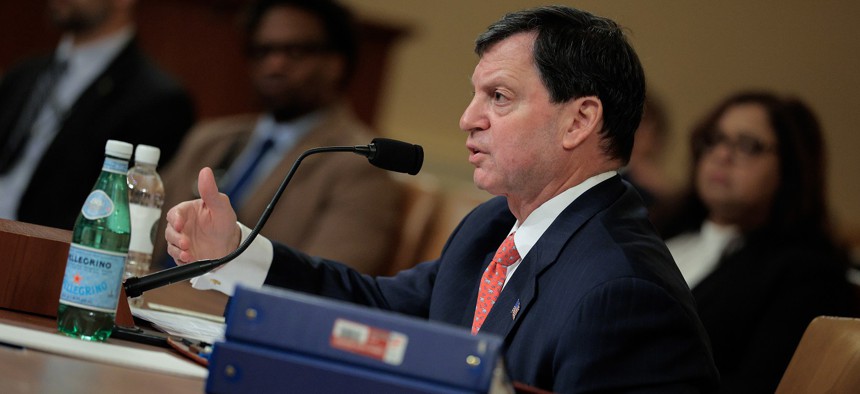
Internal Revenue Service Chief Executive Officer Frank Bisignano testifies before the House Ways and Means Committee in the Longworth House Office Building on Capitol Hill on March 04, 2026. Chip Somodevilla/Getty Images





 By
Natalie Alms
By
Natalie Alms
Frank Bisignano cited “current litigation” for why he could not provide further details about IRS data sharing with ICE, and he disputed court records detailing how DOGE employees handled data at SSA.
The IRS chief executive officer, Frank Bisignano, largely declined to offer specifics when asked about unlawful disclosures of taxpayer data to Immigration and Customs Enforcement during a House Ways and Means Committee hearing on Wednesday.
Last week, a federal judge found that the IRS had broken the law in erroneously sharing thousands of peoples’ information with ICE over the summer as part of an agreement between the Treasury Department and the Department of Homeland Security to share IRS data on immigrants with ICE.
Bisignano, who is also the head of the Social Security Administration, confirmed that no one at the IRS had been disciplined or fired because of the disclosures.
But he cited “current litigation” when asked to elaborate further about the current status of IRS data sharing with ICE.
“All of these events occurred before my tenure,” he said at one point. “But I oversee the organization and it's my responsibility to get it right.”
Last summer, ICE asked the IRS for information on 1.28 million people. The IRS then disclosed the last known addresses of 47,289 people.
In 42,695 of those cases, the IRS violated the law by sharing the last-known address information for those people, Judge Colleen Kollar-Kotelly of the U.S. District Court for the District of Columbia wrote in her opinion last week.
The IRS failed to make sure ICE’s request met legal requirements, and this led to the disclosure of confidential addresses to the immigration agency “in situations where ICE’s request for that information was patently deficient,” wrote Kollar-Kotelly.
The government is appealing the case. The Treasury-DHS data sharing agreement — which the then-acting head of the IRS resigned over last spring — is also at the center of other ongoing lawsuits.
Two courts have blocked the agencies from transferring taxpayer information, or ICE from using the IRS data it already has. Earlier this week, another panel declined to issue an injunction over the agreement.
Many Democrats on the committee have asked the Treasury Inspector General for Tax Administration to investigate the matter, and a few members introduced a resolution of inquiry on Wednesday demanding records from the Treasury Department and Department of Homeland Security.
“When taxpayers file their tax returns, they don't expect the IRS to take that information and share it with people that they're not authorized to share it with,” Rep. Linda Sánchez, D-Calif., said during the hearing.
Bisignano also skirted questions about data sharing controversies at SSA.
Last March, a Department of Government Efficiency employee signed an agreement to share SSA data with a political advocacy group aimed at overturning election results in certain states, according to a January court filing from the Justice Department.
SSA didn’t know about that agreement or other instances of DOGE sharing agency data — including by using a third-party server that hadn’t been approved for data storage — for months.
Asked by the top Democrat on the committee, Rep. John Larson, D-Conn., about the incident, which occurred before Bisignano had taken the helm at SSA, Bisignano said, “If you want to talk about Social Security, I come see you anytime you want to talk about Social Security. This is an IRS hearing.”
The January court filing followed other allegations from SSA’s former chief data officer, Chuck Borges, who resigned after filing a whistleblower complaint last summer alleging that DOGE employees created a live copy of sensitive SSA data on a vulnerable cloud server. Bisignano has already told concerned lawmakers who asked about that disclosure that data wasn’t accessed, leaked, hacked or otherwise shared in an unauthorized way.
Rep. Steven Horsford, D-Nev., asked Bisignano why taxpayers should trust that he’d protect their data, “when you weren’t able to do it over the SSA,” prompting a back-and-forth during which Bisignano said that it isn’t accurate that DOGE shared sensitive information about Americans.
“I’ve spent my career protecting [personally identifiable information], and I’ve protected it in any job I’ve ever had, including my current responsibilities,” said Bisignano. “I don’t think the facts are accurate.”
“So it's not accurate that millions of Americans’ personal identifiable information, including Social Security information and other vital information, was leaked by DOGE?” asked Horsford.
“No,” said Bisignano.
“Despite the fact that the Trump administration's own counsel in court records had to admit to that fact, you still won't take responsibility for that information on behalf of millions of Americans?” asked Horsford. “It's the biggest data breach in U.S. history, in my estimation.”
“Your estimation is inaccurate,” said Bisignano.