
Experts hope new AI czar’s leadership can move the needle on regulation
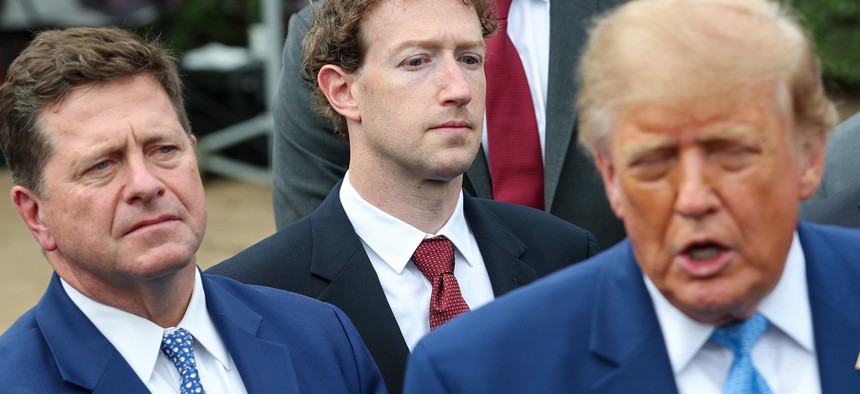
U.S. Director of National Intelligence Jay Clayton, CEO of Meta Platforms Mark Zuckerberg and U.S. President Donald Trump hold a press briefing with AI executives following a meeting on artificial intelligence, outside the West Wing of the White House on September 29, 2026 in Washington, DC. Kevin Dietsch/Getty Images





“Maybe [the AI czar] can work with Congress to help come up with some governance, some laws” covering AI, one former Trump official told Nextgov/FCW.
President Donald Trump officially announced on Sunday that Jay Clayton, the director of national intelligence, will helm the administration’s artificial intelligence portfolio. Several former officials told Nextgov/FCW they hope the White House’s new AI czar will engage with Congress to examine potential guardrails around use of the emerging capabilities and figure out what actually needs governing.
In a Truth Social post, Trump said Clayton will lead a “Super Intelligence Force” focused on coordinating “the Federal Government's engagement with Consumers, Public Interest Groups, Religious Organizations, Critical Infrastructure Providers, and Super Intelligence Companies.” Trump signed an executive order on Sept. 29 calling for federal agencies to begin referring to AI as “super intelligence.”
In an interview with The Wall Street Journal that was published on Saturday, Clayton said the task force will have 120 days to report on the risks and opportunities posed by AI and provide recommendations on the role that the government should play.
Undersecretary of Defense for Research and Engineering Emil Michael, Office of Personnel Management Director Scott Kupor and Federal Trade Commission Chairman Andrew Ferguson will also serve as vice-chairs of the Super Intelligence Force. Other members include Vice President JD Vance and Defense Secretary Pete Hegseth, as well as external advisors like venture capitalist David Sacks, who previously served as the administration’s AI and crypto czar until March.
Although Trump has vocally opposed imposing new regulations on tech firms that could hinder U.S. competition with China, when he first floated the appointment of a new AI czar and the creation of an AI Force in a Truth Social post last month he said his administration “will also be looking for BAD” in AI development.
In interviews conducted prior to Clayton’s selection as AI lead, former Biden and Trump White House officials and a Democrat lawmaker shared their hopes for how a new AI czar will guide the nation’s policies on the emerging capabilities.
One former Trump administration official, granted anonymity to speak candidly, said they hoped the task force would ultimately resemble the National Space Council’s model, which advised the president on space policy and coordinated efforts across the government and commercial sectors. Although that space council was revoked by Trump in a December 2025 executive order, the official said the AI czar could help distill collected input into policy recommendations.
“Maybe [the AI czar] can work with Congress to help come up with some governance, some laws that address different pieces of it, and then we can kind of move forward,” they added. “I don't think there's going to be like one bill, one AI act that covers everything. But I think you sort of pick and choose what's most important.”
Rep. Don Beyer, D-Va., who co-chairs the Congressional Artificial Intelligence Caucus, also said a task force can’t replace the need for federal regulation. He noted that Trump has taken a similar approach to the risks posed by AI as he has to climate change, which he considers to be fake.
“We need the president to move away from ‘this is a hoax,’ to understand that we must responsibly regulate this, and then I think listen carefully to the best intentions coming from the AI leaders about how best to structure it,” Beyer said.
But an important part of this work, another former official said, is shifting the basic understanding of how to approach AI regulations.
Arati Prabhakar, who served as director of the White House Office of Science and Technology Policy from 2022 to 2025 during the Biden administration, said much of the current conversation around AI policies is misframed around the idea of promoting balance between innovation and safety. This is one area, she said, where the AI czar will have to particularly focus.
“We need to be aggressive as heck about using AI, and aggressive as heck about making sure that it's being done safely,” she said. “And not only are they not trade-offs, getting the safety and getting it on the right track is a condition that is required in order to achieve advances.”