
‘It would be insane’ for spy agencies to not have AI model early access, lawmaker says
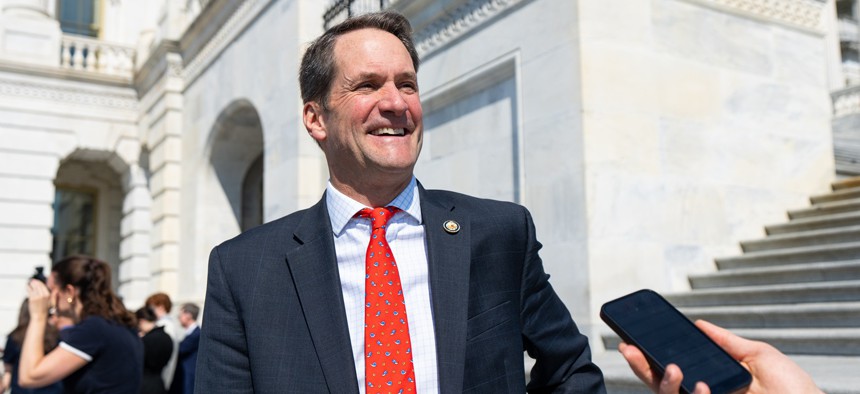
Rep. Jim Himes, D-Conn., speaks to a reporter on the House steps after a vote in the U.S. Capitol on Thursday, April 23, 2026. Bill Clark/CQ-Roll Call, Inc via Getty Images


The top Democrat on the House Intelligence Committee said the Commerce Department should also have a role in AI policy.
Rep. Jim Himes, D-Conn., the top Democrat on the House Intelligence Committee, said Tuesday it would be “insane” for U.S. intelligence agencies to not have early access to advanced artificial intelligence models that could be used for hacking and cyberdefense.
His remarks, delivered on a panel at Politico’s Security Summit, come as the Trump administration is reportedly considering a major AI executive order and debating whether the Commerce Department or intelligence community should oversee evaluations of AI models. They also come as President Donald Trump makes a planned trip to China this week, where he is expected to discuss AI matters with Chinese President Xi Jinping.
“Making sure that, in particular, where our real computational brains are, the National Security Agency, making sure they have access to the most capable hacking tools … it would be insane not to do that, right?” he said.
The NSA, the spy community’s premiere hacking, codebreaking and foreign eavesdropping giant, has been testing Mythos, a major Anthropic model that’s been held back from full public release due to its substantial cyber capabilities, multiple people familiar with the matter said.
On Monday, The Washington Post reported the Trump administration is split over whether to give spy agencies or the Commerce Department dibs at evaluating models. Commerce officials are pushing back against a White House proposal to house an AI evaluation center within the intelligence community, according to the report.
Himes said the Commerce Department should also have a role to play in AI policy.
“Across the government, we should be looking at these capabilities,” he said, adding that “we ought to be cultivating — not damaging — our relationship with the producer of this remarkable new technology,” in a nod to the ongoing legal complaints Anthropic has lodged at the Defense Department, which deemed it a supply chain risk earlier this year after the company said it wouldn’t meet certain Pentagon demands.
Himes said he doesn’t think the legal spat between the DOD and Anthropic has set back the intelligence community in the near term, though “if this drags out, if [Defense Secretary] Pete Hegseth gets a bee in his bonnet about this and just decides to target because his ego is damaged … that will be a massive liability for United States national security.”
Officials are circulating draft policy documents with language clarifying the government’s ability to use private sector tech without outside stipulations, Nextgov/FCW reported last week. It’s not clear if the contracting language is part of a coming executive order or a separate policy initiative.
The ongoing discussions highlight how the Trump administration is closely examining cyber threats brought on by advanced AI models and is looking to take a more hands-on approach toward the AI sector, despite prior laissez-faire positions.