
Trump’s goal to create state-by-state citizenship lists isn’t feasible, experts say
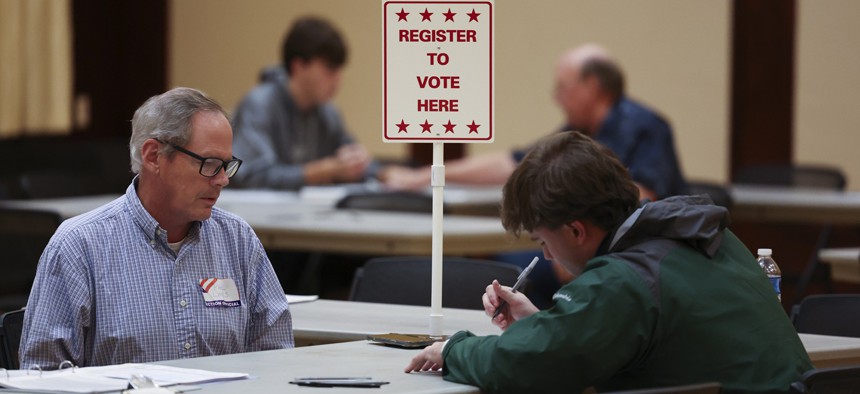
Ellen Schmidt for The Washington Post via Getty Images



 By
Natalie Alms
By
Natalie Alms
A Tuesday executive order mandating that DHS create state-by-state citizenship lists is Trump’s latest effort to exert some control over state-run elections.
President Trump directed the Department of Homeland Security to assemble lists of adult citizens in each state in a Tuesday executive order meant to crack down on mail-in voting.
Before he signed the order, Trump told reporters it was “foolproof.” But experts say that compiling these citizenship lists isn’t feasible, as the federal government does not have the reliable data needed to construct accurate tallies of citizens and the states in which they reside. If implemented to assist in verifying voter eligibility, such lists could disenfranchise eligible voters, they say.
The new executive order is the latest front in the Trump administration’s efforts to exert control over state-run federal elections, although the Constitution gives the power of election administration to states. Congress has the ability to set election regulations.
Experts told Nextgov/FCW the late-Tuesday executive order is likely unconstitutional. Voting rights advocates and Democrat state officials have promised to sue.
The push to create state-by-state citizenship tallies is a “further escalation” of existing efforts at the federal level to scrutinize voter rolls, said John Davisson, senior counsel and director of litigation at the Electronic Privacy Information Center, a Washington, D.C.-based research and advocacy group.
The Justice Department has sued at least 30 jurisdictions, including Republican states, demanding access to voter registration databases, which include names, birthdates, addresses and more. Trump has also been pushing lawmakers to pass the SAVE Act, which would require proof of citizenship for voter registration, something the president has also attempted to mandate via executive order.
DHS, meanwhile, has been building out its SAVE system, or Systematic Alien Verification for Entitlements, to enforce laws that only U.S. citizens can vote in federal elections by turning data it owns or can access into a searchable, national citizenship system. There is no evidence of large numbers of non-citizens widely voting in American elections.
SAVE was originally created to verify the immigration status of people applying for government benefits. In the course of its overhaul to the system, DHS has added U.S. citizens to SAVE and pulled in additional government datasets like passport records, Social Security files and driver's license databases.
States that have run their voter rolls through SAVE have already ended up kicking American citizens off voter rolls as a result, according to a legal complaint filed earlier this year.
The latest executive order instructs DHS to use this system in combination with data from the Social Security Administration and other records to create state-by-state lists of U.S. citizens who will be over the age of 18 at the time of an upcoming federal election — and send that list to each state before the election takes place. DHS has 90 days to stand up the infrastructure to make this new citizenship list.
But the government doesn’t have the right data to get this done, experts told Nextgov/FCW.
The federal government “does not have reliable, accurate up-to-date information of the citizenship status of all the people residing in the United States,” said Jon Sherman, litigation director at the Fair Elections Center, which along with EPIC and other groups, is suing over the overhaul of the SAVE system.
As Nextgov/FCW has reported, the SAVE system does not cover all U.S. citizens. SSA itself, which contributes data to the DHS system, has said that its data isn’t meant to be a definitive record of U.S. citizens.
SSA’s database of Social Security numbers was “designed to administer benefits — not to form the basis of a national citizenship registry,” Kathleen Romig, the director of Social Security and disability policy at the Center on Budget and Policy Priorities, told Nextgov/FCW. “Using SSA data to check voter eligibility will inevitably lead to errors, potentially disenfranchising U.S. citizen voters.”
The federal government also does not have a reliable way of confirming the state residency of all U.S. citizens, said Davisson.
Beyond data quality issues, matching up different datasets is simply a difficult thing to do, said Cody Venzke, senior policy counsel at the American Civil Liberties Union.
“They are trying to bring together hundreds of millions, if not billions, of different records from a variety of agencies that may have them formatted in a variety of ways and match them all together automatically,” he said.
The executive order also leaves open a number of other implementation questions, said Sherman, including the fact that it does not mention primaries for federal elections at all.
The order directs the U.S. Postal Service to use rulemaking to track mail-in and absentee ballots. States are to send USPS lists of what voters will be provided with such ballots, and voters are prohibited from getting such ballots unless they’re on another USPS-approved list. How the DHS citizenship lists fit into this is unclear.
“It's an extremely funny thing: we are undertaking this unprecedented, centralized database of U.S. citizens that unites our state DMV data, our passport data, our Social Security information, as well as any information that benefits programs provide, for a problem that is exceedingly rare,” said Venzke.
The states that have used SAVE to check their voter rolls so far have found very few instances of people on voter rolls who shouldn’t have been, he said. “What we are doing is… bringing a missile launcher to kill a fly.”
If you have a tip you'd like to share, Natalie Alms can be securely contacted at nalms.41 on Signal.
NEXT STORY: Agency CIOs must supply top-down IT contract information, OMB memo states