
Trump signs executive order setting rules for mail-in voting and eligibility lists
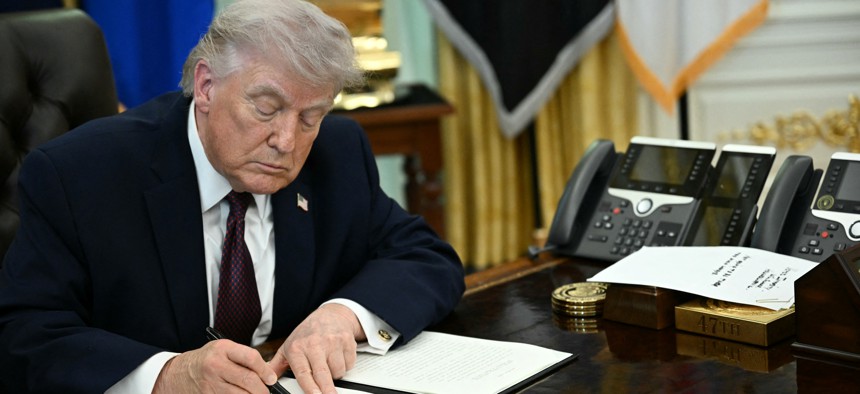
President Donald Trump signs an executive order cracking down on mail-in voting ahead of midterm elections in the Oval Office of the White House in Washington, DC, on March 31, 2026. Brendan SMIALOWSKI / AFP via Getty Images





The president has long disputed the mail-in voting process since his 2020 election run. The order is very likely to face legal challenges.
President Donald Trump on Tuesday signed an executive order targeting nationwide mail-in voting rules, including directing his administration to implement trackable mail ballot identifiers and to create a list of U.S. citizens confirmed eligible to vote in their respective states.
The order, which will certainly face legal challenges, comes as consequential midterm elections approach in November. It represents some of the most significant moves the Trump administration has taken to date to exert more control over the election administration process.
The directive mandates that the Department of Homeland Security collaborate with the Social Security Administration to create a comprehensive list of verified U.S. citizens eligible to vote in each state. It also directs the U.S. Postal Service to start a rulemaking process that would require states to inform the agency about voters requesting mail-in ballots, as part of a measure that would prohibit voters from getting a mail-in ballot unless they are on a USPS-approved eligibility list.
Beyond the citizenship provisions, the order also directs requirements for barcoded ballot envelopes, state-submitted voter participation lists and centralized tracking of mail-in ballots.
The president’s distrust of mail-in voting is rooted in a mix of longstanding concerns about voter fraud, which were sharply amplified during the pandemic-era expansion of mail voting in 2020 and reinforced by his post-election legal fights.
It’s unclear how the administration would reliably determine which state a voter resides in using federal datasets that are not designed for real-time address verification.
The order also leaves open a range of technical questions, including how records from DHS, SSA and the Postal Service would be matched and updated across systems, what security standards would govern those data streams and how officials would prevent errors, manipulation or unauthorized access to newly created voter-related datasets.
“This executive order is part of a familiar playbook: use baseless attacks on our elections to lay the groundwork for future election challenges,” Voting Rights Lab CEO Samantha Tarazi said in a statement. “But the facts are clear: mail voting is a secure and reliable voting method that millions of Americans — including Trump himself — rely on to make their voices heard.”
The order “is clearly illegal,” Larry Norden, vice president of the Elections & Government program at the Brennan Center for Justice, told Nextgov/FCW, adding that Trump “has no authority to set the rules for our elections. It will certainly get struck down, just as his attempt to set rules on elections through executive order last year was struck down."
The administration made a similar effort to reshape election rules via a March 2025 executive order that sought to require documentary proof of citizenship for voter registration and direct federal election officials to change registration procedures. It was partially struck down in October when a federal court blocked provisions of it.
The president has recently involved Director of National Intelligence Tulsi Gabbard in his election integrity efforts, where she was seen during an FBI raid of a Fulton County, Georgia elections office that was at the center of his false claims of election fraud in 2020. Her team also seized voting machines in Puerto Rico last year and has since said the systems contain cybersecurity vulnerabilities.
The efforts, broadly speaking, underscore Trump’s continued focus on challenging the 2020 election results, despite having made a comeback to the White House in 2024. His recent call to “nationalize” election processes also runs counter to constitutional standards that place states at the center of election administration.
Cybersecurity specialists, election experts and former Trump administration national security officials have for years said there is no evidence of widespread fraud in the 2020 election.
“Like Trump’s first executive order on elections, this unconstitutional power grab will be challenged in the courts. But it hands his allies in the states a blueprint to push his extreme and unpopular agenda forward,” Tarazi said.