
Secret Service is embracing new solutions to combat malicious drones, director says
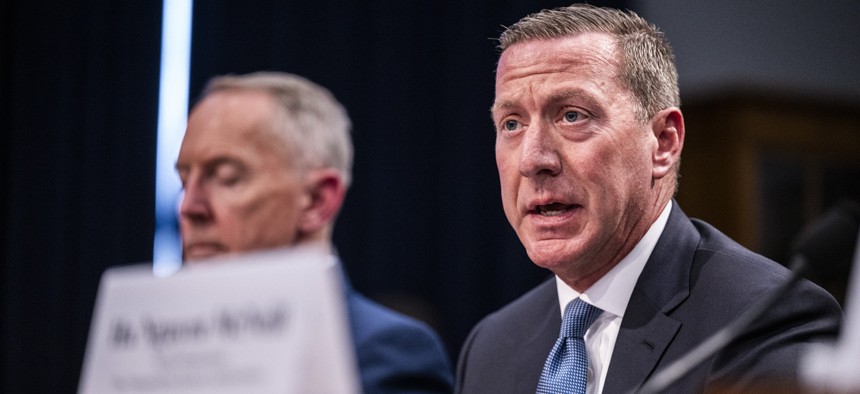
Sean Curran, Director, U.S. Secret Service speaks during a House Committee on Appropriations and Subcommittee on Homeland Security hearing on Capitol Hill on April 16, 2026 in Washington, DC. Roberto Schmidt/Getty Images





U.S. Secret Service Director Sean Curran explained that the agency is “looking at kinetic solutions — something that we haven’t done before, and something that I’ve asked our technology department to lean into.”
The U.S. Secret Service is moving to embrace kinetic mitigation technologies to counter the threats posed by unmanned aerial systems — or drones — ahead of multiple upcoming large-scale events, the agency’s head said on Thursday.
During a budget hearing held by the House Appropriations Subcommittee on Homeland Security, Secret Service Director Sean Curran noted that the agency is preparing for the upcoming FIFA World Cup in a few months, America’s 250th birthday celebration in July and other high-profile meetings like the G20 Summit in December. He said, however, that 2028 “will be our busiest year on the calendar,” with the U.S. both hosting the Olympic and Paralympic Games, as well as being in the midst of the next presidential campaign that year.
Curran warned that adversaries are increasingly looking to use drones and other new technologies to threaten U.S. leaders and other targets, which has necessitated that the agency enhance its own counter-drone abilities — particularly in preparation for these events.
“We’re also leading the way to detect, deter and defeat drone threats by exploring and deploying new technologies, such as kinetic solutions,” Curran said. “Our personnel are also thoroughly investigating drone incursions and pursuing criminal prosecutions.”
He said part of this effort includes thinking outside the box, as well as working more closely with federal agencies to mitigate the dangers posed by drones.
Rep. John Rutherford, R-Fla., said during the hearing that addressing the threat posed by drones is “one of the things that I’m greatly concerned about.”
Curran told him that the agency is “looking at kinetic solutions — something that we haven’t done before, and something that I’ve asked our technology department to lean into.”
Kinetic counter-drone technologies are used to physically disrupt or destroy unmanned aircraft. DHS noted in December 2025 that some of the solutions its Science and Technology Directorate evaluated include the use of satellite-jamming systems and direct-fire weapons to bring down malicious drones.
Curran added that the agency has also partnered with the Department of Defense to advance its counter-drone efforts, saying that he was traveling to Florida after the hearing adjourned “to see this system that we’ve moved into place in South Florida.”
Mar-a-Lago, President Donald Trump’s Palm Beach-based resort, is located in the southern part of the state.
The Secret Service, like other components of the Department of Homeland Security, has not received funding since the agency’s appropriations lapsed after Feb. 13. Curran said, however, that the ongoing shutdown has so far had a minor impact on the agency’s technology efforts.
“There are some supply chain issues with getting some of the equipment up to speed, but I will tell you that we are leading the way right now,” he said. “We’re spending just over $100 million over the past year and a half to get our technology up-to-date.”
President Donald Trump’s proposed fiscal year 2027 budget, which was released earlier this month, also seeks “$100 million for protective counter-measures, including areas like counter-[unmanned aerial systems],” Curran noted.
If you have a tip you'd like to share, Edward can be securely contacted at Grahed.40 on Signal.
NEXT STORY: Senate committee approves quantum reauthorization bill with 7 amendments