
Trump signs AI executive order after postponement last month
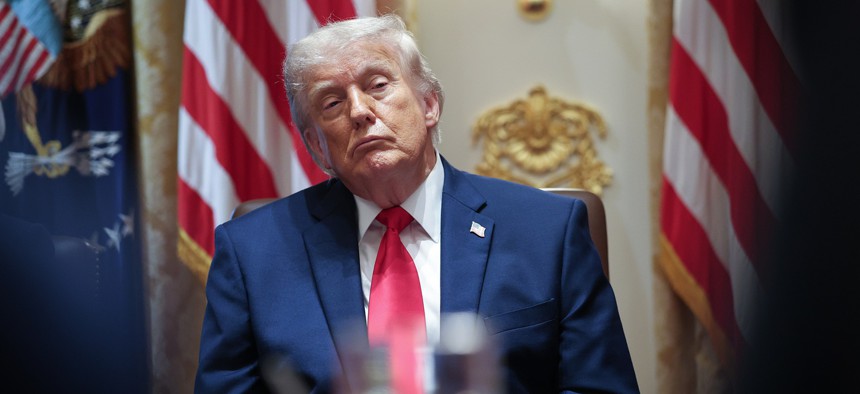
U.S. President Donald Trump listens to members of his Cabinet speak during a meeting in the Cabinet Room of the White House on May 27, 2026 in Washington, DC. Win McNamee/Getty Images





The order encourages developers of advanced AI to grant the U.S. and certain critical infrastructure operators 30 days of pre-release model access. Earlier drafts had set 90 days of early access.
President Donald Trump on Tuesday signed a cybersecurity-focused artificial intelligence executive order directing national security and civilian agencies to expand oversight of advanced AI systems, marking the administration’s latest attempt to balance growing fears over catastrophic AI-enabled cyber risks with a broadly pro-innovation agenda.
The directive scales down the degree of federal oversight of AI models from what was initially included in an earlier version that was set to be signed two weeks ago, but that signing was postponed amid overregulation concerns from industry.
Per the order, companies developing cutting-edge AI systems would be encouraged to provide the federal government with 30 days of pre-public access to those models, as well as limited early access for select critical infrastructure operators. An earlier outline of the order viewed by Nextgov/FCW suggested the government would be granted a longer window of 90 days to assess covered frontier models.
The more limited pre-release access period, coupled with language in the order that explicitly prohibits licensing or preclearance requirements, suggests the administration is seeking visibility into advanced AI systems without establishing a formal approval process before companies can release new models, a dynamic that is more favorable to industry.
One section of the order, focused on cybersecurity, directs federal agencies to secure Defense Department and other national security networks within 30 days. Another includes a binding operational directive to secure federal civilian networks and facilitate access to frontier AI models across critical infrastructure sectors, including hospitals, banks, utilities and state and local governments, which must also be issued within 30 days.
It also calls for the Treasury Department — with support from the Office of the National Cyber Director, the National Security Agency, the Department of Homeland Security and the Cybersecurity and Infrastructure Security Agency — to establish a voluntary coordination clearinghouse between the government, AI companies and critical infrastructure operators.
Additional provisions would direct the Office of Management and Budget to identify existing federal grant funding that could support AI vulnerability-detection efforts within 30 days. It also tasks the Office of Personnel Management with increasing cyber hiring via the U.S. Tech Force within 60 days. The Tech Force, launched in December, has expressly been recruiting cyber talent for the last several weeks, though it has only onboarded 10 total employees thus far.
The other section of the directive focuses on establishing a new government framework for overseeing advanced AI systems, including the creation of a classified benchmarking process to determine which models qualify as “covered frontier models.”
Per the order, the White House Office of Science and Technology Policy, the National Institute of Standards and Technology, CISA and others would have 60 days to establish the classified evaluation process.
The NSA, in consultation with those agencies, would then be tasked with formally determining which AI systems meet the threshold. The NSA’s involvement in these efforts was reported in May by Nextgov/FCW.
In the same section governing frontier model development, the Commerce secretary is also tasked with assisting in the development of a classified AI benchmarking process that will inform the voluntary framework for AI developers. The final draft of the order states that the agency's secretary will work “through the Director of the National Institute of Standards and Technology,” a caveat that wasn’t included in the initial draft, per a copy reported last month by Politico.
The administration’s approach to AI has shifted in recent months amid the emergence of Anthropic’s Mythos, a powerful cybersecurity-focused AI model that has become a major driver of government discussions, as officials grapple with how advanced AI systems can rapidly uncover vulnerabilities across computer networks.
OpenAI’s recent release of GPT-5.5-Cyber, which also demonstrated sophisticated cyber capabilities, has further heightened concerns in Washington over how quickly these systems are advancing and how they could reshape both cyber defensive and offensive operations.