
Bipartisan pair of senators acknowledge need for federal AI standard that accounts for state laws
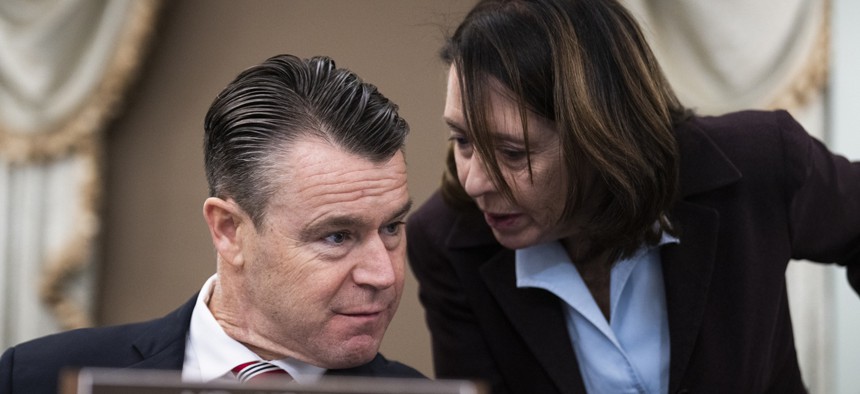
Sen. Maria Cantwell, D-Wash., and Sen. Todd Young, R-Ind., attend the Senate Commerce, Science and Transportation Committee hearing on Thursday, February 9, 2023. Tom Williams/CQ-Roll Call, Inc via Getty Images




Sens. Cantwell and Young sound off on the policy requirements the U.S. needs to strengthen its scientific enterprise to win the global AI race.
Sens. Maria Cantwell, D-Wash., and Todd Young, R-Ind., both acknowledged the need for a sweeping federal standard on artificial intelligence that offers uniform regulations — but also takes into account important state-level laws — while speaking at a Center for Strategic and International Studies event on Wednesday.
“I favor coming up with a federal standard that's consistent with our constitutional responsibilities to facilitate interstate commerce, but I, as a practical matter, recognize that we may have to accommodate narrow areas of state concern, so an example might be the deepfake laws that a handful of states have,” Young told Nextgov/FCW during the event.
Cantwell echoed his sentiment, saying a blanket rule that doesn’t recognize niche state laws is ineffective. She told Nextgov/FCW that the dialogue on developing a functional federal framework needs to continue as the U.S. seeks to lead the world in AI innovation and implementation.
“I think getting a federal standard is an important thing to do, but to get a federal standard, you’ve got to get that right balance between … consumer laws in the state,” Cantwell said. “But yeah, I do think that we got to keep moving.”
Young and Cantwell’s comments come shortly after lawmakers failed to pass a 10-year moratorium on state AI regulations in last year’s budget reconciliation bill. President Donald Trump signed an executive order in December that seeks to identify state laws deemed overly burdensome and withholds certain federal funding from those states, though some regulatory areas are exempt, like child safety.
Proponents of a moratorium argue that a patchwork of state laws will stifle innovation as companies try to comply with disparate regulations. But opponents argue that stripping state regulations without a federal regulatory standard in place leaves the AI industry open to misuse and endangerment of people’s privacy and safety.
“Companies are only going to keep deploying these massive amounts of money if they have certainty about what the future looks like,” Young said. “The investment will stop if the investors lose faith in our regulatory system, because it becomes impossible to assess what your hurdle rate is for any given investment.”
Young also advocated for the Trump administration’s permitting reform for data center construction as a near-term opportunity to fortify U.S. infrastructure, something he said was supported at a bipartisan level. He cited workforce development, smart international alliances and continued funding for tech research as critical policy actions.
“I think that investment in research and development is really key, and the purpose there is to ‘de-risk’ some of these technologies so that the private sector can step in, but it's also to come up with fundamental breakthroughs that benefit our entire economy,” Young said.
Cantwell echoed the need for a strong domestic R&D ecosystem, starting with steady public sector funding to the scientific research budget.
“You want the constant ecosystem of those scientists in helping other people understand basic science and the proliferation of that science,” Cantwell said.
Diversifying the geographic locations of innovation is also important to Cantwell, who cited the CHIPS and Science Act’s tech hubs program as an example of how to do so.
“You can't do all the innovation you want to do in expensive places like Seattle and Silicon Valley,” Cantwell said. “If America is going to compete with China, we need that innovation to be across the United States.”
Cantwell also advocated for embracing clean energy solutions to respond to the power demands of AI, rethinking the administration’s current tariff scheme and, in continued agreement with Young, cultivating strategic international alliances to fortify the U.S. AI supply chain.