
Trump’s FY27 budget proposes boosts and cuts to tech operations
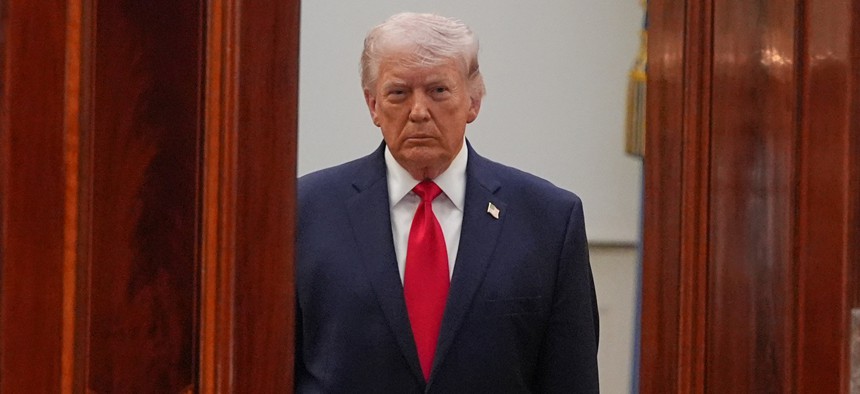
President Donald Trump arrives to address the nation from the Cross Hall of the White House on April 1, 2026 in Washington, DC. Alex Brandon-Pool/Getty Images



Agencies like CISA, NIST and the IRS would see notable reductions in their budgets for next year, while programs at Energy and the VA would get additional financial support.
President Donald Trump’s fiscal year 2027 budget is out. The proposal reflects the Trump administration’s priorities, but will likely change significantly in becoming the eventual federal budget approved by Congress.
Nextgov/FCW reporters break down the major highlights below:
Cybersecurity
The proposed budget sheds around $707 million from the Cybersecurity and Infrastructure Security Agency. The move mirrors efforts last year to draw down resources from the nation’s main civilian cyberdefense bureau that is located in the Department of Homeland Security. CISA has drawn the ire of the president and many of his allies over past activities tied to election security.
A cut of this size would mark a sharp escalation from the prior year’s budget fight, when the White House sought roughly $490 million in reductions — about 16% of the agency’s initial $3 billion budget — but ultimately faced congressional resistance that brought proposed cuts closer to a range of $130 million to $300 million. If enacted, the FY27 proposal would deepen the reductions by more than $200 million compared to the administration’s earlier request, signaling a continued push to significantly scale back the agency’s footprint.
“CISA was more focused on censorship than on protecting the nation’s critical systems, and put them at risk due to poor management and inefficiency, as well as a focus on self-promotion” the FY27 document says.
It adds that the budget would remove “duplicative” programs focused on state and local cyber funding. Notably, it proposes eliminating programs “focused on so-called misinformation and propaganda as well as external engagement offices such as council management, stakeholder engagement, and international affairs.”
Those offices were targets of frequent workforce reductions in CISA over the last year. The proposal’s call to eliminate stakeholder engagement functions could have far-reaching effects, as those offices serve as a primary conduit between the Cybersecurity and Infrastructure Security Agency and state, local and private-sector partners that own or operate much of the nation’s critical infrastructure.
“Like the President’s cyber strategy, the President’s CISA budget reflects his utter lack of understanding of the urgency of the cyber threats we face and how to mobilize the government to help confront them. As of 2023, CISA was spending $2 million on countering information operations, an effort initially launched at the behest of Congressional Republicans during the first Trump Administration,” said Rep. Bennie Thompson, D-Miss., the ranking member on the House Homeland Security Committee.
“There is nothing that justifies a reckless $700 million cut to CISA, particularly at a time of heightened tensions with Iran and an increasingly aggressive China,” he added. “I am committed to working with my colleagues to push back against these cuts and ensure we can protect government and critical infrastructure networks.”
Despite the cuts to CISA, the budget adds funding to other cyber components of the government. The Treasury Department’s Office of Terrorism and Financial Intelligence would get a $15.2 million infusion for “key investments in critical cyber capabilities, sanctions targeting, and combating illicit financial activity,” it says. Treasury often sanctions nation-state hackers and cybercriminals when the U.S. government makes a determination that their activity poses a national security threat.
An allocation of $403 million under the Transportation Department would go to support a Trump 2.0 executive order concentrating on the nation's capital and contribute to enhancing the visibility of law enforcement within the D.C. Metro system. Funding is specifically earmarked for improvements such as upgrading camera and monitoring systems and implementing cybersecurity enhancements.
Emerging Tech
Major emerging technologies, specifically artificial intelligence and quantum information and computing sciences, were broadly spared from major cuts, with the administration writing “The Budget maintains funding for research in artificial intelligence and quantum information science at key agencies, to ensure the United States remains on the cutting edge of these critical technologies’ development and responsible use.”
AI received a $1.2 billion investment across the Department of Energy apparatus, with a focus on how it can improve energy systems. The new funding will also go towards supporting seven AI supercomputers at Argonne and Oak Ridge National Laboratories. At the defense level, the budget also prioritizes AI in defense systems and within the Armed Forces enterprise.
The National Nuclear Security Administration would receive $32.8 billion — an increase of 12% over the previous year — to foster new nuclear capabilities and deterrents in a bid to strengthen American energy dominance.
Several of the budget’s proposed cuts support the Trump administration’s effort to eliminate “wokeness” from government operations, government-funded programs and AI systems used in federal operations. The document highlighted a Baltimore, Maryland-based health AI tool funded by the Agency for Healthcare Research and Quality to help 15- to 25-year-olds “optimize their sexual health decision making” as an example of such programs that would be slashed.
The National Institute of Standards and Technology also suffered cuts of $993 million under the proposed budget to reduce “wasteful spending at NIST that has long funded awards for the development of curricula that advance a radical climate agenda.”
Among the cut programs, the budget completely eliminates the Manufacturing Extension Partnership, saying it has failed to accelerate the U.S.-based manufacturer’s ability to compete globally. This follows the nominee for NIST director Arvind Raman’s March testimony before the Senate Commerce committee vocalizing his support for the MEP program.
VA modernization
The White House’s proposed budget would allocate $4.2 billion for the continued rollout of the Department of Veterans Affairs’ new electronic health record system. The modernization initiative, which was paused in April 2023 to address technical and safety issues at the VA medical facilities where the software had been deployed, is set to resume on April 11. The agency plans to deploy the Oracle Health EHR system at 13 sites in 2026, with the goal of roughly doubling the number of go-lives in 2027.
Friday’s budget document said the Trump administration has made accelerating deployments of the modernized system “a top priority effort.”
The agency’s FY26 budget directed $3.4 billion toward VA’s EHR modernization project, although Congress included a provision in the funding measure that made 30% of those funds contingent upon the agency providing “an updated life-cycle cost for the program, a facility-by-facility deployment schedule, certification on healthcare performance baseline metrics for facilities where the EHR has already been deployed, projected staffing levels necessary to support the schedule proposed, and the certification of four safe successful deployments without any adverse events.”
More broadly, the proposed FY27 budget for VA also looks to enhance the agency’s adoption and use of new capabilities and modernized software systems.
The request calls for $130 million to be allocated to the Veterans Benefits Administration “for automation and artificial intelligence investments modernizing veterans claims processing by reducing errors and delivering benefits to veterans faster.”
VA’s 2025 AI use case inventory, which was released in January, listed 367 instances of the agency’s exploration and adoption of the capabilities, and 28 of the uses were focused on government benefits processing.
The proposed budget said adoption of these benefits-focused uses — the majority of which were listed in the recent inventory as still being in pre-deployment — will “limit the costly practice of relying on surge staffing and extra labor costs while using taxpayer dollars more efficiently.”
Additionally, the Trump administration’s proposal would direct $6.3 billion toward VA’s IT systems, which it said would allow the agency “to accelerate cybersecurity efforts, continue implementation of a modern integrated financial and acquisition system, support EHRM rollout, and strengthen digital platforms for mental health, community care, and housing to ensure timely, reliable access to benefits.”
IRS customer experience
Citing concerns about alleged agency bloat and privacy violations, the administration’s proposal suggests cutting $1.4 billion from the tax agency’s previously allocated FY26 budget.
It says, however, that the White House “proposes to streamline IRS operations utilizing technology improvements to help focus the IRS on providing high-quality customer service while ensuring the tax laws are fairly administered.”
While the document is vague on how this new technology would be used, the administration does cite its previous effort to eliminate the agency’s Direct File program, which allowed taxpayers to file their returns online directly with the IRS, as an example of wasteful spending. It said the program “cost over $41 million but yielded fewer than 300,000 IRS-accepted returns for tax year 2024—a cost of nearly $140 per return, when existing programs allow many taxpayers to file for free.”