
White House ‘war on fraud’ to begin with freezing Medicaid payments to Minnesota
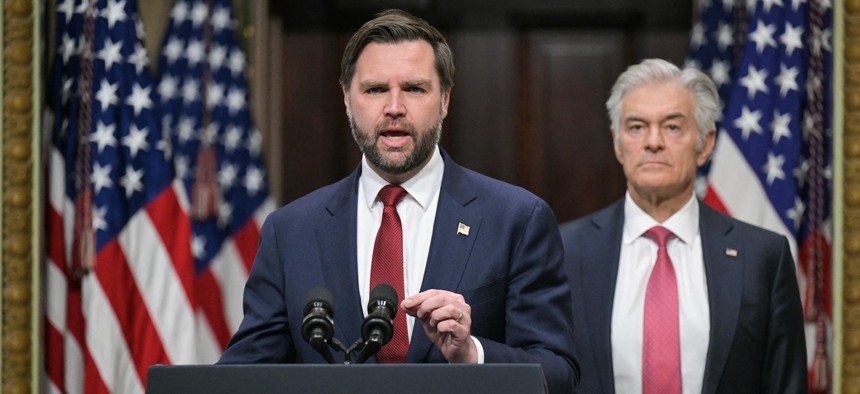
Vice President JD Vance, alongside Centers for Medicare and Medicaid Administrator Mehmet Oz, speaks about combatting fraud, at the Eisenhower Executive Office Building on the White House complex in Washington, DC, on February 25, 2026. Oliver Contreras / AFP via Getty Images





 By
Natalie Alms
By
Natalie Alms
Minnesota Governor Tim Walz called the move “retribution.”
Vice President JD Vance announced Wednesday that the federal government is withholding $259.5 million in Medicaid funding from Minnesota.
The move is part of the “war on fraud” that Trump announced during his State of the Union address. It’s the latest action aimed at Minnesota in response to an unfolding fraud scandal in the state’s social services, which the Trump administration also used to justify the immigration enforcement crackdown in the state late last year.
“We’re taking a whole-of-government approach in the Trump administration to take this fraud seriously,” the vice president told reporters Wednesday.
Medical providers have already been paid by the state, said Vance. Federal payments to the state government are being deferred while the federal government waits for more information from Minnesota, which has 60 days to respond. The Medicaid program is paid for by states and the federal government, which reimburses states for a portion of the costs of the program.
If Minnesota doesn’t meet the federal government’s request, it could see $1 billion in deferred payments this year, said Dr. Mehmet Oz, administrator of the Centers for Medicare and Medicaid Services.
“They’re not the only state that’s floundering,” he said, promising more announcements soon and later pointing to Florida, New York and California as having problems. “Our goal is to supercharge program integrity over the next six months.”
Minnesota Governor Tim Walz said on social media that “this has nothing to do with fraud.”
“This is a campaign of retribution,” he said. “These cuts will be devastating for veterans, families with young kids, folks with disabilities, and working people across our state.”
CMS is using an existing process within the agency — meant to help it get more information to determine if a state expenditure was allowable — to defer claims.
“What we want to see from the governor of Minnesota, from the entire administration there in Minnesota, is some affirmative steps to make sure that the people who are billing us for Medicaid services are actually providing those Medicaid services,” said Vance.
This isn’t the first time the Trump administration has withheld funding from states in the name of fraud. Earlier this year, the Trump administration froze $10 billion in funding for child care subsidies, social services and cash support for low-income families in California, Colorado, Illinois, Minnesota and New York in the name of fraud prevention, a move that a federal judge has since preliminarily blocked.
When asked if the administration would only be concentrating on blue states, Vance said that the decision has been based on the number of services the administration has seen that were fraudulently billed and on the fact that only blue states have encouraged undocumented immigrants to get on Medicaid, though he did not elaborate on where that claim came from.
The deferral announced Wednesday follows a CMS review of Medicaid spending in the fourth quarter of fiscal 2025, in which the agency says it found $243.8 million in “unsupported or potentially fraudulent” claims and $15.4 million “related to claims involving individuals lacking a satisfactory immigration status.”
Undocumented immigrants aren’t eligible for traditional Medicaid, and individuals who aren’t U.S. citizens have to have a "qualified" immigration status to be eligible. The majority of Medicaid fraud is committed by healthcare providers, not beneficiaries, according to Andy Schneider, research professor at Georgetown University’s McCourt School of Public Policy and a Medicaid expert who previously worked within CMS itself during the Obama administration, where he focused on program integrity.
Trump’s immigration crackdown in the state has had effects on the ongoing anti-fraud efforts in social services. Federal prosecutors have estimated that the total fraud could be as much as $9 billion.
In Minnesota, many of those who were spearheading anti-fraud efforts have left the U.S. Attorney's Office for the District of Minnesota in recent months, some over the administration’s handling of the shooting of Renee Good, who was killed by an ICE agent in January.
Vance and Oz also announced a six-month moratorium on new enrollment for certain suppliers of durable medical equipment, prosthetics, orthotics and supplies. The pause will give CMS time to install new safeguards, the agency says.
CMS also launched a new request for information asking for input on how it can detect waste, fraud and abuse in its programs. The Department of Government Efficiency released years of open-source Medicaid data earlier this year, saying that the public could help look for fraud.
“We're certainly going to make sure that our anti-fraud efforts go after the fraudsters and not after anybody who actually benefits from these services,” Vance told reporters.
“The problem is the fact that these programs are being defrauded to begin with,” he said. “Our social safety net will disappear unless we take fraud more seriously.”
In addition to targeting Medicaid fraud specifically, the Trump administration has also created a new Justice Department division to combat fraud.
A national focus on fraud is long overdue, Linda Miller, an anti-fraud expert who worked at the Government Accountability Office for a decade and is now the president of the nonprofit Program Integrity Alliance, told Nextgov/FCW via email.
But “the emerging narrative — that federal fraud is primarily a story about immigrants gaming public benefits — is not only empirically wrong, it's strategically ruinous,” she said. “It directs limited investigative and administrative resources toward the margins of a problem whose core is something far more sophisticated and far more dangerous: a global financial crime ecosystem that has identified the U.S. government as a soft target.”
Last year, Trump fired nearly 20 inspectors general, who are tasked with combatting waste, fraud and abuse in the government, days after taking office. That action has raised concerns among experts that the administration is politicizing the issue and making progress against fraud more difficult.
Trump "should be applauded for focusing on protecting taxpayers' dollars,” one of those fired inspectors general, Mark Lee Greenblatt, told Nextgov/FCW. He was previously the watchdog at the Interior Department.
“The question is how he will execute that war,” he said. “Will he wield it as a political cudgel to effect his policy goals? What if a political ally becomes a subject in an anti-fraud investigation — will the president prioritize his political needs over ferreting out fraud?”