
House panel subpoenas Oracle heads over VA health record overhaul’s ballooning costs
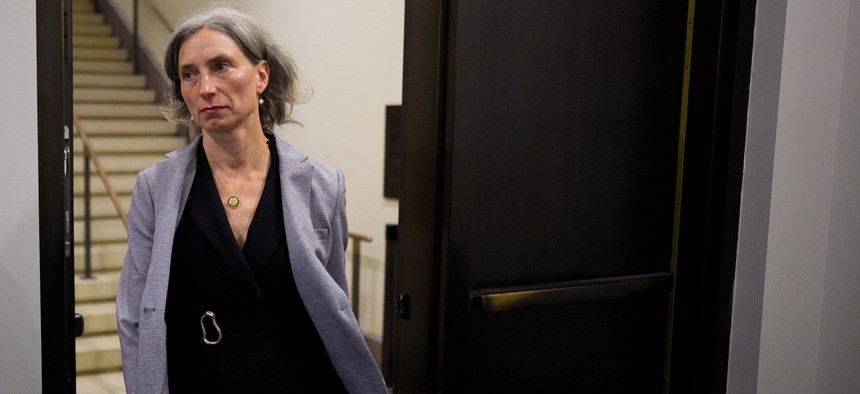
Rep. Maxine Dexter (D-OR) arrives for a Democratic caucus meeting on Capitol Hill on September 1, 2026 in Washington, DC. Andrew Harnik/Getty Images





The House Veterans’ Affairs Committee voted 19-0 to subpoena Oracle Chairman and Co-founder Larry Ellison and Oracle CEO Mike Sicilia after VA announced plans to boost its contract with the tech giant by $17 billion.
The House Veterans’ Affairs Committee unanimously voted on Wednesday to subpoena two top Oracle officials amid the Department of Veterans Affairs’ move to modify its contract with the tech giant for the ongoing deployment of its new electronic health record system.
VA announced last month that it was extending its current 10-year, $10 billion modernization deal with Oracle to include an additional $17 billion ceiling and three option-year periods. The extension comes after VA and Oracle faced extensive issues implementing the system across the agency’s nationwide network of 164 medical facilities, which have resulted in numerous tech glitches, usability concerns and patient safety questions.
VA first contracted with Cerner in 2018 to upgrade its health record system. Oracle subsequently acquired Cerner in 2022.
The massive contract extension, which members of the committee said caught them off guard, dominated the discussion during Wednesday’s hearing that was ostensibly focused on VA’s renewed efforts to right the troubled modernization initiative.
Following the contentious hearing, members voted 19-0 in favor of a motion from Rep. Maxine Dexter, D-Ore., to subpoena both Oracle Chairman and Co-founder Larry Ellison and Oracle CEO Mike Sicilia to appear before the panel to further discuss the project’s cost and status. Dexter said her motion came only after the tech giant refused an invitation from committee Chairman Mike Bost, R-Ill., to have a representative testify before the panel.
“When the vendor responsible for a taxpayer-funded contract going from $10 billion to roughly $27 billion will not sit at this table and answer our questions, all of us are being prevented from doing our oversight duties,” she said.
Lawmakers from both sides of the aisle also pushed back against VA officials who appeared before the committee to tout the recent resumption of software rollouts at medical facilities.
VA restarted full-scale deployments of the Oracle software earlier this year after it paused most rollouts in April 2023 to address a host of issues. The agency has deployed the system at 11 VA medical facilities thus far in 2026, with plans for an additional two rollouts before the end of the year and another 26 go-lives next year. VA is hoping to accelerate go-lives on an annual basis, with plans to finalize all deployments in 2031.
VA Deputy Secretary Paul Lawrence, who has been overseeing the agency’s push to speed up the modernization project, told lawmakers “the program is back on track” and cited promising results following rollouts earlier this year at medical facilities located in Indiana, Ohio and Michigan.
But lawmakers said they were alarmed by the project’s ballooning cost, with Rep. Nikki Budzinski, D-Ill., calling the revised deal “just a blank check for Oracle” and Rep. Derrick Van Orden, R-Wis., saying the $17 billion contract extension “is corruption.”
Lawrence defended the modified agreement, telling lawmakers that the extension was needed because VA is about to exhaust the initial agreement’s cost ceiling.
“What I can tell you, since I showed up at the end of March [2025], we have spent exactly the money you have allowed us. We have deployed in the schedule exactly as we said we would,” he said. “We have had serious conversations with our contractors that this is the money available to do the things we need to do.”
VA previously told Congress it estimated that it would cost roughly $37 billion to complete the project, with more than $19 billion for sustainment and operations costs over a ten-year period that would raise the project’s total lifecycle figure to over $56 billion. But Bost said that estimate does not fully include “the program's historical cost, its full operating and sustained cost and an assessment of future risk.”
Bost, Budzinski and the panel’s top Democrat, Rep. Mark Takano, D-Calif., also noted that Oracle officials previously told lawmakers they would “eat the cost” of any overruns.
Oracle’s Sicilia made similar comments in July 2022 testimony before the Senate Veterans’ Affairs Committee, saying at the time the tech giant “is committed to delivering the VA an EHR system that exceeds expectations without exceeding the contracted cost,” and that “if there are issues with performance or workflow we commit to fixing those issues at our expense.”
Lawrence said he was unaware of that prior commitment and that “I've got to figure out what was promised and see how our acquisition folks dealt with that.”
Questions about the modernization project’s total cost have been an ongoing issue, with lawmakers and a congressional watchdog repeatedly voicing concerns about a lack of financial clarity.
Carol Harris, the Government Accountability Office’s Director of Information Technology and Cybersecurity, once again raised those concerns on Wednesday, saying that VA needs to come up with a complete cost estimate and a fully integrated master schedule for future deployments.
But beyond fleshing out its cost and deployment plans, Harris said VA still needs to come up with a viable strategy for ultimately mothballing its legacy health record system — the Veterans Health Information Systems and Technology Architecture, or VistA.
Harris called the cost of maintaining the system “a little bit of a black box,” noting that “with decommissioning VistA, we don’t yet have a cost estimate associated with even just operating VistA annually.”
She said that the best estimate GAO has been able to come up with for maintaining the legacy system “over like a two-fiscal-year period was like $2 billion dollars, and we were only able to verify $1 billion of that number, as just an example.”
Edward can be securely contacted at Grahed.40 on Signal.
NEXT STORY: TMF will have $200M to spend next year without appropriations, official says