
DHS exploring new biosurveillance capabilities as biological threats evolve, officials say
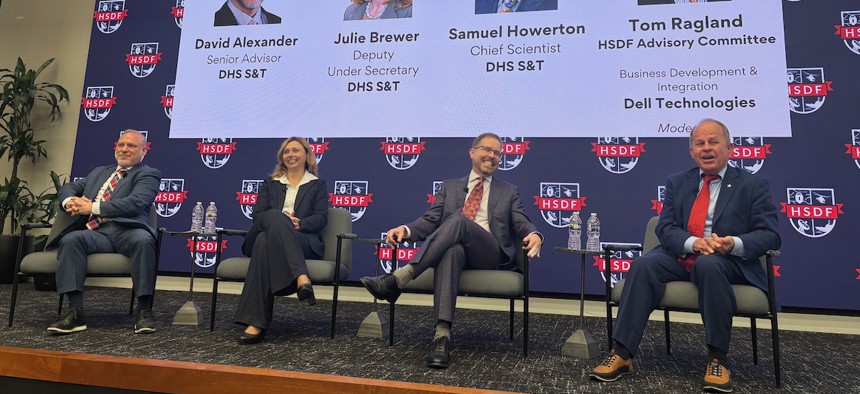
Dr. David Alexander, senior science advisor at DHS S&T; Julie Brewer, deputy undersecretary for science and technology at DHS; Dr. Samuel Howerton, chief scientist at DHS S&T; and Tom Ragland, homeland security integrations executive at Dell Technologies, speak during an event hosted by the Homeland Security & Defense Forum in Washington, D.C., on Sept. 22, 2026. Edward Graham/staff

DHS Science and Technology Directorate officials said emerging technologies are forcing the agency to rethink how it detects biological agents.
With artificial intelligence and other capabilities potentially driving the development of novel biological threats, officials with the Department of Homeland Security’s research and innovation unit say they are exploring ways of using agent-agnostic technologies to conduct broader biosurveillance activities.
Speaking at a Homeland Security and Defense Forum event on Tuesday, several officials from the DHS Science and Technology Directorate cited biosurveillance as an area where the agency component is trying to be more ambitious when it comes to getting ahead of future risks, since its typical biological-detection architecture may no longer be suitable for this new environment.
Julie Brewer, DHS deputy undersecretary for science and technology, said “the threat of bio and the [lower] barrier to entry that AI is really creating in this space” are major concerns for the agency.
While she said DHS has been working with lawmakers and the White House on “developing the vision for biosurveillance of tomorrow and the major investment that the government does need to make to really advance the integration of data we have, as well as the ability for environmental biodetection in concrete spaces,” she said the agency also has “to think about biosurveillance in much more of a macro look at it.”
This more all-encompassing approach to biosurveillance requires capabilities that aren’t limited in the types of biological agents they can detect, or even the spaces in which they can be detected.
David Alexander, senior science advisor at DHS S&T, said the ability for bad actors to exploit new technologies "requires us to think through, ‘what capabilities do we need for the significant challenges that we need to accomplish?’”
To better leverage new tools against biological threats, Alexander said this means having DHS look beyond current threats to try to anticipate some of the risks that might emerge. While he called it “an aspirational goal” right now, he said this “would require persistent, agent-agnostic biosurveillance” — essentially broadening the current approach to detecting and identifying new pathogens and bio threats.
“To achieve that means we have to go beyond just looking at the capability we have today — which is limited in terms of what it can detect, limited into where it can detect — and recognize that we need to start looking at biosecurity and biodefense from the lens of how will that affect our border enterprise?” Alexander said. “How would that affect our maritime enterprise? How would that affect state levels? How would that affect special security events and VIP protection? How would that affect just the urban, rural and critical infrastructure landscape?”
He noted that the agency is engaging industry for biosurveillance tech needs and other DHS S&T priority areas — such as the use of autonomous systems at the border — through further private sector outreach. DHS previously published a request for information in May that asked for feedback on “current, emerging, developmental, or operational capabilities relevant to homeland security biosurveillance and biological detection missions.”
The agency similarly launched a prize challenge earlier this month seeking “algorithmic approaches" that can detect potential biological threats.
DHS manages programs to identify and defend against biological attacks — such as the BioWatch program, an early warning system for detecting airborne pathogens — but Brewer said “we need to shift operational environments because the threat has evolved, but the way we think about detecting and responding has not evolved.”
Agent-agnostic biosurveillance efforts, she added, are not going to be solved by relying on one specific technology. Brewer said this type of detection includes wastewater surveillance, anonymized public health information and environmental biodetection, although she added that getting better access to other federal agencies’ biological data is one area where coordination needs to improve.
“Every one of us has bio data; nobody's willing to share it because we've got to protect our own data,” Brewer said. “But imagine the power of an IT stack that, along that chain, could integrate the data, but protect the data in a way that it was anonymized, and it only allowed decision makers to understand certain pieces.”
The development of more advanced artificial intelligence tools and other emerging capabilities has raised concerns from officials — and even some tech executives — about how new technologies can be exploited by bad actors or operate outside of safety guardrails.
A report released last month by the research nonprofit RAND said the AI-infused bio threat landscape requires “the creation of a layered strategy that combines approaches rather than one that relies on any single intervention at any single node to achieve defense-in-depth that prevents harm across several pathways.”
The Trump administration has taken some steps to limit the creation of new pathogens and biological threats, including through the release of a new high-risk life sciences policy in July that prohibits federal funds from being used for domestic dangerous gain-of-function research. The mandate defined this as research that “enhances a property or properties of a biological agent in ways that make it more dangerous.”