
Lawmakers worry over new rule that will allow sales of Nvidia’s H200 chips to China
Li Hongbo/VCG via Getty Images




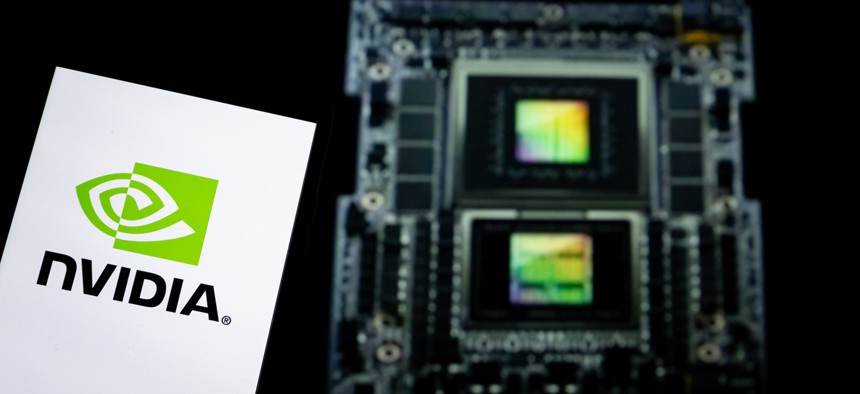
A revised licensing review policy will allow Chinese firms to purchase Nvidia’s H200 chips, although some members of Congress say the move will embolden Beijing’s own AI ambitions.
House lawmakers are concerned that weakening export controls that restrict China’s access to advanced, U.S.-made semiconductor chips could diminish American leadership in artificial intelligence technologies — particularly if planned licensing reviews are not strictly enforced.
President Donald Trump announced in December that his administration would allow tech giant Nvidia to sell its H200 AI chips to China in exchange for the U.S. government receiving a 25% cut of the revenue. The H200 represents the company’s second-most powerful AI-chip.
On Tuesday, the Commerce Department’s Bureau of Industry and Security formally greenlit the move by announcing a revised export policy on sales of the H200 to China under new rules set for publication in the Federal Register on Thursday.
“In order to qualify, license applicants must demonstrate that exporting these products to China will not reduce global semiconductor production capacity currently available to U.S. customers; that the Chinese purchaser has adopted export compliance procedures, including customer screening; and that the product has undergone independent, third-party testing in the United States to verify its performance and security,” BIS said in a press release.
Although lawmakers and expert witnesses used a House Foreign Affairs Committee hearing on Wednesday to counter fears that China is imminently prepared to dethrone the U.S. as the global leader in AI production, they all warned that expanded access to advanced American-made chips could supercharge Beijing’s AI and military ambitions.
Rep. Brian Mast, R-Fla., the chairman of the House panel, said during his opening remarks that “Nvidia has made such good chips that if they were sold freely to the [Chinese Communist Party], the CCP would likely overtake us in the AI arms race.”
“Make no mistake: If China buys a chip, they are buying it so they can take it from an American company, or they're buying it to put a Chinese company ahead of an American company, or they are buying it to make the Chinese military better than the United States military,” he added. “That is their goal. Instead of the U.S. military having the AI advantage, the Chinese military would have the AI advantage.”
Democrats have charged that Trump’s move to open up sales of Nvidia’s H200 chips to China is being used as a bargaining chip in ongoing trade negotiations with the adversarial nation and is prioritizing short-term economic gains over national security. Some Republicans have countered that the move, in part, helps control China’s AI ambitions by making the country reliant on a powerful — though second-tier — chip that it does not domestically produce. Nvidia’s fastest performing chip, called Blackwell, is still barred from being sold to Chinese firms.
GOP lawmakers, in particular, voiced support during the hearing for the BIS plan to review potential sales of the H200 chips to China, with the caveat that the agency does its due diligence when vetting purchasers.
Rep. Bill Huizenga, R-Mich., said he appreciated the rule but added that “one: the devil’s in the details; and two: rules and regulations are only as good as your willingness to enforce them — and that’s what we’re going to be watching for on this.”
Although Mast expressed deep concerns about China’s access to Nvidia’s advanced chips during the hearing, he responded several times to some of his Democratic colleagues’ remarks about BIS’ revised policy to highlight some of the requirements and conditions that must be met before a license is granted. He noted, for instance, that the final rule states that “no chips would be approved if there is a military end user, and there are very specific controls in it to ensure no remote access by a number of end users as well.”
But New York Rep. Gregory Meeks, the top Democrat on the panel, called the new policy a strategic mistake that degrades national security. He noted that, just last month, the Justice Department announced that it broke up a major AI chip smuggling network that exported or attempted to export at least $160 million worth of export- controlled Nvidia H100 and H200 chips to China.
“The president has said he will not approve H200 licenses for bad actors in China. While this does not allay concerns about smuggling and diversions, I am also skeptical that the administration will pick the right customers from the start,” Meeks said.
Matt Pottinger, who served as deputy national security advisor during the first Trump administration and appeared before the committee as a witness, also warned that “selling Nvidia's H200 chips to China will supercharge Beijing's military modernization, enhancing capabilities in everything from nuclear weapons to cyber warfare, autonomous drones, biological warfare and intelligence and influence operations.”
Beijing has already moved to advance its military might through a Military-Civil Fusion Strategy, which is focused on breaking down barriers between the country’s commercial sector and Beijing’s military development. Rep. Jim Costa, D-Calif., said the new policy’s requirement that Chinese customers cannot use the chips for military purposes “rings hollow” because of Beijing’s strategy.
Pottinger said the requirement “would be very, very difficult, if not impossible, to enforce.”
How much the newly revised policy will ultimately benefit Chinese companies or Beijing, however, remains unclear. Reuters reported on Wednesday that Chinese customs authorities told agents that Nvidia’s chips are not permitted into the nation, and that CCP officials also told tech companies not to purchase the chips unless it is absolutely necessary for them to do so.