
Getting quantum tech from research to commercialization requires partnership, federal experts say
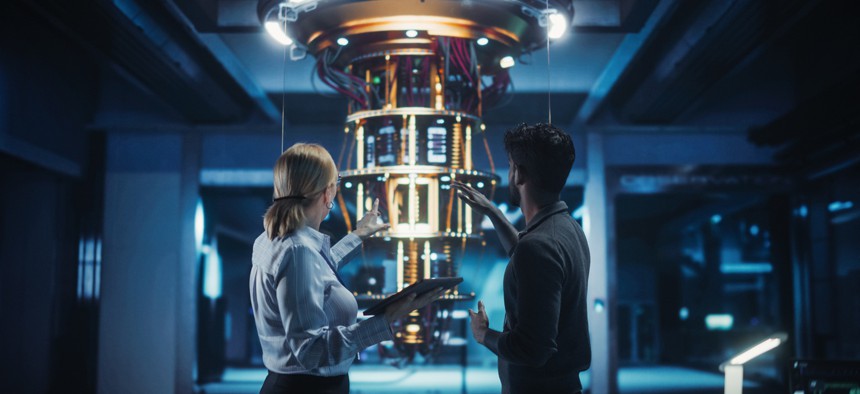
gorodenkoff/Getty Images





Federal experts working in quantum information sciences and technology mapped out commercialization paths for quantum technologies, specifically quantum computing, at a Thursday hearing.
Better government and private sector coordination is needed to bridge the gap between quantum research and commercial applications, according to federal officials who spoke at a Thursday House Science, Space and Technology Committee hearing.
Those experts testified that the application landscape of quantum technologies — particularly computing — is still in its early stages, with industry help needed to innovate past current fundamental technology challenges.
As private and public investment in quantum technology continues to grow, with an October 2025 McKinsey report estimating approximately $2 billion was invested globally in 2024, the expectation that there will be commercial applications that deliver a return on investment is growing, especially with the looming arrival of a fault-tolerant quantum computer expected around 2030.
James Kushmerick, the director of the Physical Measurement Laboratory at the National Institute of Standards and Technology, testified that the government’s work with industry partners is a big piece of the commercialization puzzle.
“The real plan here is to kind of co-develop with industry,” Kushmerick said. “NIST and other government laboratories have the expertise and the technology. Industry is capable of commercializing it and pushing it out the door and creating that economic and quantum advantage and dominance that we're looking for.”
Kushmerick added that there are no major bureaucratic hindrances to engaging with private sector counterparts in these partnerships, but ongoing technological barriers remain. Despite those problems, Kushmerick confirmed that movement in the quantum computing field is “well along the way.”
“For quantum computing in particular, when we started the [National Quantum Initiative], we were in the noisy intermediate-scale quantum regime, where… [it's] just hard to do things,” Kushmerick said. “And now we have demonstrations of error correction in quantum systems. So we have made tremendous progress, and it still needs to advance, but I think we're all along the way.”
Still, in response to a question about artificial intelligence and its impact on quantum computers, Tanner Crowder, the quantum information science lead at the Department of Energy, said it is too early to tell.
“It's very difficult to see what the end goal or what the end applications will ultimately be,” Crowder said. “There are some very promising ones that we see in the future, like error correction, the search for quantum algorithms… but we see AI advancing quantum systems, and we also see quantum systems advancing AI.”
Crowder similarly noted that quantum technology applications for the electrical grid are “nascent” and need further exploration.
With user-ready applications still yet to be realized, several fundamentals of the quantum technology sector demand refinement, the experts testified. Error correction, or the ability for a quantum computer to process data via qubits while detecting and correcting errors, is a core component to viable quantum computing. Crowder noted that, in addition to error correction, scaling a quantum network is another critical step to practical quantum computing applications.
“Networking is … very important to us,” Crowder said. “We want to be able to connect systems together, and we need quantum networks to do that. It is impractical to send quantum information over classical networks, and so we need to continue to push that forefront and look to interconnect heterogeneous systems at the data scale level so that we can actually extract this information and compute upon it.”
Crowder said that the “most exciting” application of quantum networking now is distributing quantum data between different devices. Applications in the networking arena can bridge connectivity between remote quantum sensors, a network NIST is currently exploring. Reliable connection, supported by robust error correction methods, will allow the distribution of precise information.
Quantum sensing has been operational for years in various systems. For both Crowder and fellow witness Mark Clampin, the deputy associate administrator at NASA’s Science Mission Directorate, improving existing sensing technologies is still a priority.
“The key area right now is quantum sensing because, in every area of measurement you look at, quantum sensing gives you that jumping capability that allows you to address new scientific problems or gives you the additional capabilities you need to really pursue the exploration agenda that we're following to the Moon and then on to Mars,” Clampin said.
In the private sector, the call for federal support to get quantum technologies ready for commercialization is loud. D-Wave, a quantum computing company specializing in annealing systems, says there is room in the pending National Quantum Initiative Reauthorization Act to strengthen language about commercial applications.
“This language is needed given that annealing quantum computing is already addressing some of the nation’s most complex challenges in logistics, emergency response, defense, and national security,” said D-Wave’s Global Public Affairs and Government Relations Leader Allison Schwartz in a statement.
Kushmerick echoed that request, saying he “would welcome” working with House staff to focus the bill text on accelerating research and development goals.
“Quantum computing, at its heart, is good for two things that we know of right now: that's code breaking and … making things,” Crowder said. “We want to be able to do chemical simulations. We want to be able to do high energy physics simulations and material science simulations. We can look past the scientific applications and look towards things like being able to create better fertilizers, better, more anti-corrosive materials that you could see transitioning to industry and making the American experience even better than it already is.”