
The government wants your help solving today’s biggest challenges
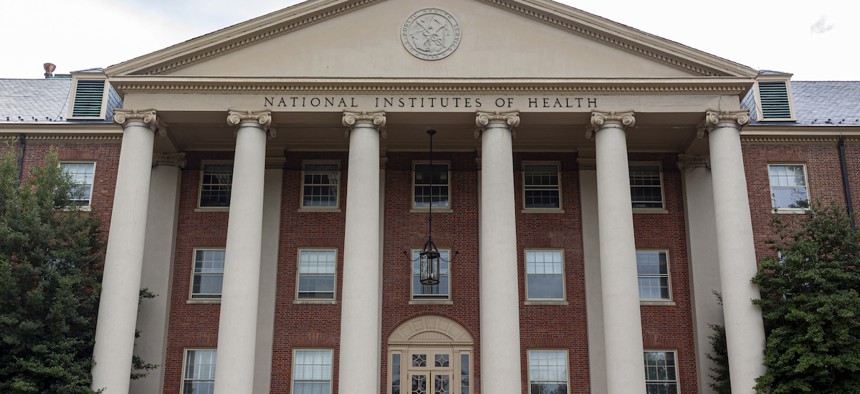
View of the main historical building (Building 1) of the National Institutes of Health (NIH) inside Bethesda campus. U.S. Public Health Service seal is seen on top of it. Grandbrothers / Getty Images






NIH is offering $1 million for practical ideas that could help long-acting HIV prevention and treatment reach more people, and applicants do not need a traditional research background to participate.
A few years ago, I tried to help a team of astronauts survive a Martian dust storm.
Fortunately, nobody was actually in danger. I was participating in the second NASA MarsXR Challenge, a government-sponsored competition hosted on the HeroX open-innovation platform. NASA wanted members of the public to design virtual reality scenarios that could someday help train astronauts for missions on Mars.
The first phase focused on storyboarding, so participants did not need to know how to program a VR simulation. They needed to imagine a realistic challenge, explain how astronauts would respond and take advantage of the immersive capabilities offered by virtual reality. My team designed a scenario in which astronauts left their rover behind while collecting rock samples in terrain too rough for a vehicle. When a surprise dust storm swept into the area and visibility began to collapse, they had to navigate back to the rover using digital waypoints and beacons they had placed along their route.
It seemed like a plausible worst-case scenario and, admittedly, a pretty exciting video game mission. The design required astronauts to think ahead, use the available technology and remain calm when conditions suddenly changed. Our entry earned an honorable mention in the first phase. We did not advance to the programming round, where winning concepts could be developed into functioning VR training missions, but the experience gave me a firsthand look at how seriously NASA approaches open-innovation competitions.
NASA has used HeroX and the NASA Tournament Lab to solicit outside ideas for everything from virtual reality astronaut training to building better lunar rover wheels. Some of the most visible government-sponsored challenges over the past several years have naturally focused on space exploration.
But one of the most consequential challenges open in 2026 is aimed at a problem that is far more Earth-bound and deeply human. The National Institutes of Health’s Office of AIDS Research is offering $1 million in prizes for ideas that could help more people gain access to long-acting HIV prevention and treatment. The competition, called the NIH ARISE-HIV LAUNCH Challenge, is open for first-round submissions through Aug. 6.
Federal government involvement goes well beyond an agency endorsement for the HIV Challenge. The Office of AIDS Research is the official sponsor and is providing the $1 million prize purse. The NIH Office of the Director is conducting the challenge under the federal prize authority established by the America COMPETES Reauthorization Act.
The challenge is also part of a broader program called Advancing Research in Implementation Science to End HIV, or ARISE-HIV. That effort involves all NIH institutes, centers and offices that award HIV funding or support related prevention, care and treatment research. HeroX provides the public competition platform, and the challenge appears through the NASA Tournament Lab’s wider open-innovation network.
To be clear, the current contest is not asking participants to invent a new HIV medication. Scientists have already developed long-acting products that can prevent or treat HIV without requiring patients to take a pill every day. Some are administered every two months, while others can provide protection for as long as six months. The challenge is getting those advances to the people who need them and making sure they remain connected to care.
In an August 2025 post reflecting on her appearance with NIH Director Jay Bhattacharya on The Director’s Desk podcast, Office of AIDS Research Director Geri R. Donenberg described the gap the new challenge is trying to address.
“We have effective, lifesaving interventions, but people are not benefiting equally,” she wrote.
Donenberg explained that implementation science can help determine how, where and by whom effective treatments should be delivered to reach different populations. An approach that works well for patients in one community may prove impractical in another because of transportation, cost, staffing, stigma, scheduling or limited access to health care.
That is where the LAUNCH Challenge comes in. NIH is asking participants to develop actionable ideas in at least one of four areas: access, delivery, engagement or retention.
An access proposal might explore how mobile clinics, home-based services, street medicine or pharmacists could bring long-acting products to people who are not well served by traditional health care systems. A delivery proposal could address the staffing or coordination needed to administer injections safely and reliably. That might include evening appointments, transportation assistance, child care support or better integration with mental health and substance-use services.
Engagement proposals could focus on building awareness, understanding and trust among patients and their families. Finally, retention ideas might help patients remain on schedule and connected to care during the months between appointments. But those are just a few suggestions. By all means, if you have better ideas, feel free to participate in this new challenge and earn a share of the prize money.
NIH is deliberately casting a wide net looking for precipitants. Individuals, informal teams, community organizations, health professionals, researchers, universities and companies can all participate. People and organizations that do not currently receive NIH funding are specifically encouraged to enter as the agency is looking for fresh and new ideas.
The first-round submission for the ARISE-HIV Challenge is pretty approachable. Participants need to complete an online concept submission totaling about three pages. Participants must also provide a short public abstract and identify whether their proposal addresses access, delivery, engagement, retention or some combination of those areas.
Judges will place the greatest weight on public health significance and impact, which accounts for 40% of the score. Innovation and novelty make up 35%, while the remaining 25% focuses on whether the idea is pragmatic enough to work outside a controlled research environment. HeroX and government officials explained the judging process and the importance of the challenge in a recent YouTube video.
Completed Phase 1 entries must be submitted through HeroX by 5 p.m. Eastern on Aug. 6. NIH expects to award as many as 35 first-round prizes of $10,000 each. Those winners will be invited into Phase 2, where they will develop more detailed implementation and evaluation plans. Up to 13 second-round winners could receive approximately $50,000 each.
And this is a busy time for government sponsored and federally focused challenges as the HIV event is not the only one being opened to outside solvers. The Department of Energy’s Office of Electricity recently launched the $500,000 Storage Design Strategies to Ease Production Prize, known as the Storage Design STEP Prize. It asks developers of emerging grid-scale storage technologies to identify manufacturing, material-sourcing and supply-chain obstacles before those problems prevent promising designs from reaching commercial production. Phase 1 entries are due Oct. 8.
Another active competition, the privately organized GoAERO Prize, is supported by NASA, RTX, Boeing, Honeywell, Iridium and other partners. Teams for that challenge are actually building compact, portable aircraft that could autonomously carry a person or emergency supplies into areas where conventional rescue vehicles cannot easily reach. Its final fly-off will take place at NASA’s Ames Research Center in April 2027. The best overall performer can earn $1 million, with additional prizes for missions involving rapid deployment, difficult conditions and precise maneuvering around obstacles.
The live challenges are radically different, but they share the same underlying idea. Agencies and other sponsors describe a difficult problem, establish rules and rewards, then open the door to people who may never have encountered the issue through a conventional grant, contract or government job.
My Mars scenario never became a functioning astronaut-training mission. But earning an honorable mention showed that someone outside NASA could still contribute an idea the agency considered useful. The next valuable idea may come from a community health worker who understands why patients miss appointments, an engineer trying to manufacture a new kind of battery or an aviation team that knows how to reach people stranded after a disaster.
For readers with a useful perspective, technical skill or firsthand understanding of one of these problems, the invitation is real: take a look, join a team or submit an idea. You may not win the top prize, but you could still contribute something that advances a technology, helps an agency or improves someone’s life.
John Breeden II is an award-winning journalist and reviewer with over 20 years of experience covering technology. He is the CEO of the Tech Writers Bureau, a group that creates technological thought leadership content for organizations of all sizes. Twitter: @LabGuys