
Agencies ramp up pressure on their workers to quit
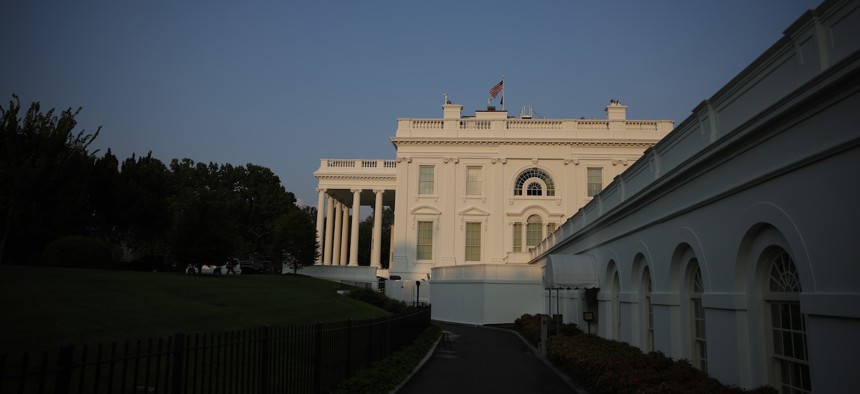
Federal employees have continued to receive increasingly insistent emails related to the deferred resignation program. Anna Moneymaker/Getty Images




 By
Erich Wagner
By
Erich Wagner
New guidance continues to defend its deferred resignation program as legal, though it fails to address its apparent violation of the Anti-Deficiency Act.
With just two days remaining before the deadline for federal workers to accept or reject the Trump administration’s so-called deferred resignation program, agencies are again defending its legality and increasingly coaxing feds to take the deal.
Federal workers have until Thursday to respond to one of a series of emails offering what Trump officials are calling “buyouts,” in which a federal worker is paid their current salary and benefits until Sept. 30 though will have effectively quit by the end of February. Administration officials say employees who accept the deal will be placed on paid administrative leave—in an apparent effort to circumvent the $25,000 cap on Voluntary Separation Incentive Payments—while the Office of Personnel Management has already begun granting agencies Voluntary Early Retirement Authority for eligible federal workers.
But according to Axios, only 20,000 feds have thus far accepted the deal, which has been widely panned by Democrats and federal employee groups as illegal and unenforceable. That accounts for less than 1% of the 2.3 million federal workers, and well below the White House’s reported target of 10%.
That might be why federal employees have continued to receive increasingly insistent emails related to the deferred resignation program. In an email to employees, the General Services Administration warned that the offer will no longer be on the table following Thursday’s deadline and suggested that layoffs and “geographic consolidation” were in the agency’s future.
“The GSA budget, workforce and space portfolio will be drastically reduced, along with the rest of the federal workforce,” the agency wrote. “GSA is moving quickly towards full-time, in-office reporting for 100% of the workforce, with very few exceptions . . . Those who remain with the agency will be held to new performance standards which tie to the agency’s new priorities and performance culture.”
“As a reminder, the deferred resignation offer—which allows eligible employees to keep their government pay and benefits through Sept. 30, 2025, without any expectation of performing work—expires on Feb. 6, 2025,” wrote Chris Nelson, the Agriculture Department’s acting chief human capital officer in an email to workers. “While we of course value your government service, we want to make sure that you have all the answers you need so you can appropriately consider the deferred resignation offer.”
OPM on Tuesday issued new guidance seeking to defend the offer’s legality, insisting that the agreement resigning federal workers will sign legally binds agencies into maintaining their pay and benefits until September.
“The deferred resignation program offers employees who opt into the program an exemption from any return-to-work requirements and full pay and benefits regardless of workload, with the expectation that most employees will transition their duties and be placed on administrative leave for the bulk of the deferred resignation period,” wrote acting OPM Director Charles Ezell. “Those assurances are binding on the government. Were the government to backtrack on its commitments, an employee would be entitled to request a rescission of his or her resignation.”
Additionally, the memo says that in the event that the government shuts down on March 15, agencies would simply furlough participants in the deferred resignation program just as they would current federal workers.
“An employee who has chosen to participate in the deferred resignation program will not be placed at a disadvantage compared to other employees if congressional appropriations lapse,” Ezell wrote. “In the event of a partial or complete government shutdown, payments to all affected employees (regardless of whether they accepted the deferred resignation offer) would be temporarily paused.”
But the memo does not address the program’s exposure under the Anti-Deficiency Act, the law ensuring that the government does not exceed congressional appropriations. While federal employees are guaranteed backpay in the event of a shutdown, their positions are only funded until March 14, under the terms of the current continuing resolution. The government’s plan to pay resigning employees past that date would amount to a breach of that law.
And a sample deferred resignation agreement sent to federal workers Monday evening raises more concerns about the offer’s validity. In addition to outlining the timetable—resigning employees would continue to work until Feb. 28, after which they would be placed on paid administrative leave—the document requires employees to waive their right to pursue litigation—administrative or judicial—against the agency and waives that right on behalf of unions who may represent them.
The sample agreement also has an apparent loophole: an agency head may rescind the deal at any time.
“By signing this agreement, the parties acknowledge that they have entered the agreement knowingly, voluntarily and free from improper influence, coercion or duress,” it states. “Employee understands that this agreement cannot be rescinded, except in the sole discretion of the [agency head], which shall not be subject to review at the Merit Systems Protection Board or otherwise.”
In a letter to President Trump on Monday, Rep. Gerry Connolly, D-Va., led all Democrats on the House Oversight and Reform Committee in demanding the president rescind the offer altogether.
“This offer would precipitate a mass exodus of the most experienced and capable federal employees, leaving our agencies severely understaffed and incapable of fulfilling their responsibilities,” they wrote. “The consequences of this brain drain will be felt by every American. Already, many federal agencies, including the Federal Aviation Administration, struggling with understaffing—this offer only exacerbates the problem.”
And in a lawsuit filed Tuesday in the U.S. District Court for Massachusetts, the American Federation of Government Employees, AFSCME and the National Association of Government Employees sued OPM to halt the program, arguing that the abbreviated timeline for accepting resignations coupled with the shifting legal justifications and other explanatory documents amounted to two violations of the Administrative Procedures Act’s bar against agencies taking arbitrary and capricious actions.
“Particularly in light of the extremely compressed timeline to participate in the Fork Directive, OPM’s continual changing of the contours of that program—and the rights and obligations of employees under it—reflects the opposite of reasoned decision-making,” the unions wrote. “OPM’s need to broadly and flatly assert that the exploding offer in the Fork in the Road directive was ‘lawful’ and ‘valid’ only demonstrates the agency’s awareness of the tremendous extent of uncertainty surrounding the directive's validity, and an effort to rush federal employees to make a decision in a matter of days despite that uncertainty.”