
DHS secretary plans post-election security review
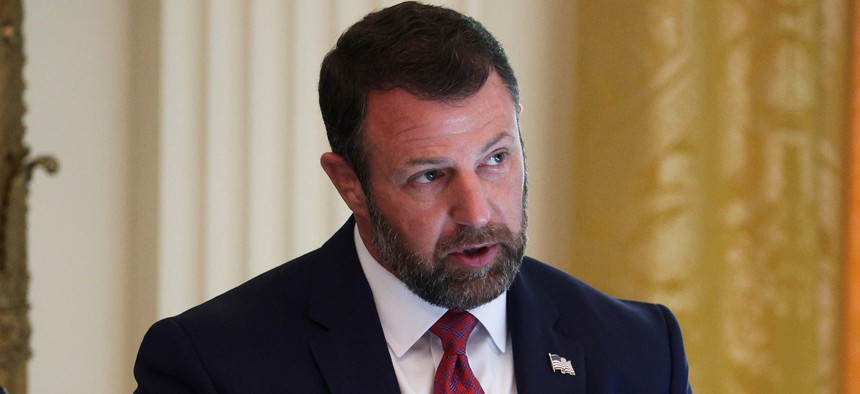
U.S. Secretary of Homeland Security Markwayne Mullin speaks during a roundtable discussion on cybercrime in the East Room of the White House on October 21, 2026 in Washington, DC. Alex Wong/Getty Images






Markwayne Mullin told CISA employees he wants to assess election systems after the vote, as the agency faces scrutiny over cuts to its support for states.
Homeland Security Secretary Markwayne Mullin plans to review the nation’s election security posture after the midterms and consider changes aimed at bolstering public confidence in voting systems.
Mullin outlined the plans during an all-hands address at the Cybersecurity and Infrastructure Security Agency’s headquarters Tuesday, according to a CISA official with direct knowledge of the remarks. The official was granted anonymity because they were not authorized to discuss details of the speech.
The secretary told employees he intended to hold a “debrief” after the elections and weigh whether changes to systems were needed to improve trust in election outcomes among voters. He also said DHS was not seeking to “suppress” votes and said the department’s goal is ensuring ballots are secure and legally cast.
The scope of that review and the changes Mullin might pursue remain unclear. But his remarks come as the Trump administration has sought greater control over election procedures, including attempted restrictions on mail voting that would require voters to appear on new Postal Service lists before their ballots could be transmitted.
More recently, the Justice Department asked Washington state to withhold ballots from hundreds of people flagged as alleged noncitizens, following a similar effort in California. Audits and studies have consistently found noncitizen voting to be rare.
Election cybersecurity work can include protecting voter registration records, keeping voter check-in systems available and preventing attacks that knock polling-place information or results websites offline. Disrupting those services can cause confusion and delays for voters, though they do not directly affect how people cast their ballots.
Foreign influence campaigns can separately seek to discourage participation or undermine confidence in the outcome by spreading false claims about candidates or amplifying divisive political issues online. Current and former officials previously told Nextgov/FCW that cuts to certain federal programs have weakened relationships used to identify and counter foreign influence campaigns, even as artificial intelligence makes deceptive messages easier to produce and spread.
Sen. Mark Warner, D-Va., and Rep. Jim Himes, D-Conn. — the top Democrats on the Senate and House Intelligence panels — said last week that U.S. intelligence has described Russian disinformation and more targeted Chinese influence efforts. The lawmakers said they have seen no indications of a foreign operation to manipulate voting machinery or alter ballots.
Mullin’s address was first reported by Politico. His remarks come as CISA tries to boost election security support following staffing and program cuts that state officials say have disrupted their access to federal expertise.
The agency’s September election plan assigns its 10 regional directors an election adviser role and describes a free platform for sharing threat information among election officials, state intelligence hubs and federal partners. Mullin pledged at the time that the plan would be “implemented in full.”
Some state officials have warned that renewed assistance arrived too late for parts of their midterm preparations. One Arizona cybersecurity official said last month that their state had been without a CISA cybersecurity adviser since March 2025.
The debate over CISA’s election work stretches back to 2020, when the agency affirmed the security of that year’s election and rejected President Donald Trump’s false claims that it had been stolen. Trump and his allies have since accused CISA of enabling government censorship through its work to counter election-related disinformation.
Those grievances have helped shape much of the administration’s efforts to narrow the agency’s role during Trump’s second term. In the last year, officials have also undertaken acute efforts to scrutinize the security of voting infrastructure.
Although voting machines and related systems contain known security vulnerabilities, officials and cybersecurity experts have found no evidence that these flaws have been widely exploited in a way that would alter election outcomes.