
White House unveils billions in investments for Genesis Mission
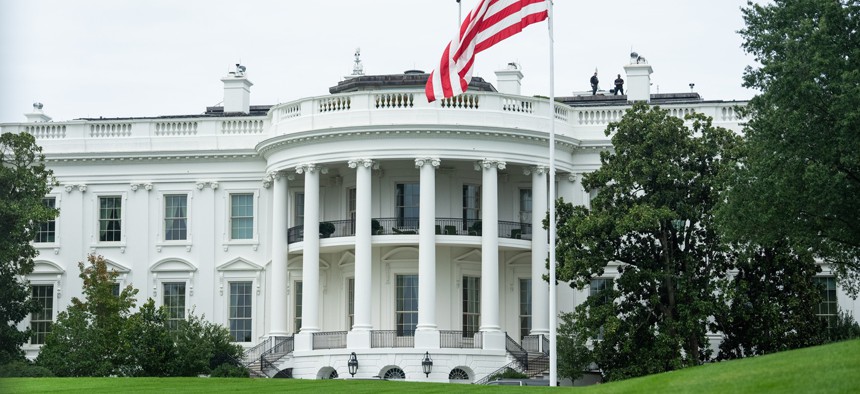
Aaron Schwartz/Getty Images





Eleven leading tech firms pledged to provide $2.4 billion in compute credits to help drive scientific research and technological innovation through the use of artificial intelligence and other emerging capabilities.
The Trump administration on Thursday announced billions in investments from the federal government to help advance U.S. scientific research and development, with almost a dozen leading tech companies also committing to provide cloud and software credits to help the White House follow through on its Genesis Mission initiative.
The announcements came at the White House’s AI Science Summit, which the administration billed as a $6 billion push to drive the next era of U.S.-led scientific and technological innovation and to further expand the effort across the government. The event evolved out of a White House Office of Science and Technology Policy report released in July that detailed ways of ushering in “the Golden Age of American Innovation.”
Eleven tech giants pledged to provide $2.4 billion in compute credits for the Genesis Mission Consortium, which the White House said will be used to support “over 15 Federal agencies working towards National Science & Technology Challenges.”
The industry commitments included $1 billion from Nvidia, $500 million from AMD and $200 million from OpenAI. Anthropic and Google each pledged $150 million, while AMP and Emerald AI each committed $100 million. Amazon Web Services, Armada, Crusoe and Micron each committed $50 million.
"American scientists are on the cusp of breakthroughs that will define the next century — from accelerating biomedical research and improving health outcomes, to AI-driven drug discovery — but they need computing power at scale," David Appel, interim vice president of Worldwide Public Sector at AWS, said in a statement.
Federal agencies also unveiled a host of new funding opportunities, programs and partnerships to further drive scientific discovery.
The Pentagon announced a series of steps to align with the White House effort, including establishing an enterprisewide framework to measure and enhance the effectiveness of its laboratories and research centers. The department similarly announced up to $350 million for quantum computing initiatives to strengthen use of the advanced capabilities for national security purposes.
"President [Donald] Trump has made it clear that technological dominance requires us to move faster, safeguard our research, and build right here in America," Emil Michael, undersecretary of Defense for research and engineering, said in a statement. "We are answering that call by dismantling barriers to commercialization, modernizing our labs, and ruthlessly securing taxpayer-funded research from foreign exploitation.”
The same day, the Energy Department announced $159 million in new phase II Genesis Mission project awards, $96 million for early-career researchers and a new graduate fellowship program, along with an effort to advance the development of fault-tolerant quantum computers.
Trump also used Thursday’s summit as an opportunity to award the National Medal of Technology and Innovation and the National Medal of Science to six leading tech executives. One of the award recipients was SpaceX CEO Elon Musk, who helmed the cost-cutting Department of Government Efficiency at the start of Trump's second term.