
Trump redoubles pro-AI stance amid calls to slow development
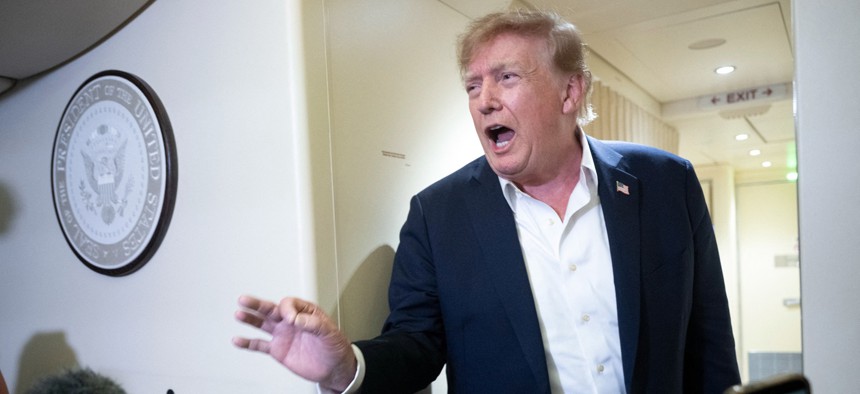
US President Donald Trump speaks to the press aboard Air Force One while flying to Joint Base Andrews, Maryland from Ireland on September 13, 2026. Brendan Smialowski / AFP via Getty Images




Industry leaders put out a public call to “pace the frontier” of artificial intelligence development over the weekend, reinvigorating the debate over how to best compose effective regulations.
President Donald Trump on Monday pushed back against major tech leaders’ recent calls to slow the pace of artificial intelligence development for the sake of safety, saying the U.S. does need “strong and smart” guardrails but that the country is already outfitted with the proper safety infrastructure.
In a Truth Social post, Trump wrote that the “only control or ‘guardrails’ that AI needs is a STRONG AND SMART (High IQ!) PRESIDENT, and the U.S.A. has that, in spades!” He added that his administration has been working to stop AI developers from “doing bad, or potentially bad ‘things’” and that current U.S. regulatory structures already offer a level of oversight that can ensure AI won’t be used to cause harm. Trump also doubled down on the national security impetus to ensure the U.S. is dominant in the creation of new AI products over other countries like China.
Trump’s comments follow public posts from both Anthropic CEO Dario Amodei and OpenAI CEO Sam Altman concluding that the broader AI industry needs to slow its research into potentially dangerous AI products.
Amodei first wrote in a weekend blog post that AI developers should “pace the frontier” in order to ensure that the technology’s innovation doesn’t outpace the ability to deal with threats it may pose.
“The most effective method of pacing is via regulation that targets all US frontier AI companies, as that covers even those who are unwilling to cooperate voluntarily,” Amodei wrote.
OpenAI CEO Sam Altman similarly warned against the ways “AI progress could go very badly,” in an early Monday X post, saying that safety techniques need to stay ahead of progress on model capabilities and that concentration of power could cause “dystopian” results.
“We already have tremendous CRIMINAL and REGULATORY power over these companies!,” Trump wrote. “There is a SICK conspiracy going on against AI and Data Centers, and the only one that is happy about it is China. WHOEVER WINS AI, WINS! We are leading China, and all others, and will continue to do so. Conspiracy Theorists, Treasonists, Traitors, and Leakers, BEWARE!”
Trump followed this initial post with more commentary, calling the warnings of AI threats — which were catalyzed by a series of Tuesday X posts made by former OpenAI and Anthropic employee Jacob Coxon — part of a larger “hoax.”
“Concerning AI, when, in the History of Business, did anyone see the Leaders of an Industry call for Regulation that, if strongly implemented, will drive them into oblivion and bankruptcy?” Trump wrote on Monday. “AI taking over the World, destroying Humanity, and all other things bad, is a HOAX.”
Coxon’s posts following his resignation from Anthropic over safety concerns went viral and have captured Congressional attention, with multiple lawmakers calling for the prioritization of AI regulatory legislation on X.
As Trump prepares to welcome Xi Jinping, the president of the People’s Republic of China, to the White House on Sept. 24, he wrote that China isn’t slowing down their development of new AI technologies, and he plans on keeping with his pro-AI agenda to ensure U.S. dominance in the market.
Speaking on CBS Sunday Morning, Amodei, who has long been an advocate for responsible AI development, said that the burden of ensuring safe AI is not confined to just the AI industry or the federal government.
“I feel both sides of the responsibility,” Amodei said. “It shouldn’t be my responsibility alone or Anthropic’s responsibility alone or all of the AI company’s responsibility alone or even one government’s responsibility alone. This is bigger than all of us.”
Trump, however, made clear his regulatory posture would continue to favor industry growth.
“The only reason the AI/Data Center outburst is happening is because the United States is leading, by a lot, every other country,” Trump said on Truth Social. “Don’t kill the Golden Goose!”
The White House did not respond to a request for comment by the time of publication.
Industry experts are also divided on the path ahead for AI regulation. The Center for Democracy and Technology echoed Amodei and Altman’s call to pace the frontier of AI tech development and supported more federal regulatory mechanisms.
“Companies clearly need stronger incentives to ensure AI systems won’t cause harm to individuals, critical infrastructure, and society more broadly,” CDT President & CEO Alexandra Reeve Givens said in a statement. “Especially concerning is the White House’s approach of secret, arbitrary processes and vague threats of retaliation, which is not only ineffective but also undercuts the cornerstones of democracy. Governance mechanisms must be effective, legitimate, and collaboratively designed, providing transparency and a foundation for public accountability.”
Adam Thierer, a senior policy analyst at the R Street Institute, sided with the Trump administration, writing on X that surrendering the competitive lead the U.S. has in AI technology is “incredibly dangerous thinking,” particularly if its development is dictated by a “combination of governments,” for diversified oversight, as Amodei suggested on CBS Sunday Morning.