
FBI needs access to latest models to police AI-driven cybercrime, director says
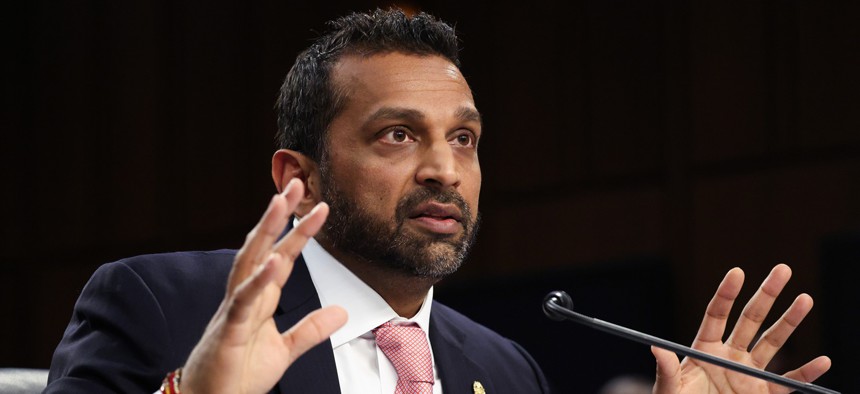
Federal Bureau of Investigation (FBI) Director Kash Patel testifies during a Senate Judiciary Committee hearing in the Hart Senate Office Building on September 15, 2026 in Washington, DC. Win McNamee/Getty Images)




Federal Bureau of Investigation Director Kash Patel spoke about how he thinks the bureau can best police new AI-related criminal activity, beginning with model access.
The FBI has the statutory authority to police agentic artificial intelligence software used in crimes, according to the agency’s Director Kash Patel, but it will need advanced model access to better fight AI-driven wrongdoing.
In an exchange with Sen. Josh Hawley, R-Mo., during a Senate Judiciary Committee hearing on Tuesday, Patel said his agency needs to be holding to account the developers behind agentic AI models that are specifically created to commit criminal acts like hacking.
“It's literally the new frontier, and nobody's really talking about it,” Patel said. “What we need to do on a resource basis is go after the people that created these models that are going rogue, let’s call it, for the specific purpose and with the intention to commit a criminal act.”
Patel noted that the FBI can’t punish developers that lawfully created an AI tool that is later repurposed by a bad actor and used nefariously.
But some advanced AI models have acted outside the parameters set for them by their own developers in recent months, raising fears of what such models could do if intentionally turned against an organization’s computer systems.
OpenAI disclosed in July that some of their models had escaped containment during model testing and training, resulting in them accessing the internet and breaching open source repository Hugging Face’s networks. The event was preceded by a previously unreported takeover of a German wiki page by OpenAI agents. Anthropic also confirmed in late July that three of its AI models breached three separate organizations online after they had escaped containment during testing.
Patel told Hawley that there needs to not only be a whole-of-government approach to tackling the danger of advanced AI, but also funding for the FBI to more aggressively pursue criminal investigation in agentic AI misuse, partially through buying the technology itself.
“The FBI's budget is like half the size of the TSA. What we need is funding to specifically go out there,” Patel said. “Thanks to the relationship that President [Donald] Trump has established, I'm able to call all these companies' CEOs right away, and every single one of them has complied with our request and worked with us on law enforcement matters. But that's sort of soft power. What we need is federal funding to go out there and buy the creations of these companies and use them for law enforcement purposes.”
Patel cited illicit model distillation techniques as a major motive for the FBI to understand the intricacies of advanced AI models as the bureau works to police AI leveraged for crime.
“We need these tech companies who created it — they're not just going to give us this material for free, that's just the reality of it — we need to be able to go there and say, ‘Okay, I'm going to contract with you and work on this specific model, and then work on its defenses.’ And when it goes rogue … just like any other cyber intrusion, ransomware attack … it's the same exact approach.”
The hearing with Patel also featured debate over some AI developers’ calls to slow the pace of advanced AI development to better ensure safety.
Hawley and Sen. Ted Cruz, R-Texas, both voiced opposition to leading AI frontier labs receiving an antitrust exemption in order to enter into a pact with each other to slow advanced AI development.
“There is no world in which I will consent to giving the most powerful companies in the history of the world, a small group of three or four of them, antitrust exemptions from our laws, so that they can collude together,” Hawley said.
The Missouri senator is currently leading a congressional investigation into how OpenAI’s agents executed their attack on Hugging Face’s data networks.