
US opposes global AI standards but sees value coordinating on ‘real-world harms,’ State official says
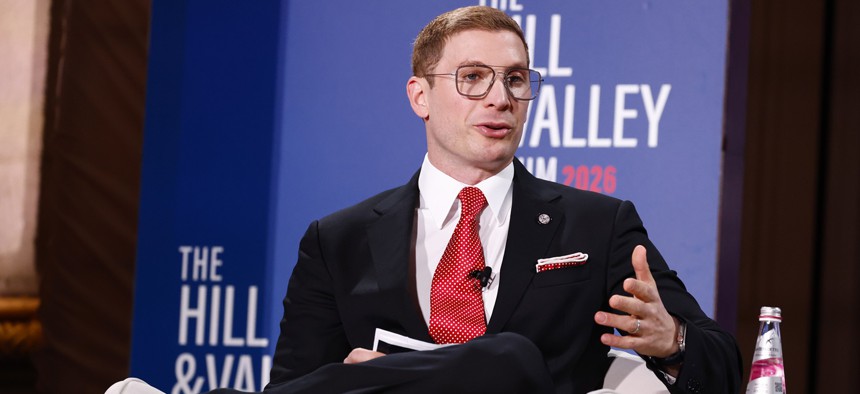
Jacob Helberg participates in the "Allies, Industry and the AI Supply Chain" panel during The Hill & Valley Forum 2026 at Andrew W. Mellon Auditorium on March 24, 2026 in Washington, DC. Paul Morigi/Getty Images for The Hill & Valley Forum



The White House wants to shape global AI norms by maintaining and advancing the nation’s tech superiority, but sees “potential benefits” in collaborating with international partners on some issues.
Although the Trump administration is opposed to working with international governing bodies to establish any frameworks around the use and development of AI technologies, a top State Department official said conversations are still taking place with allies about coordinating responses to certain national security threats.
During an Atlantic Council event on Monday, Under Secretary of State for Economic Affairs Jacob Helberg said the White House “is highly skeptical of supranational bodies in the business of governance,” but added that the administration is open to closer global collaboration on other tech- and cyber-related issues despite its “America First” agenda.
“There is a conversation surrounding the benefits — the potential benefits — of coordinating with other countries on addressing, you know, cybersecurity threats, threats around physical infrastructure risks, around deepfakes,” Helberg said. “So, you know, coordinating with other partners on the identification of real-world harms that are worthy of coordination.”
He added that it “is a conversation that's very much taking place, but as an administration, we haven't yet adjudicated on, you know, what the final road ahead lies on that front.”
President Donald Trump has strongly pushed back on U.S. engagement with international bodies like the UN, including directing officials to withdraw from several global bodies and slash funding for other entities.
This opposition to international collaboration has extended to the nation’s AI policies, with the White House favoring continued support for American technology dominance over giving transnational organizations any authority to craft global standards that can be shaped by U.S. adversaries like Russia and China.
The third pillar of the administration’s AI Action Plan, released in July 2025, focused on “lead[ing] in international AI diplomacy and security,” with the document voicing opposition to international bodies creating any AI governance frameworks.
“The United States supports likeminded nations working together to encourage the development of AI in line with our shared values,” the plan said. “But too many of these efforts have advocated for burdensome regulations, vague ‘codes of conduct’ that promote cultural agendas that do not align with American values, or have been influenced by Chinese companies attempting to shape standards for facial recognition and surveillance.”
Trump also signed an AI executive order on Tuesday that calls for firms to voluntarily provide the federal government with pre-public releases of their models to review them for potential cybersecurity or national security risks.
U.S. officials have also warned European Union allies to refrain from further regulating AI technologies and other emerging capabilities. During an April event in Brussels, Helberg said the bloc’s current regulatory regime is pushing American companies out of its orbit and that "Europe is accruing a [technology] lag that will not be reversible in years.”