
Trump memo pushes national security agencies to move faster on AI
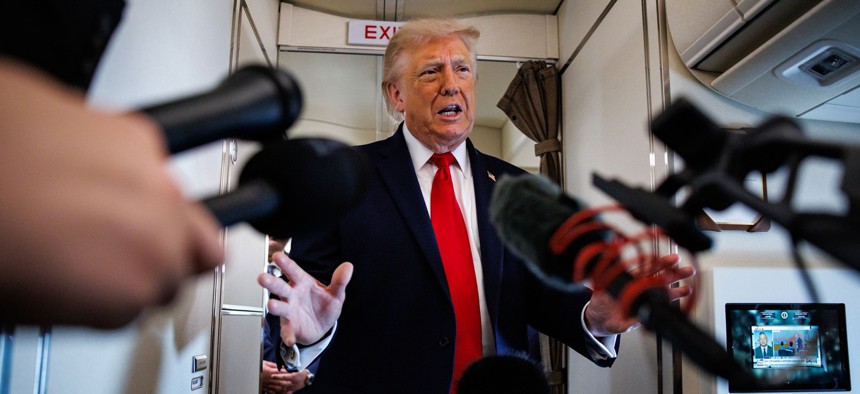
President Donald Trump speaks with reporters while aboard Air Force One on June 5, 2026 en route to Chippewa Falls, Wisconsin. Samuel Corum/Getty Images


The directive calls for deeper partnerships with AI companies while directing agencies to guard frontier models and the data centers that power them from foreign adversaries.
President Donald Trump on Friday signed a national security memo aimed at speeding up government use of advanced artificial intelligence across the military and intelligence community, while also trying to harden those systems against foreign theft and manipulation.
The National Security Presidential Memorandum reflects a growing view inside the White House that U.S. security agencies are moving too slowly to adopt frontier AI tools, even as the evolving technology improves rapidly and rivals like China seek ways to craft their own versions.
It calls for agencies like the FBI, the Office of the Director of National Intelligence and the Office of the National Cyber Director to build “deep, proactive” relationships with AI companies so that cutting-edge models can be made available to national security personnel faster.
It also instructs officials to identify areas where AI could improve government operations, including intelligence analysis and cyber threat detection. At the same time, the memo says the tools cannot be used for unlawful surveillance of Americans, language that speaks to long-running civil liberties concerns over how agencies collect, analyze and process data.
The memo also focuses heavily on protecting U.S.-developed AI models from foreign adversaries. It directs senior officials, including Defense Secretary Pete Hegseth and NSA Director Gen. Joshua Rudd, to work with private-sector companies on security protocols meant to prevent advanced models from being stolen, copied or compromised.
One area of concern is model distillation, a technique in which an AI system repeatedly queries another AI system in an attempt to mimic its performance and build out a separate model. The White House in April accused China of carrying out “industrial-scale” distillation attacks on U.S. AI systems.
The memo also directs agencies to work with industry to secure the infrastructure that supports frontier AI, including the data centers that store the enormous amounts of computing power needed to run advanced models. Data centers have recently become more attractive targets during periods of geopolitical tension.
Trump recently signed an AI security executive order that leans heavily on voluntary cooperation with industry. That order encourages developers to submit powerful new models to a 30-day government review before public release.
More AI-related guidance is expected soon. Nick Andersen, CISA’s acting director, said last week that the cyber agency is preparing a binding operational directive focused on AI-enabled cyber threats.
The administration’s approach to AI has shifted in recent months as officials confront a new class of cyber-focused models, including Anthropic’s Mythos, that can rapidly identify vulnerabilities across computer networks. The model has become a major driver of government discussions over how advanced AI systems could reshape both defensive and offensive cyber operations.
Last week, Anthropic said it is expanding Project Glasswing — its controlled-access program for giving trusted organizations early access to Mythos — to about 150 additional entities. The new group spans more than 15 countries and includes organizations in water, healthcare, communications and other critical infrastructure sectors.
OpenAI’s recent release of GPT-5.5-Cyber, which also demonstrated sophisticated cyber capabilities, has further heightened concerns in Washington over how quickly these systems are advancing and how they could reshape both cyber defensive and offensive operations.