
White House accuses China of ‘deliberate, industrial-scale campaigns’ to steal US AI models
itsarasak thithuekthak/Getty Images


The White House Office of Science and Technology Policy told federal agencies that the Trump administration will be enhancing its engagement with the private sector to counter foreign-led distillation campaigns designed to undermine U.S. AI advances.
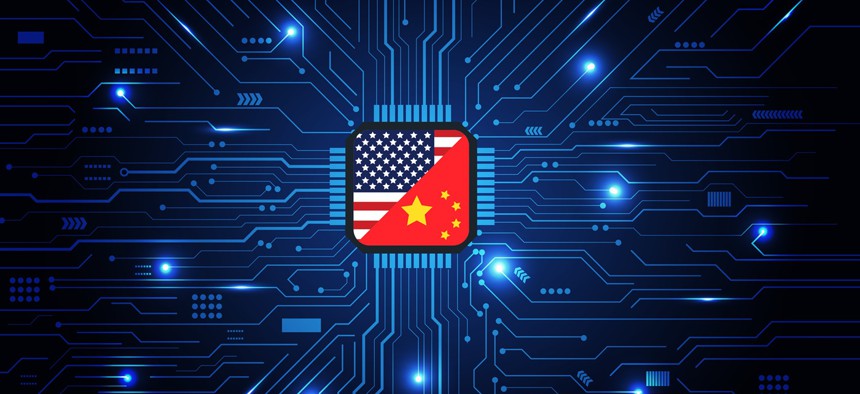
The White House Office of Science and Technology Policy on Thursday accused China and other foreign entities of engaging in “deliberate, industrial-scale campaigns to distill U.S. frontier AI systems,” and said that the Trump administration will be taking steps to safeguard domestic artificial intelligence products.
In a memo sent to federal agencies, the White House office warned that these distillation campaigns — in which a deluge of requests are sent to an AI model in order to train a knockoff version of it — are allowing bad actors to steal proprietary information from U.S. companies.
“Models developed from surreptitious, unauthorized distillation campaigns like this do not replicate the full performance of the original,” the memo said. “They do, however, enable foreign actors to release products that appear to perform comparably on select benchmarks at a fraction of the cost.”
Anthropic in February accused three Chinese-based AI companies — DeepSeek, Moonshot AI and MiniMax — of overwhelming its Claude model with 16 million exchanges from roughly 24,000 fraudulent accounts.
Those allegations came the same month that OpenAI sent a letter to members of the House China Select Committee that said, in part, that it had seen evidence “indicative of ongoing attempts by DeepSeek to distill frontier models of OpenAI and other US frontier labs, including through new, obfuscated methods.”
Thursday’s memo does not cite any specific companies engaged in distillation campaigns against U.S. AI firms. But OSTP Director Michael Kratsios said in an X post that “these foreign entities are using tens of thousands of proxies and jailbreaking techniques in coordinated campaigns to systematically extract American breakthroughs.”
OSTP told agencies that the Trump administration will be taking a series of steps to expand engagement with U.S. companies and crack down on foreign-based distillation campaigns.
These include sharing more information with the private sector about attempts to conduct large-scale distillation attacks, enabling companies “to better coordinate against such attacks;” partnering with firms to develop a set of best practices to counter these campaigns; and looking at developing new steps to hold foreign actors accountable for their actions.
The memo said these actions are consistent with the White House’s AI Action Plan, which was released in July 2025 and emphasizes the importance of “preventing our adversaries from free-riding on our innovation and investment.”
The White House’s warning about China-based distillation campaigns is the latest salvo in the U.S. and China’s ongoing competition to lead the global AI race. It also comes as major American AI firms have rolled out what they say are advanced AI models that have exquisite cybersecurity capabilities that could cause national security risks if they fall into the wrong hands.
Retired Gen. Paul Nakasone, who led the NSA and U.S. Cyber Command, said the administration may consider export controls, diplomatic protests and tailored technology restrictions as potential responses to the distillation efforts.
“And we’re going to be very, very careful about how we’re going to share that [AI technology] with a series of different partners,” he said, speaking at a Wednesday roundtable with reporters in Nashville when asked about the campaigns. Nakasone now leads Vanderbilt University’s Institute of National Security.
Given China’s increasingly bellicose tone toward Taiwan, and the potential for preemptive actions against the U.S. in advance of a full-scale invasion of that country, lawmakers have also been worried about how technology advances will ultimately benefit Beijing. Through China’s military-civil fusion strategy, the country has moved to enhance its military strength by removing barriers with its commercial sector.
President Donald Trump and Chinese President Xi Jinping are scheduled to meet next month in Beijing for a summit to discuss a host of issues, including export controls on semiconductors and IP theft.