
House Homeland panel gets briefing on Anthropic’s Mythos
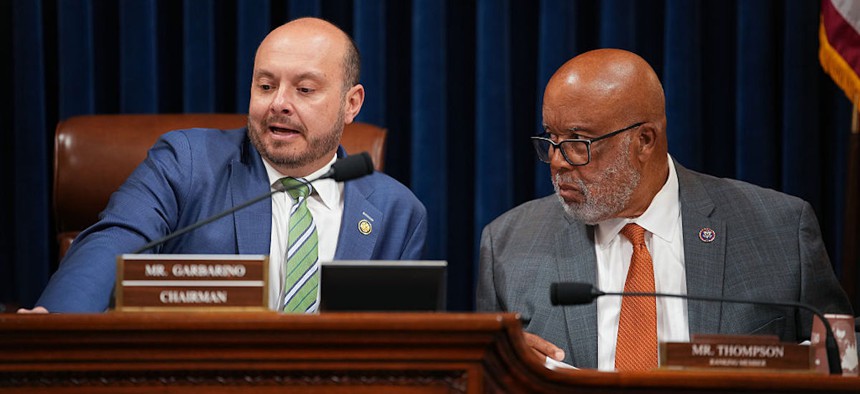
House Homeland Security Chairman Rep. Andrew Garbarino, R-N.Y., and Ranking Member Rep. Bennie Thompson, D-Miss., look on ahead of a House Homeland Security Committee hearing on Capitol Hill on March 25, 2026 in Washington, DC. Members of the committee received a briefing on Wednesday about Anthropic's Mythos AI model. Andrew Harnik/Getty Images




The conversation was “productive and focused on a range of AI security and competitiveness issues,” according to one person familiar with the meeting.
Members of the House Homeland Security Committee were briefed Wednesday on Mythos, the Anthropic artificial intelligence model that has drawn vast attention across the cybersecurity community for its advanced hacking capabilities.
Anthropic executives provided the panel with a live demonstration of Mythos, allowing members to see how advanced AI can identify and reason through software vulnerabilities, according to a committee aide who attended the briefing and requested anonymity to communicate details of the demo.
“What we saw reinforced the urgency of ensuring that federal agencies, including our civilian cyber defenders, can responsibly access and deploy the most advanced U.S. models to find and patch vulnerabilities before foreign adversaries or criminal actors exploit them,” said the aide, who noted the briefing was one of the first live demonstrations delivered to Congress.
President Donald Trump is meeting with Chinese President Xi Jinping this week, where AI competition is expected to come up in the discussion. Last month, the White House accused Beijing of attempting to copy components of U.S. AI systems to build similar models of its own through a process known as distillation.
“As the [People’s Republic of China] aggressively works to close the AI innovation gap with the United States, the committee remains focused on ensuring that America’s AI leadership translates into a durable national security advantage, not a temporary lead that adversaries can copy, steal or rapidly commoditize,” the aide added.
The briefing was “productive and focused on a range of AI security and competitiveness issues,” according to a second person familiar with the demo.
Members discussed how the U.S. can preserve its advantage in AI, including maintaining leadership in compute power and preventing China from obtaining advanced chips, said the person, who added that attendees discussed safeguards for advanced AI models and ensuring future systems are developed and deployed safely and securely.
Lawmakers also asked questions about Anthropic’s engagement with the federal government, including whether an ongoing legal dispute over a Defense Department supply chain risk designation against the company is affecting conversations about the use of AI models across federal agencies, including at CISA, which reportedly doesn’t have full access to the model.
The second person did not add additional details about who in the government has access to Mythos, but said “the implications of advanced AI tools for state and local governments and under-resourced critical infrastructure sectors, including water systems, were also discussed.”
Mythos, unveiled last month, was held back from a full public release on the grounds that it could pose national security risks in the wrong hands. U.S. critical infrastructure stakeholders have been vying for access to the tool so it can be run against their own systems to identify and patch previously undiscovered vulnerabilities that could be exploited by hackers.
The Hill first reported news of the demo.
It’s unclear which government agencies have access to Mythos, although multiple reports and people familiar with the matter previously confirmed to Nextgov/FCW that the NSA is among them.
Senate Intelligence Committee Vice Chairman Mark Warner, D-Va., told Politico that he and Chairman Tom Cotton, R-Ark., were briefed on Mythos by Gen. Joshua Rudd, who leads Cyber Command and the NSA, but did not provide further details.