
House amendment responding to Pentagon-Anthropic conflict fails committee vote
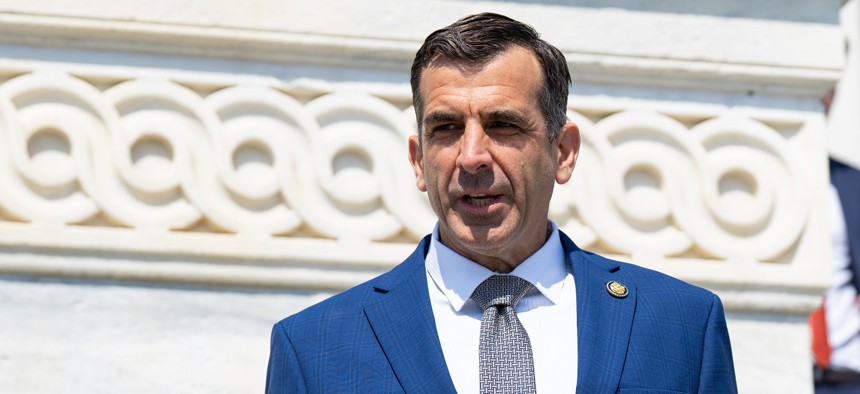
Rep. Sam Liccardo, D-Calif., walks down the House steps after a vote in the U.S. Capitol on Thursday, May 1, 2025. Bill Clark/CQ-Roll Call, Inc via Getty Images




Lawmakers split over an amendment to the Defense Production Act from Rep. Sam Liccardo, D-Calif., that would have prohibited the government from blacklisting firms opposed to their tech being used in certain situations.
An amendment to the Defense Production Act that would have specifically forbidden government agencies from blacklisting firms that refuse to deploy their high-risk technology products in situations that could harm U.S. citizens failed to move forward during a House Financial Services Committee markup on Wednesday.
The proposal was rejected in a 16-25 vote.
Rep. Sam Liccardo, D-Calif., introduced the amendment in response to the ongoing fallout between the Department of Defense and Anthropic after the company refused to relax their AI safety standards for Pentagon deployment.
As a result, President Donald Trump ordered all federal agencies to begin offloading Anthropic products from government workflows over the course of the next six months.
“A $380 billion hyperscaler, Anthropic has warned the Pentagon and the public of the potential misuse of its product for mass surveillance of U.S. citizens and for autonomous killing machines that could exceed human constraint. They seek reasonable guardrails,” Liccardo said during the markup. “The Pentagon's bureaucrats and lawyers believe they know better. They told Anthropic that if they sought guardrails, they'd blacklist the company as a supply chain threat preventing any other government agency from buying their software.”
Support for the amendment within the committee fell along party lines, with Reps. Sean Casten, D-Ill.; Bill Foster, D-Ill.; and Maxine Waters, D-Calif., all voicing support for Liccardo’s amendment.
Republican lawmakers disagreed with the context of the amendment.
Rep. Warren Davidson, R-Ohio, said that the amendment was “out of place” in the DPA, due to the bill’s usual bipartisan nature.
“We haven't even figured out what to do on artificial intelligence as a body,” Davidson said. “So the idea that we're going to figure that out and jam it into this amendment I think is problematic.”
Committee Chairman Rep. French Hill, R-Ark., echoed Davidson’s posture, saying that — in the context of the DPA — he didn’t support the amendment.
“The idea is that DPA should be trying to manage scarcity,” Hill said. “At the same time we ought to be, I think, concerned in this committee of undercutting all government authority.”
Hill added that engaging vendors to work on sensitive national defense issues “will always entail procurement for uses that someone may have issue with, but that doesn't mean that it's the government attempting to be retaliatory or punitive.”
Despite the lack of support on that particular measure, both Hill and Davidson agreed that they want to continue working with Liccardo and other Democrats on moving forward with effective AI policy.