
Lawmaker warns intelligence contractors' Trump ballroom donations may be scrutinized
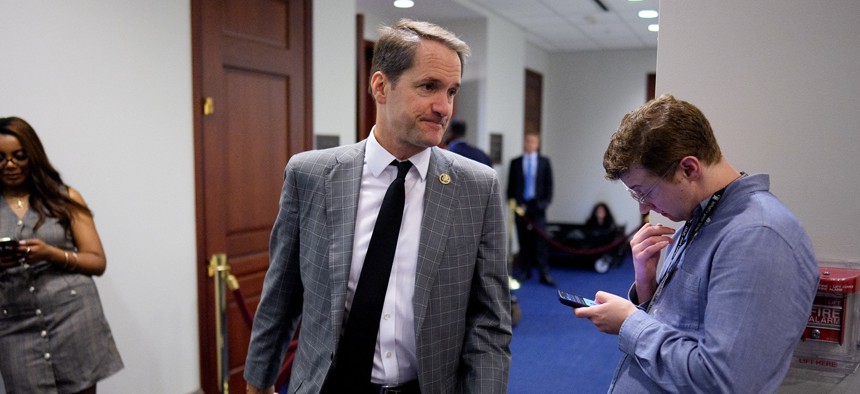
Rep. Jim Himes (D-CT) departs a Democratic caucus meeting on Capitol Hill on September 1, 2026 in Washington, DC. Andrew Harnik/Getty Images






Rep. Jim Himes, the ranking member of the House Intelligence Committee, wants to examine whether contributions were tied to federal contracts or access to administration officials.
The House Intelligence Committee’s top Democrat warned Monday that intelligence contractors could face congressional scrutiny over donations to President Donald Trump’s White House ballroom project, including whether the contributions were connected to government contracts or access to senior officials.
Rep. Jim Himes, D-Conn., wrote to the National Defense Industrial Association asking it to remind member companies of their obligations to respond to congressional oversight. He said lawmakers were likely to pursue investigative steps concerning the donations and other dealings between contractors and the administration.
“At times, the Administration has appeared to inappropriately fuse the government contracting process with the attempted extraction of political or private favors,” Himes said in the letter to NDIA President and CEO David Norquist.
The notice signals potential scrutiny in the coming months of the financial relationships between the White House and companies that serve the nation’s vast array of spy agencies.
Nextgov/FCW has asked NDIA and the Office of the Director of National Intelligence for comment.
The White House announced the ballroom project in July 2025, saying private contributions would cover its construction rather than congressionally appropriated funds. The White House has identified donors like Booz Allen Hamilton, Palantir Technologies and Lockheed Martin, alongside technology companies like Amazon, Google and Microsoft.
Himes said some publicly named donors belong to NDIA and have significant intelligence community contracts. His letter did not name specific companies or identify any contract awards he believes warrant examination.
He outlined questions about how donations were solicited, who participated in those discussions and whether contributions were linked to obtaining or retaining government business, presidential access or other benefits. Potential investigative steps could include requests for documents, communications and transcribed testimony.
The warning comes as Democrats appear increasingly well positioned to regain the House in November. The nonpartisan Cook Political Report said Friday that Republicans are on track to lose their majority. A Democratic takeover would give the party control of committee investigations when the new Congress convenes in January.
Under the panel’s current rules, subpoenas compelling documents or testimony require authorization from the chairman, after consultation with the ranking member, or a vote of the full committee.
The inquiry could also examine whether the donations create actual or apparent conflicts of interest or national security risks, and whether Congress should impose additional disclosure requirements or other safeguards.
He framed the issue, in part, as a concern about pressure on contractors, asking whether companies providing national security services were being pushed into arrangements that compromised the contracting process.
“Intelligence Community contractors provide valuable services to the nation, and to the extent they are being pressured in ways that corrupt the contracting process, Congress has a vital oversight interest,” Himes wrote.
The potential scrutiny extends beyond the ballroom. Himes said lawmakers may also seek information about other “unusual dealings” involving the White House, senior administration officials and NDIA members, though he did not identify additional transactions.
“I intend to ensure this matter is thoroughly investigated,” he wrote.