
EPA’s research efforts are swayed by administration priorities, official says
Michael M. Santiago/Getty Images




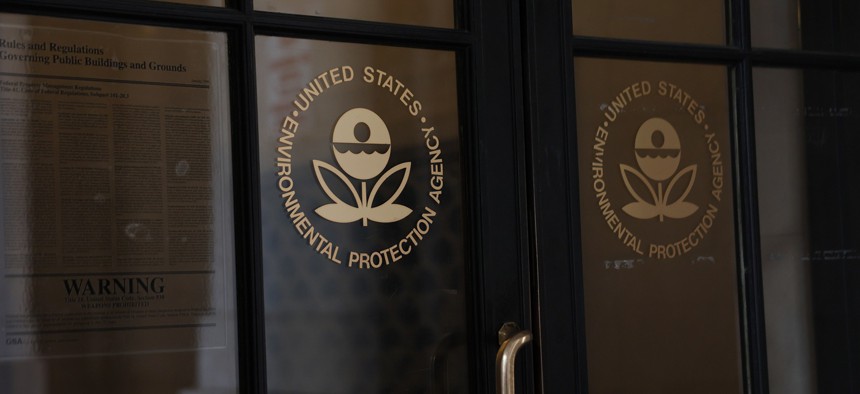
The Environmental Protection Agency’s formerly independent research office was replaced last year by a new unit housed within the agency’s Office of the Administrator.
The Environmental Protection Agency’s reorganized research office is influenced by the Trump administration’s political appointees, the agency’s top science official confirmed to lawmakers on Thursday.
The EPA shuttered its longstanding Office of Research and Development last July and replaced it with a new Office of Applied Science and Environmental Solutions, which was placed within the agency’s Office of the Administrator. In a May 2025 press release, the EPA said it was “shifting its scientific expertise and research efforts to program offices to tackle statutory obligations and mission essential functions.”
During a House Science, Space and Technology Subcommittee on Environment hearing, Maureen Gwinn — EPA’s deputy associate administrator for science in OASES — said the restructured office “serves as a coordinating hub that ensures consistency and collaboration across EPA’s research enterprise, advancing gold standard science and strengthening technical assistance to state and local partners.”
It is not surprising for a presidential administration to reshape federal agencies’ missions to align with its political priorities. But committee Democrats said the level of new political oversight over OASES raises concerns about the office’s independence.
President Donald Trump notably signed a May 2025 executive order on "Restoring Gold Standard Science” that some critics believe undercuts independent federal research by giving political appointees more of a say over the direction of scientific studies.
A study published on May 5 by the nonprofit Public Employees for Environmental Responsibility found that, at the time, there had been only 61 peer-reviewed studies published by EPA scientists up to that point in 2026, compared to a total of 339 in 2024.
Rep. Gabe Amo, D-R.I., the top Democrat on the subcommittee, noted during the hearing that an EPA interim approval process memo implemented “a ‘no surprises’ policy for EPA science that requires all OASES activities — scientific activities — be, quote, ‘supported by appropriate political leadership.’” He added that “true science follows the evidence wherever it leads, even if it's surprising, and even if those discoveries are inconvenient for Trump's political agenda.”
Gwinn said she was the one who wrote the memo after discussions with senior EPA leadership about making sure the office’s scientific research "is in agreement with administration priorities.”
“That was part of being sure that the work that we would continue to do in OASES was supportive of the administration,” she added.
When pressed by Rep. Suzanne Bonamici, D-Ore., about whether any of EPA’s research projects have been “delayed, modified or declined” because they did not align with the administration’s political priorities, Gwinn said there have been some delays in “getting a better understanding of the research, if it was related to something that in an executive order was something that was not moving forward,” although she said she would have to get back to the committee to provide examples.
Republican members said during Thursday’s hearing that the creation of OASES streamlines EPA's scientific research work by connecting it with the offices that could best operationalize that expertise.
Rep. Brian Babin, R-Texas — who chairs the full House Science, Space and Technology Committee — said EPA’s restructuring “comes at a time when scientific data, advancements in artificial intelligence and public expectations for transparency continue to grow — making it essential that EPA adapts thoughtfully and effectively.”
He added that embedding researchers within the agency’s program offices that make regulatory decisions “facilitates early communication between scientists and program staff” and helps EPA “reduce duplication, improve coordination and support a regulatory environment that encourages innovation.”
When asked by Babin, however, if the agency has seen “a diminution or an enhancement of science at EPA” since the creation of OASES, Gwinn told him it is difficult to say right now.
“I know you wanted yes or no but … we're six, seven months in,” she said, adding that “during that time, we've been developing new processes and getting things up to speed, so I'm not sure that I can give a yes or no answer at this point.”