
What the midterm results mean for federal tech policy
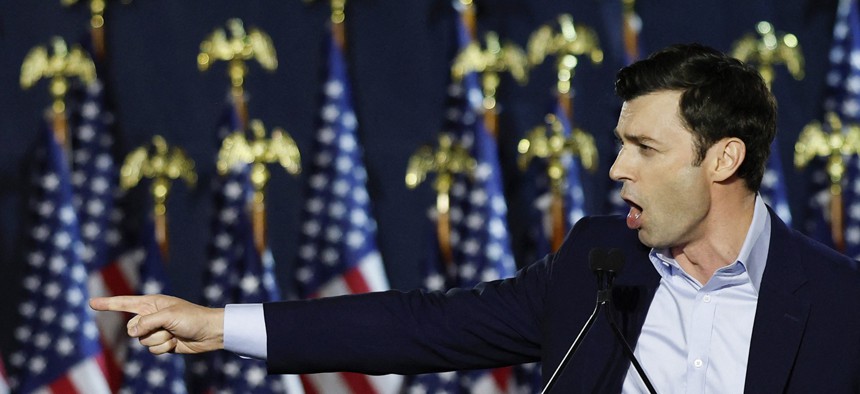
US Senator Jon Ossoff, Democrat from Georgia, speaks during an election night party after winning reelection in the US midterm elections in Atlanta, Georgia on November 3, 2026. Ossoff used his victory speech to call out “the titans of Silicon Valley [that] dig bunkers for themselves and warn that the artificial intelligence they’re creating risks human extinction.” Erik S. Lesser / AFP via Getty Images





A newly blue Congress is expected to conduct oversight on myriad tech, cyber and surveillance issues, ranging from FITARA, to workforce cuts, to data centers and more.
Major Democratic wins in the House and Senate on Tuesday are expected to shape how lawmakers will approach leading technology issues in the coming Congress.
Below, Nextgov/FCW and Route Fifty reporters break down the significant wins and what could be expected from Democrats in the coming year.
Notable wins and losses
Incumbent Republican Rep. Mike Lawler conceded to Cait Conley, a Democrat and former counterterrorism official running in New York’s 17th congressional district, according to The New York Times, though the Associated Press had not called the race as of Wednesday morning. Conley is a veteran who served as the director for counterterrorism on the National Security Council and an election security advisor at the Cybersecurity and Infrastructure Security Agency.
In an interview with Nextgov/FCW this summer, Conley expressed interest in a seat on the House Energy and Commerce Committee, which has jurisdiction over energy, telecommunications, technology and large portions of the nation’s critical infrastructure.
Rep. Kathy Castor, a key Democrat on the House Energy and Commerce Committee, won re-election in a redrawn competitive Florida seat, according to the Associated Press. She co-sponsored the Ratepayer Protection Act, bipartisan legislation meant to protect residents from higher energy costs that data center construction could drive. The bill passed the House in September and faces an unclear future in the Senate.
Not all former feds saw success Tuesday. Michael Masuda, a former engineer who worked in the State Department and the Democrat running in California’s 5th congressional district, lost his race against incumbent Republican Rep. Tom McClintock, according to the Associated Press.
Kristin Hook, a Democrat running in Texas’ 21st congressional district who formerly worked at the National Institutes of Health and the Government Accountability Office, lost her race against Republican Mark Teixeira, according to the Associated Press.
And Charles Borges, a Democrat running for a Maryland State Senate seat, lost his race against incumbent Jack Bailey, according to The New York Times. Borges is a former Social Security Administration chief data officer who filed a whistleblower complaint alleging a Department of Government Efficiency staffer copied Social Security numbers to a private cloud environment.
Cybersecurity, national intelligence and surveillance
Democrats’ midterm win in the House puts lawmakers who have questioned cuts to the federal cyber workforce and the Trump administration’s handling of U.S. spy agencies in a position to investigate both.
More broadly, with Democrats taking the Senate, they would gain a say in which of President Donald Trump’s picks to lead defense, intelligence and homeland security agencies get confirmed. While top cabinet nominees are filled for now, several dozen lower-level positions are still vacant, per data from The Washington Post and Partnership for Public Service.
Immigration and Customs Enforcement, the DHS agency that became the tip of the spear under Trump’s maximal deportation agenda and has received widespread backlash for a series of lethal incidents, will also receive significant oversight.
The second Trump administration has expanded ICE operations through AI-driven surveillance tools and private data brokers to track and profile individuals, prompting major concerns from lawmakers and civil liberties groups over misidentifications and digital tracking.
“We will investigate the administration weaponizing DHS against Americans, its out of control immigration policies, and its blatantly corrupt self-dealing,” said Rep. Bennie Thompson, who is poised to be the chairman of the House Homeland Security Committee next year.
Rep. Jim Himes, D-Conn., the top Democrat on the House Intelligence Committee, won reelection Tuesday and has already put one group on notice. In September, he warned intelligence contractors that lawmakers were likely to investigate donations to Trump’s White House ballroom. Himes wants to know who solicited the money and whether companies believed a contribution would help them secure a government contract or gain access to senior officials.
Sen. Mark Warner, D-Va., who was also reelected, will chair the Senate Intelligence Committee and may lead various oversight missions. He has proposed changing who can serve as acting director of national intelligence, arguing that the White House should not be able to install a political appointee over experienced officials the Senate has already confirmed.
Both Himes, Warner and other Democrats who sit on their respective intelligence panels have expressed concerns about politicization of intelligence findings, which especially became a flashpoint after the Iran war started in late February.
A possible FITARA comeback
With Democrats regaining the majority in the House Committee on Oversight and Government reform, the scorecard established under the Federal Information Technology Acquisition Reform Act to grade the 24 largest federal agencies on their progress in modernizing IT may see a revival.
The House Oversight Committee traditionally held semiannual hearings to review the grades, compiled in collaboration with the Government Accountability Office.
However, the scorecard was discontinued in 2023 after Republicans took control of the committee. The late Rep. Gerry Connolly, D-Va., FITARA’s author and then-ranking member of the committee, continued issuing his own scorecards and hosted roundtable discussions to review the results with agency chief information officers.
The last scorecard was released by Connolly in September 2024. Connolly died in May 2025.
Rep. James Walkinshaw, D-Va., who succeeded Connolly and previously spent over a decade working as his chief of staff, told Nextgov/FCW in June that the scorecard would likely resume if Democrats regained control of the House.
Walkinshaw also said Congress should modernize the grading scale to account for advances in artificial intelligence and cybersecurity threats.
“The question is obviously, ‘how do you develop those metrics in a way that’s objective?’ But I think that scorecard proved to be over time a good forcing mechanism to nudge agencies to modernize,” Walkinshaw said.
Walkinshaw won reelection in Virginia’s 11th District race on Tuesday.
AI companies face a new political landscape
The 2026 midterms marked a new milestone in the technology industry’s efforts to combat election misinformation, with major AI companies establishing dedicated “war rooms” to monitor their platforms for misuse.
OpenAI and Anthropic were among the companies preparing for potential AI-driven election interference, reflecting growing concerns about how generative AI could be used to spread misinformation and confuse voters.
The election also offered a test of whether artificial intelligence is becoming a more prominent political issue. AI policy has become a point of contention between lawmakers and technology companies, particularly as communities raise concerns about data center construction, electricity costs and the technology’s potential impact on jobs.
Several congressional races featured candidates who made AI regulation a central part of their platforms.
Democrat Abdul El-Sayed won the Senate race in Michigan and has called for a new Cabinet-level agency to oversee AI development and for a pause in AI frontier development.
In California’s 11th Congressional District, Democrat Scott Wiener similarly proposed the creation of a federal regulatory body to oversee AI safety and security. As of publication, Wiener’s race has not yet been called, but he is leading in current numbers.
Democrat Manny Rutinel, the congressman-elect in Colorado’s 8th District, campaigned on requiring independent safety reviews before major AI model releases.
According to polling released Tuesday from The Alliance for Secure AI and YouGov, 81% of voters said they support candidates who favor AI safeguards.
“AI has quickly become a top issue in this election, and will only become more salient as we approach the 2028 presidential election,” Alliance CEO Brendan Steinhauser said in a statement. “From here on out, every candidate from both parties will need to be an AI safety candidate if they want to win in 2028.”
According to an NBC News exit poll, 56% of voters said artificial intelligence and data centers were a “crucial or major factor” in their vote for Congress, and 44% said they were “a minor factor or not a factor” in their vote.
After the results poured in on Tuesday evening, Democrats pledged to focus on AI when they take over the majority in January.
Congressional Progressive Caucus Chair Greg Casar, D-Texas, called for Democrats to make taking on AI a top priority. Casar said the results are “the early tremor of a much bigger AI earthquake upending American politics.”
In his victory speech on Tuesday, Sen. Jon Ossoff, D-Ga., said “the titans of Silicon Valley dig bunkers for themselves and warn that the artificial intelligence they’re creating risks human extinction.”
Sen. Ed Markey, D-Mass., said Big Tech executives will “need to plant new forests for all of the subpoenas we’ll be printing,” in a post on X.
“For all the unknowns we may face in our future, Americans made it clear tonight that the era of Trump’s unchecked corruption is officially over,” said Geordan Neinstein, co-founder of the “New. Digital. Now.” PAC and a former manager at the Democratic Legislative Campaign Committee.
“I look forward to more transparency when CEOs testify in front of a Democratic Congress,” he added when asked about expected oversight of technology and AI topics.
Other federal policy shifts
Though votes are still being counted, the next Congress will likely face pressure to deliver on affordability and hold the Trump administration accountable, Amanda Renteria, CEO of civic tech nonprofit Code for America, told Nextgov/FCW.
She expects that means Congress will weigh solutions — such as clearer guidance and longer timelines — that would help states implement the One Big Beautiful Bill Act’s Medicaid and SNAP changes, noting that state officials will face pressure to implement quickly redesigned IT systems for Medicaid, SNAP and other programs. She also expects Congress to develop artificial intelligence policy and hopes it will revisit bipartisan policies such as the Earned Income Tax Credit.
Democrats will likely scrutinize defense spending growth, reorienting technology funding and procurement priorities, advisory firm Clark Street Associates wrote in a blog post.
For example, Democrats may push for increased funding for energy research programs, including the Advanced Research Projects Agency–Energy, or ARPA-E. But other technology priorities, such as domestic refining and processing of critical minerals and reducing supply chain dependency on China, will likely remain bipartisan, the post said.
“Overall, the election changes the political map more than it changes the underlying defense technology requirements,” VJ Sahi, senior managing partner at Clark Street Associates, told Nextgov/FCW.
With Democrats soon taking over Congress, they have less of an incentive to work on appropriations bills with Republicans during the forthcoming lame duck session, Sahi added.
Voters reject data centers in local ballot initiatives
It was a bad election night for data centers, as opponents of their development were successful in virtually all 40 ballot measures across 10 states, according to preliminary results.
Voters in localities of various sizes in the Midwest, South, East and West largely voted to reject data centers being built in their jurisdictions, although some of those votes are advisory and therefore not binding on local elected officials.
Ohio communities saw the most ballot initiatives on data centers, mirroring a state level effort to vote on a constitutional amendment banning new data center construction, which could be on the ballot next year. Almost 20 towns, cities and counties in the state held votes on data centers, with some asking voters if they should ban the construction of the centers writ large, while others were asked about amending their zoning laws to allow them. In every race, data center opponents appear to have been victorious.
Data centers also suffered defeats in localities in California, Illinois, Kansas, Maine and New Jersey. More votes are expected next month in Arkansas and North Dakota.
“Voters across the country have emphatically rejected the push for AI data centers. In state after state and race after race, Big Tech has failed to deliver — and everyday Americans have won,” said Mitch Jones, deputy director of Food & Water Action, a nonprofit that pushes for clean water and food.
“Not only in Washington, but in state capitols and village halls across the country, newly elected leaders are poised to stand up to the unregulated, reckless buildout of hyperscale data centers wherever they are proposed,” added Jones.
So far, the only city where data centers have prevailed in the vote last night appears to be Harwood, North Dakota, where the secretary of state’s office said 75% of the 430 people that voted rejected an amendment to the city charter that would have required an independent review and public hearing before adopting large industrial projects, including data centers. That would have applied to future projects, not the controversial Applied Digital campus that has already been approved.