
Cait Conley fears Trump’s cartel focus could create a national security blind spot
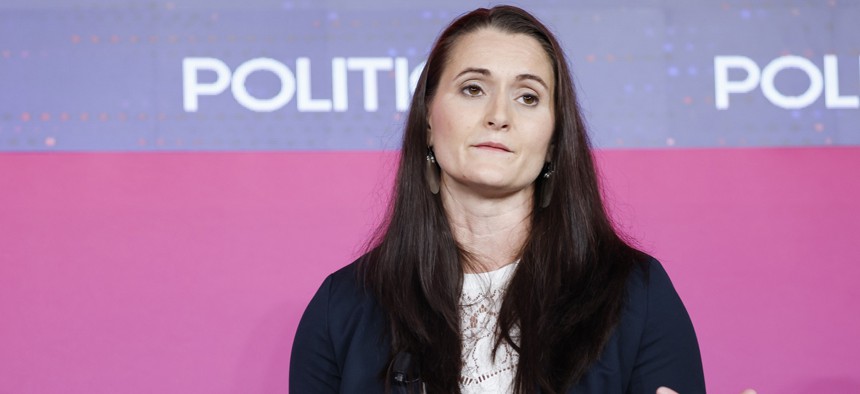
Then-Senior Advisor to the Director of the Cybersecurity and Infrastructure Security Agency Cait Conley speaks to during Politico's annual AI and Tech Summit on September 17, 2024. Anna Moneymaker/Getty Images




The NY-17 Democratic nominee questioned the administration’s planning for Iran and said she would seek a seat on the House Energy and Commerce Committee, if elected.
Democratic congressional candidate for New York’s 17th district Cait Conley fears the Trump administration’s focus on cartels and fentanyl is coming at the expense of U.S. preparedness for threats from China and Russia — a trade-off she likened to Washington’s overinvestment in counterterrorism after the Sept. 11 terrorist attacks.
“I think we learned this a decade ago, coming out of the counterterrorism fight,” Conley said in an interview discussing how she’d bring her national security policy and military experience to a congressional seat.
A West Point graduate and Army officer who later worked at the National Security Council and the Cybersecurity and Infrastructure Security Agency, Conley is challenging Rep. Mike Lawler, R-N.Y., in the coming general election.
Conley said the federal government spent years rebuilding its ability to compete with major state adversaries after concentrating much of its national security resources on terrorist organizations. She contends that the Trump administration’s focus on cartels and other threats in the Western Hemisphere risks reversing some of that progress.
“I don’t want illegal drugs coming into America, but I also don’t want to cede key national security interests to China and Russia,” Conley said. “And so we have to find a way to do it all. That is the government’s job in keeping America safe.”
“My concern is: what we have seen from this administration is a cozying up to [Vladimir] Putin [and] a willingness to sacrifice national security priorities in order to line pockets of billionaire buddies with China,” she added. “And — in terms of the federal government workforce — a dismantling of the entities that were there to protect this country against foreign malign influence operations, something that we see Russia [and] China use as the tip of the spear in many of their campaigns against America.”
She was referring to last year’s disbandment of the FBI’s Foreign Influence Task Force and the Office of Director of National Intelligence’s drawdown of its Foreign Malign Influence Center. CISA also froze much of its election security work and ended funding for programs supporting state and local election officials.
On Thursday night, President Donald Trump is widely expected to unveil previously classified findings that allies claim would prove the 2020 election was stolen from him, specifically regarding Chinese attempts to meddle in the election. In 2021, the U.S. intelligence community collectively assessed that Beijing “did not interfere with election infrastructure, including vote tabulation or the transmission of election results.” The IC also said that China “did not deploy interference efforts and considered, but did not deploy influence efforts intended to change the outcome” of the election.
Conley expressed concern that political pressure is shaping national security and intelligence assessments. Last year, then-Director of National Intelligence Tulsi Gabbard fired two top National Intelligence Council officials weeks after the group authored an assessment that contradicted Trump’s claims about Venezuelan gang members.
“I do worry about the integrity of the products that are being pushed out,” she said, “not because I worry about the integrity of the public servants doing it, but because we’re seeing a growing political influence on what those things are.”
She pointed to the conflict with Iran and the disruption of commercial traffic through the Strait of Hormuz as an example of a risk that national security planners had anticipated well before the current fighting.
“Any professional in this space who’s looked at Iran, or has been part of these war games or policy discussions … would tell you that this potential outcome was always known,” she said.
Conley said the danger that Iran could disrupt the strait, withstand an extended air campaign and inflict significant casualties had informed U.S. policy discussions for years. She acknowledged that she had no direct knowledge of the administration’s internal deliberations but questioned whether those risks were fully presented to Trump or disregarded.
Tensions in the strait have impacted gas prices across the country, including in New York.
“I don’t know if they failed to tell him the hard truths, or if this administration just didn’t want to hear it,” she said.
Lawler has voted against multiple House war powers resolutions that sought to limit the administration’s ability to continue hostilities without congressional authorization. He has argued that such measures could constrain the U.S. while American forces remain under threat.
Conley’s policy interests extend beyond congressional committees associated with homeland security, intelligence and foreign affairs. If elected, she said she would seek a seat on the House Energy and Commerce Committee.
“I would like to eventually end up on Energy and Commerce,” she said. The panel has jurisdiction over energy, telecommunications, technology and large portions of the nation’s critical infrastructure. Conley said that portfolio increasingly overlaps with national security as cyberattacks, supply-chain vulnerabilities and foreign-made technology create risks beyond the traditional defense establishment.
“National security in the 21st century is so different than the 20th,” she said.
Conley pointed to the country’s reliance on Chinese-made equipment at U.S. ports as one example. Federal officials have spent years examining cybersecurity risks associated with foreign-made cranes and other port systems.
“I don’t believe we need to pay extra to manufacture a basic drinking glass in America,” Conley said, “but I think if it’s necessary to manufacture our critical infrastructure, we should.”
A position on Energy and Commerce would also give Conley a role in debates over artificial intelligence and large data centers, including their effects on electricity rates, water supplies and local infrastructure. It would relatedly help her focus on legislation geared toward utility costs, an area that she says has been a major issue for constituents.
New York Gov. Kathy Hochul recently ordered a temporary pause on certain state environmental permits for new large data centers while her administration develops a regulatory framework.
Conley said policymakers need to assess those facilities’ effects before residents are left to absorb higher utility and infrastructure costs. She framed the issue as an opportunity for Democrats to become “the party of responsible technology” — supporting innovation while establishing standards intended to protect communities.
“Communities are bearing the costs of these decisions without guardrails,” Conley said, “and we’ve got to stop it.”
Her concerns about political influence extend beyond the quality of individual intelligence assessments. Asked how she understands Trump’s tendency to rely on his own instincts in national security matters, Conley’s answer centered less on his psychology than on the officials and institutions around him.
“I also hold a Republican-controlled Congress accountable too for not checking him,” she said, arguing that the GOP “should have reined him in and forced better judgment in execution and decision-making.”
That dynamic, in her view, reflects a broader incentive problem in Washington: elected officials focused on retaining power and senior administration officials unwilling to deliver unwelcome advice. Conley said her work at the White House and CISA gave her a close look at “the people that were there for the right reasons, and the people that were there for the power.”
She tied that argument to her support for congressional term limits and a ban on members of Congress participating in stock trading. Conley has not settled on a specific term-limit structure but said congressional service should not become a lifelong career.
She argues that addressing Trump’s approach requires more than just installing different experts or producing better intelligence; it demands electing officials willing to act, regardless of the political cost.
“At West Point, there’s a cadet prayer, and one of the lines is having the strength to choose the harder right over the easier wrong,” Conley said. “I believe that same ethos is something that members of Congress should always aspire to.”