
NIST director nominee commits to support AI standards-setting, manufacturing
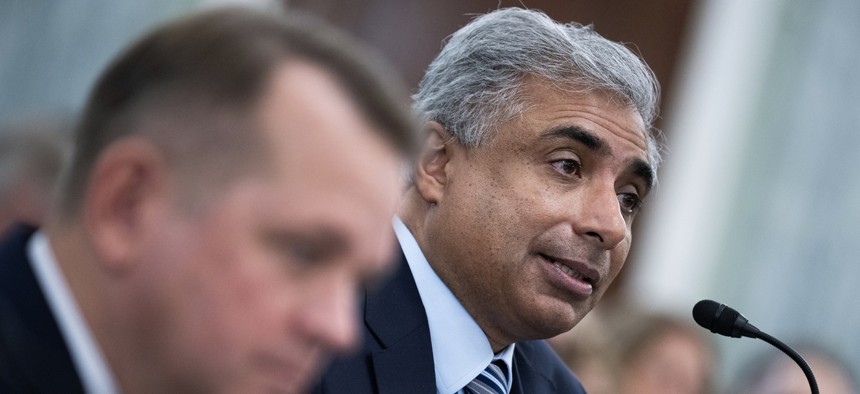
Arvind Raman, right, nominee to be director of the National Institute of Standards and Technology, testifies during a Senate Commerce, Science and Transportation Committee confirmation hearing in Russell building on Thursday, March 5, 2026. Tom Williams/CQ-Roll Call, Inc via Getty Images



Arvind Raman told lawmakers that it is “vitally important” that the U.S. lead in global standards-setting so that the country’s values are entrenched in AI development.
The nominee to lead the National Institute of Standards and Technology, Purdue University Professor Arvind Raman, told lawmakers at a Senate Commerce, Science and Transportation Committee hearing on Thursday that he is committed to advancing the agency’s metrology development for artificial intelligence technologies.
In committing to furthering the U.S.’s leadership in AI, Raman said he prioritized situating American AI policy and metrics as the leading global standard, a position NIST officials also emphasized during the Biden administration.
“When America leads in setting global tech standards, it means that the rules — international rules of commerce — are literally being based on American values: free markets, private sector, innovation, privacy, freedom of speech,” Raman said. “When we leave a vacuum for that leadership that allows for other standards that are not based on these values, they're based on state-based ideas… so it's vitally important, from a values point of view, that America leads in standard setting, in advanced technologies.”
Raman underscored the economic imperative of having the U.S. be the leader in AI standards setting, highlighting interoperability and compliance benefits in addition to supporting democratic values in emerging tech systems.
During an exchange with Sen. Maria Cantwell, D-Wash. — the panel's ranking member — Raman further said he would “proudly play” the role of uniting industry and government in crafting a common standard for AI technologies to accelerate their development and deployment.
Raman added that, as the head of NIST, he would also prioritize supporting advanced semiconductor chip manufacturing, furthering the Trump administration’s AI Action Plan, funding the Manufacturing Extension Partnership program and ensuring NIST oversight programs are operational and transparent.
“I'm fully committed to this administration's priorities to re-industrialize America, bringing manufacturing back,” he said.
Sen. Ed Markey, D-Mass., questioned whether Raman would support NIST testing programs that evaluate the performance of facial recognition systems, such as those used by federal agencies like Immigration and Customs Enforcement, as well as his stance on the ongoing conflict between Anthropic and the Pentagon.
Raman said he was “not in a position” to weigh in on the Anthropic-Pentagon situation and said he would support directives stipulated in the AI Action Plan.
Sen. Ted Cruz, R-Texas — who chairs the committee — also pressed Raman as to whether he would maintain NIST as a nonregulatory and unbiased agency, speaking to the Trump administration’s stance against “woke AI” perspectives infecting policy.
Raman affirmed that he would reorient NIST "to its apolitical mission and [ensure] that it does not serve as an engine for divisive left wing ideology under the guise of ‘safety.’”
The agency has played a major role in aiding the development of AI policy and best practices, releasing an AI Risk Management Framework, cybersecurity guidelines to protect networks from AI-powered attacks, and a lexicon for AI industry terms.
Under the second Trump administration, NIST’s AI projects have seen changes. The agency’s former AI Safety Institute was rebranded as the Center for AI Standards and Innovation, a change that Commerce Secretary Howard Lutnick said reflected the new focus on light-touch regulations when innovating in AI.