
Oracle defends VA’s EHR system costs as lawmakers question latest $17B increase
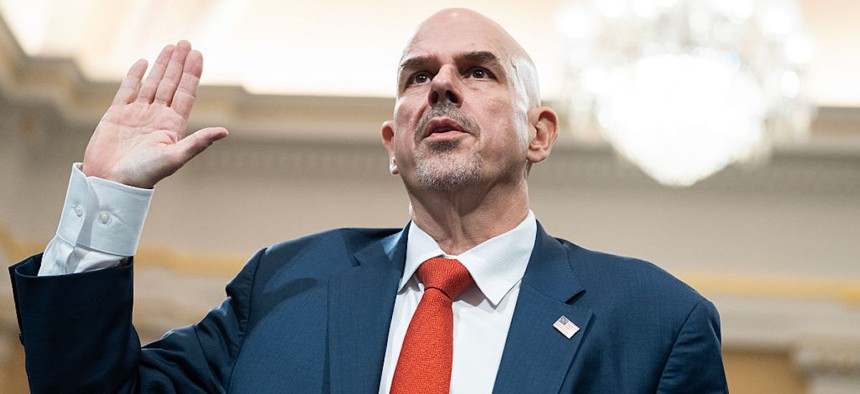
Mike Sicilia, CEO of the Oracle, is sworn in to the House Veterans' Affairs Committee hearing titled "Beyond Go-Live: VA Electronic Health Record Modernization Status Update," in Cannon House Office Building on Thursday, November 19, 2026. Tom Williams/CQ-Roll Call, Inc via Getty Images




 By
Grace Dille
Mike Sicilia, Oracle co-CEO, said the company has absorbed costs to improve the system, but lawmakers remain skeptical that the latest contract increase will be the last.
Oracle co-CEO Mike Sicilia defended the company’s handling of the Department of Veterans Affairs’ Electronic Health Record Modernization program during two congressional hearings this week, explaining that the project’s expanded scope and a two-year deployment pause have driven up costs.
However, lawmakers on both sides of the aisle continued to question whether VA’s latest $17 billion contract increase will be enough to complete the long-troubled modernization effort.
Sicilia, who appeared before the Senate Veterans’ Affairs Committee on Wednesday and the House Veterans’ Affairs Committee on Thursday, maintained that Oracle has followed through on a 2022 promise to absorb costs associated with fixing problems with the system.
“I did promise that Oracle would absorb costs, commit to improving the system,” Sicilia told lawmakers. “I believe Oracle's kept that commitment by stabilizing the system, moving to our cloud at our expense, improving system performance and workflows and making many other no-cost commitments.”
“The sheer amount of scope increases and the two-year pause could not be anticipated when I made that statement,” he added.
Sicilia said the reset of the program, which VA announced in 2023, resulted in a large expansion of the program scope.
The original system was designed to support 85,000 concurrent users, Sicilia said, but that number has since grown to 195,000. He added that the number of interfaces needed for the EHR has also increased from 57 to 165.
“The program is very different than it was in 2018,” Sicilia said, adding that Oracle has not raised its unit prices and is not trying to “gouge the government.”
“I’m not here to milk the taxpayers or the veterans for $17 billion,” he said. “We’re here to deliver for the veterans. If there are better ideas, if people have other cost approaches, I’m absolutely willing to listen to that.”
VA first contracted with Cerner in 2018 to upgrade its electronic health record system under a 10-year, $10 billion contract. Oracle subsequently acquired Cerner in 2022 and rebranded the combined unit as Oracle Health.
Ongoing issues ultimately led to VA and Oracle renegotiating their contract in May 2023, with the deal being modified from an additional five-year term to five one-year terms.
The latest modified agreement, which places the contract value at roughly $27 billion, can cover work through May 2031.
Last September, VA provided a revised estimate for the costs to implement and operate the system by the end of 2031 that totaled roughly $37 billion.
Lawmakers remain unconvinced of new cost estimate
The program’s contract ceiling increase from roughly $10 billion to $27 billion has drawn scrutiny from lawmakers.
The hearings this week came after the House VA panel vote in September to subpoena Sicilia and Oracle Chairman and Co-founder Larry Ellison to testify about the program’s ballooning costs and status. The committee voted unanimously, 19-0, to authorize the subpoenas after Oracle declined an earlier invitation to send a representative to testify.
“I find myself really no more confident in this program, and I’m certainly not seeing a justification for the $17 billion increase in its cost,” Rep. Mark Takano, D-Calif., the top Democrat on the House VA Committee, said during his closing remarks on Thursday.
Rep. Derrick Van Orden, R-Wis., went further, saying, “This contract needs to be severed immediately.”
“You’ve historically underperformed on this, and it’s unacceptable,” he added. “You’re going to be back here in six months asking for more money.”
During Wednesday’s Senate hearing, Sen. Thom Tillis, R-N.C., also expressed skepticism that the current cost estimate would be VA’s last.
“This is an execution fail. It’s not a platform fail,” Tillis said, adding, “Until you change the methodology, I could fully bet, I could create a Kalshi bet that you'll be back for more money beyond the $37 billion, and I’d put a lot of money on it.”
Dr. Neil Evans — acting program executive director of VA’s Electronic Health Record Modernization Integration Office — argued that VA is in a better position now to estimate future costs.
“It becomes much easier to project what the long-term costs are when you have a clear understanding, when you have a stable product that has been built and that you’re now rolling it out directly,” Evans said on Wednesday.
However, Carol Harris, a director of IT and cybersecurity at the Government Accountability Office, told lawmakers that VA still has not produced a comprehensive lifecycle cost estimate for the program.
She also questioned Sicilia’s promise that there would be no additional costs as the system continues to be deployed.
“On paper that sounds real good, but in execution … what we have seen is there’s still very poor user satisfaction of the system itself,” Harris said. “There are still changes that will be needed.”