
How Broadcom’s VMware buy meant a ‘fundamental shift’ for county tech
JHVEPhoto via Getty Images

 By
Chris Teale
By
Chris Teale
Leaders said the 2023 acquisition has led to negative changes in licenses, pricing and support, with many now considering moving away from the longtime vendor.
A major technology infrastructure provider is creating huge headaches for county governments, leaders have said, and they are blaming a recent acquisition for those issues.
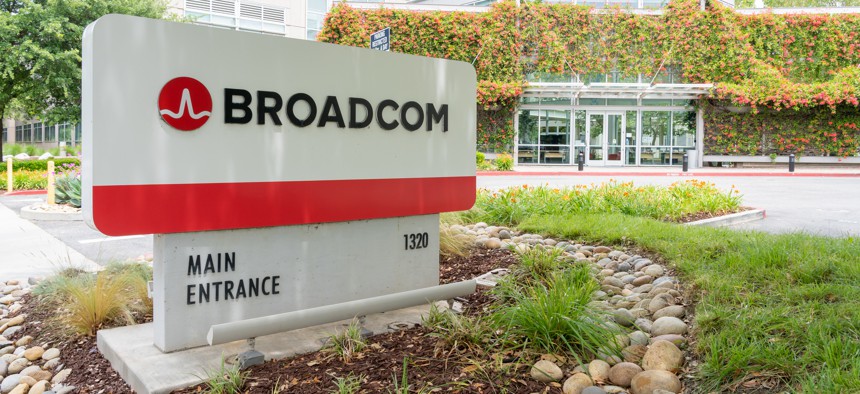
Broadcom bought VMware in November 2023. Multiple county technology leaders, as well as experts and observers in the private sector, told Route Fifty that, in the years since, it has set off a scramble as the company has changed licensing requirements, reduced support and raised prices. Route Fifty is owned by Nextgov/FCW's parent company, GovExec.
The changes have made for difficult decisions for cash-strapped local governments, who must choose to absorb the price hikes, take on additional products under new licenses that they may not need or otherwise shift to a new technology provider altogether. And it shows no signs of slowing down.
“The challenge goes far beyond a slight increase in renewal costs; it’s a fundamental shift in how Broadcom is managing the product roadmap and the client relationship,” one county tech leader told Route Fifty in an email on condition of anonymity to not jeopardize vendor relationships.
“Across the market, public and private alike, the Broadcom acquisition of VMware created a real shockwave,” Olivier Lambert, CEO and co-founder of open-source software company Vates, said in an email.
An Acquisition of Governments’ "Plumbing"
Broadcom began life as a division of Hewlett-Packard, known as HP Associates, in 1961. It focused mostly on semiconductor products then, and has since expanded to a wide variety of products and solutions that includes networking and wireless device connectivity, servers and storage systems and infrastructure software, as well as data centers, mainframes and the cloud.
While the company does not disclose its customers publicly, it is a strong partner of the federal government and earlier this year signed an agreement with the General Services Administration under its OneGov strategy to provide agencies with discounted access to various software products.
The company is similarly embedded in state and local governments’ technology infrastructure. A high-level official at a technology reseller, integrator and deployer, who spoke on condition of anonymity to avoid jeopardizing existing business relationships, said its involvement is as important and longstanding as “plumbing” for many governments.
Similarly, VMware’s products have become heavily embedded in government agencies’ tech stacks, especially at the state and local level. The company offers various cloud computing and virtualization services, and it plays a crucial role for government agencies still reliant on a data center. VMware also offers services like application modernization, cloud management and a zero-trust cybersecurity framework.
At one stage, the technology reseller official estimated, VMware was in use by up to 90% of state and local governments in some form.
Naveen Chhabra, principal analyst for infrastructure, private cloud and infrastructure automation at research and advisory firm Forrester, said in an interview the company’s market penetration was, “in the best of its times” over 80% across all sectors, private and public.
“Over the past two decades, VMware became the default layer running critical workloads, everything from permitting systems to public safety applications and education services,” Lambert said. “Because of that, it’s rarely just a matter of swapping one piece of software for another. Virtualization platforms are connected to backup systems, monitoring tools, automation pipelines, identity services, and disaster recovery processes. Many agencies also built internal expertise and operational procedures around VMware’s ecosystem.”
Broadcom bought VMware in a cash and stock transaction valued at $69 billion, and closed on the deal in November 2023. At the time, Broadcom President and CEO Hock Tan said in a statement the acquisition represented “another important step forward in building the world's leading infrastructure technology company.” County leaders already were curious about the impact of the acquisition on the services they received.
“The questions are always going to arise about, what is that impact going to be?” a second county tech leader said on condition of anonymity to not jeopardize vendor relationships. “Many times, when we see some of these acquisitions, typically there's an integration of personnel, and then some staff get laid off, and customer service sometimes can become a question as well. It's our due diligence as chief information officers to raise those to the forefront and get in front of that to the extent possible.”
Licensing Changes
One major impact on state and local customers was seen almost immediately, and had wide-reaching ramifications as they considered their licensing agreements with VMware and its new parent company.
A month after the deal closed, Broadcom and VMware announced what they described at the time as an effort to “simplify its portfolio and transition from a perpetual to a subscription model.” That simplification, as the companies put it, meant that the VMware Cloud Foundation division portfolio would feature two primary options: VMware Cloud Foundation — or VCF — its flagship offering of hybrid cloud to allow customers to run their applications, and the new VMware vSphere Foundation — or VVF — a simpler offering for smaller and mid-sized customers.
At the time, VMware said its VCF offering’s subscription price would be reduced by half and include higher support levels. Broadcom spokespeople did not respond to repeated inquiries and a detailed list of questions for this article.
But based on conversations with government and industry leaders, the reality on the ground has not been so positive. The first county tech leader said their government relied on the VVF license, which they said, “fully meets our operational needs.” However, that tech official said it took three months just to get a quote on renewing the VVF license, and even then, the government was only granted a one-year renewal.
“This approach has led many of us local governments to speculate that Broadcom’s goal is to eventually kill off the VVF tier and force everyone into VCF, regardless of whether they need that level of complexity,” they said.
That tech leader noted that the VCF offering, in addition to being pricier, has many more features that their local government does not need, meaning that a forced transition would have them paying for superfluous services.
Analysts have previously noted that the trend of Broadcom and VMware focusing on their higher-spending VCF clients goes beyond local governments. In a blog post last year, Chhabra and several other Forrester analysts called it a “seemingly harsh but clearly stated strategy.”
“VMware, before acquisition, had 12 different product lines, each catering to different personas in the IT organization, from infrastructure, to operations, to security, to networking, to applications,” Chhabra said in the interview. “After Broadcom acquired VMware, Broadcom made two different schemes… One is a smaller bundle. The second is the bigger bundle. And Broadcom is trying to push everyone to the bigger bundle, because that costs more. Broadcom is very reluctant in selling a smaller bundle to customers.”
Prices Jump in “Ruthless” Strategy
Despite Broadcom and VMware’s promises, leaders inside and outside of government say prices have jumped dramatically in recent years, creating difficulties for localities that have limited budgets.
Lambert said the disappearance of various programs under the previous a la carte way of buying services has had a dramatic impact.
“Historically, many public institutions benefited from discounted pricing programs,” he said. “In several cases we’ve seen, those programs disappeared, leaving agencies facing renewal costs that were several times higher, sometimes approaching 10 times their previous spend.”
Chhabra said price increases were part of the post-acquisition strategy, in a bid to dramatically increase operating margins and net margins. It’s a strategy that has proven popular with investors as earnings have stayed strong, although Chhabra estimates that even now, the company is only hitting 40% to 50% profit margins, indicating there is more to come.
“I suspect they will be even more ruthless going forward,” he said.
That makes life extremely difficult for governments as they navigate uncertain financial times. Groups like the National Association of State Chief Information Officers have consistently warned of the pressures of managing budgets while trying to modernize or even just maintain their technology offerings.
“Public-sector organizations typically operate with fixed, pre-approved budgets,” Lambert said. “When an infrastructure platform suddenly becomes dramatically more expensive, agencies cannot simply absorb the increase. That forces them into rapid evaluation of alternatives, often under tight timelines and without having planned a migration strategy in advance.”
Given those price hikes, it may be tempting for governments to terminate contracts and licenses quickly in a bid to recoup some of their money. But the tech reseller official warned that is a “nuclear approach” that ends a government’s relationship with Broadcom broadly, not just with its VMware products. Leaders “don’t realize the implications” of severing the relationship, they said.
“It's specifically designed as a lock-in mechanism for large enterprises, which most state and local [governments] are not,” the tech reseller said. “But if you're talking about a consolidated state agency, they don't have a choice. They can't cancel that contract because they still have a mainframe, they still have this other piece of security software, they still have other Broadcom relationships in place. They don't realize the termination is complete separation between their company and Broadcom, not just canceling a line item on a quote.”
Customer Support Drop Off
Multiple government leaders also said they have seen a drop-off in the level of customer support they receive from Broadcom and VMware, especially as the companies have looked to outsource their support systems.
The first county leader said they have seen a “significant decline in the quality of support and general responsiveness from their team.”
Andy Turner, manager for infrastructure and cloud engineering at Chesterfield County, Virginia, said it is a far cry from when VMware was owned by Dell, which meant there was “one throat to choke” in dealing with vendors, support and other issues. Things got much worse after Broadcom bought VMware, he said.
“We weren't getting a response,” Turner said. “Now, we don't need a ton of support from them. But when we do, it's usually something critical, and we just weren't getting any response from them whatsoever. It was days before we would get responses from support.”
The technology reseller official accused Broadcom of discriminating against smaller customers by continuing to maintain good support for their larger enterprise customers.
Making it even more complex from a support standpoint is that much of VMware’s customer support is now outsourced, Chhabra said. That could mean talking to an outsourced employee who is unfamiliar with governments’ specific rules and regulations, which could make those public-sector customers wary.
“People want some security and privacy involved, so they would have less comfort talking to an outsourced agent, outsourced supplier, than talking to the vendor directly,” Chhabra said. “That's an implication for security-focused, security minded government agencies, not as much for the regular enterprises. But it certainly brings the question of support quality into the conversation.”
Migrating Not Just "Flipping a Switch"
The combination of all those issues has many governments looking to transition their tech infrastructure away from Broadcom and VMware, but in many instances, that isn’t an easy transition to make. The second county tech leader said governments “can't just flip a switch and move away from the infrastructure.”
“Over the past two decades, VMware became the default layer running critical workloads, everything from permitting systems to public safety applications and education services,” Lambert said. “Because of that, it’s rarely just a matter of swapping one piece of software for another. Virtualization platforms are connected to backup systems, monitoring tools, automation pipelines, identity services and disaster recovery processes.”
Staff also need reskilling, in many instances, as they are certified and trained in VMware products but may be unfamiliar with competing vendors. The second county tech leader said moving away from VMware requires a “completely different skill set.” While a lot of the knowledge is the same, “it's a completely different learning curve, different certifications.”
“I'm confident in our team's ability to adapt and implement an alternative solution,” Turner said. “The problem is, we've been using it for so long. The average tenure of my staff is probably around 10 years, probably more than that, and it’s years and years of institutional knowledge of VMware. The majority of the staff are certified for VMware; some of them have been using it for 15 years."
Migrating away from VMware can be challenging, especially for large IT organizations. And smaller organizations may have signed long-term contracts already with VMware in the hope of putting off any renewal issues for a few years.
“It requires a year or two, getting ahead of this,” the tech reseller official said. “My customers fall all along a range of proactivity. Some of them are 30-year government folks, where this is very challenging for them to take that step back and get aggressively proactive. Others are very progressive… It comes down to the customers getting ahead of it and getting proactive, because it's a significant change.”
The process of migration can be challenging, although Lambert said it’s “often less complex than many organizations initially assume,” especially for small enterprises that only have a few dozen virtual machines on VMware. Phased migrations are typically the best way to go, as agencies start with non-critical workloads to validate the new platform they are migrating to, then move their core systems once they are confident in what they are moving to.
Agencies still must consider a number of other factors, he said, including making sure that hardware is compatible to avoid replacing servers. Migration plans also should maintain operational continuity, to ensure that backup, disaster recovery and monitoring tools remain functional throughout the transition.
There is hope that migration is possible. The first county tech leader said their government is “actively executing plans” to move entirely away from Broadcom and VMware products. That effort is expected to be more or less completed this summer, and the leader said it will “ensure our long-term stability and cost-predictability.”
Overall, though, the uncertainty has created an environment, experts said, where governments are trying to break free of their current situations, but need to plan further ahead than they are used to if they are to be successful.
“People are fleeing where they can,” the tech reseller official said. “But they can only flee if they get ahead of it by a year or two.”