
EHR restart was ‘phenomenal’ despite persistent challenges at initial sites, VA secretary says
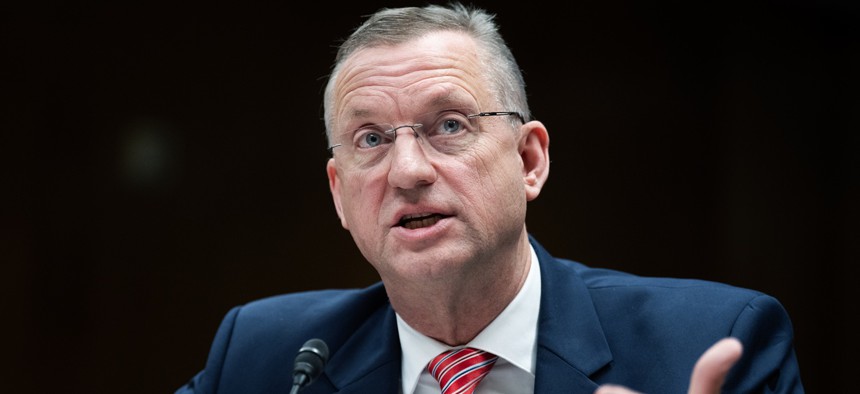
Veterans Affairs Secretary Doug Collins testifies during the Senate Appropriations Military Construction, Veterans Affairs, and Related Agencies Subcommittee hearing on the FY2027 budget request for the Department of Veterans Affairs, in Dirksen building on Thursday, April 30, 2026. Tom Williams/CQ-Roll Call, Inc via Getty Images




Veterans Affairs Secretary Doug Collins told lawmakers the department has rectified issues with its electronic health record modernization project moving forward and is “going to go back” and address problems at its initial deployment sites.
The head of the Department of Veterans Affairs told lawmakers this week that last month’s resumed rollout of its new electronic health record system occurred “flawlessly,” but said efforts are still needed to address problems at the medical facilities where VA first deployed the software prior to instituting an operational freeze.
In budget hearings before the Senate Veterans’ Affairs Committee on Wednesday and a House Appropriations subcommittee on Thursday, VA Secretary Doug Collins praised the restart of the department’s EHR modernization and called it “probably one of the best untold good news stories in federal government.”
Since VA signed a $10 billion contract with Cerner in May 2018 to modernize its EHR system — the department’s fourth attempt since 2001 to replace its legacy software — the effort has been slowed by cost overruns, patient safety concerns and technology issues. Cerner was acquired by Oracle in 2022 and rebranded as Oracle Health.
The initial Cerner contract was ultimately revised to over $16 billion, and a recent cost projection provided to Congress now estimates the project’s total price tag at around $37 billion.
VA paused most deployments of the new EHR system in April 2023 to address the software’s safety and usability challenges. The department subsequently conducted a joint rollout of the Oracle Health EHR system with the Pentagon in March 2024 at a healthcare site in North Chicago.
At the end of the Biden administration in December 2024, VA announced plans to restart rollouts at four Michigan-based medical sites in mid-2026. Collins has moved to scale up the number of go-lives since being sworn in last January, including adding an additional nine medical facilities to VA’s 2026 deployment schedule. The department says it will implement the EHR software at a total of 13 sites in 2026, with plans to roughly double the number of deployments in 2027.
Last month, VA exited its reset period and went live with the new EHR software at the four Michigan facilities. Collins said the department “had a phenomenal rollout” in the state and added that “my only problem I have right now in the VA is I have more centers wanting to go ahead and get ahead of the line than anything else, because it's actually working.”
Collins pointed to the ongoing need for interoperability between VA’s disparate medical sites — as well as with community care providers and the Defense Department — and said some of the initial challenges were due to the department ceding too much authority to the first rollout sites, which undermined efforts to streamline connectivity across the department’s healthcare system.
“We allowed one hospital to do it this way, we allowed another hospital to do it this way, we allowed another hospital to do it this way,” he said. “We gave them all independence, like the VA is famous for, but yet never discussed the fact that there were certain conditions in the original system software-wise that didn't work. And then when you tried to compound it with the individualization, if you would, it just didn't work at all.”
But even as Collins said new rollouts seem to show the modernization effort is back on track, he acknowledged that challenges remain at the medical facilities that received the modernized health record system prior to the April 2023 operational pause.
The new EHR software was first deployed at the Mann-Grandstaff VA Medical Center in Spokane, Washington in 2020, but the system inadvertently routed over 11,000 orders for clinical services to an “unknown queue” without alerting clinicians. A July 2022 report from VA's Office of Inspector General found that the software bug resulted in “multiple events of patient harm.” That was ultimately only one of the major problems caused by the new system.
Sen. Patty Murray, D-Wash., told Collins on Wednesday “I’m really glad to see that the most recent rollouts … seem to have gone better,” but said the initial EHR rollout in her state “was a disaster.” While VA and Oracle Health officials have since addressed the unknown queue issues, other technical and usability difficulties with the software at the early sites have continued.
Murray pressed Collins to speak with providers at Mann-Grandstaff “because we cannot ignore the fact that those original sites are still seeing problems and you need to be aware of that.”
“As you move forward with the 13 new ones, I want to make sure that the budget supports both deploying to those new sites and making sure that the old ones that have been out there are improving,” she said, calling for a “detailed plan” from the department on how it plans to address these ongoing issues.
Collins reiterated his takeaway that the initial six sites where the new EHR software was deployed “were allowed to act as if they were independent, not connected and [to] do whatever they wanted to do, and you had subsystem software problems,” but said “we’ve fixed that issue moving forward and we’re going to go back and fix those as well.”
During Thursday’s House hearing, Collins was clear to draw a distinction between the initial rollout challenges and the deployment restart.
“We can talk all day long about the problems of Washington state, but you can't compare them to anything that we're doing now,” he said. “They're just two separate conversations, and Michigan has come off flawlessly.”
Although the full House overwhelmingly passed the VA FY27 funding bill on May 15, lawmakers on the House Appropriations VA subcommittee said they still wanted to hold the hearing because they had not met with Collins prior to the bill’s passage.
The administration’s FY27 budget proposal requested $4.2 billion for EHR rollouts, although the measure that passed the House last week allocated $3.4 billion for the modernization program.