
The new FBI: Better technology to meet the mission
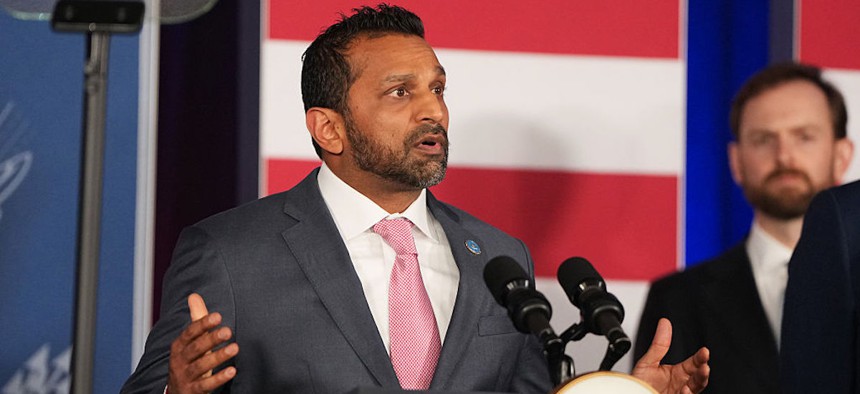
FBI director Kash Patel speaks during a press conference in St. Cloud, Minn. on Friday, Oct. 30, 2026. U.S. Secretary of the Treasury Scott Bessent, along with FBI Director Kash Patel, Centers for Medicare & Medicaid Services Administrator Dr. Mehmet Oz, and Federal Trade Commission Chairman Andrew Ferguson held a press conference to make an announcement regarding fraud. Leila Navidi/The Minnesota Star Tribune/Getty Images




COMMENTARY | FBI Director Kash Patel outlines how the Bureau has upgraded its technology capabilities.
Of this FBI’s many historic successes over the last 21 months of the Trump Administration, perhaps our most consequential has been our complete overhaul in technology capabilities. For too long, outdated technology and bureaucratic processes slowed the Bureau's ability to deliver results. Those days are over.
Through adoption of Digital Automation Solutions and Superintelligence — which this FBI has increased by 605% — across the Bureau, we are on a course to save nearly 640,000 labor hours, the equivalent of about 79,000 workdays.
Our SI program began by listening to the people doing the work. Through our SI Champions Program and Task Force, we started collecting success stories from across the field, and early results have been tremendous. In the past 90 days alone, users of our programs report saving an estimated 829 hours, about 104 workdays, by automating transcription, accelerating translation, reducing data triage and streamlining jail call review. If that pace holds, every year these use cases alone will return more than 3,300 hours, or over 413 workdays.
These are much bigger than numbers — they are cases that matter to the American people. For example, in San Antonio, during multiple investigations of human trafficking, drug trafficking, fraud and money laundering — one wiretap alone produced more than 1,900 sessions of poor-quality audio. SI transcription saved roughly 633 hours of manual work.
More importantly, in one specific case, the time saved allowed agents to move quickly enough to help rescue a trafficking victim and return the victim safely to their family. In another case out of Mobile, analysis of jail calls in threat cases used to take months. With SI transcription and summarization, processing time for non-priority calls fell from about ten minutes to about two — in this case, ultimately contributing to four arrests.
Our Digital Automation Solutions program uses software bots to handle repetitive, transaction-based computer tasks, freeing people for analytical work that requires human judgment. 29 offices across the Bureau have deployed automations.
As of October, we have fielded more than 121 of them, connected to dozens of existing FBI applications, saving over 635,000 labor hours. One specific automation helps our Human Resources Division enter benefits data for new employees, saving about 1,275 hours a year and giving new hires a more efficient transition.
Hippo Chat, the FBI’s new SI chatbot built directly into our systems, reduces administrative workload associated with file reviews and other evaluations. It synthesizes large quantities of documents, like large search warrant returns, into a readable format with the relevant information — reviewing thousands of photos at one time, organizing them into a spreadsheet for easy triage by cases agents and analysts and more.
We’ve also introduced Microsoft CoPilot Chat, our first enterprise AI assistant focused on the administrative side of the Bureau, and ‘AJae,’ our inaugural platform for analyzing case data across all violations and data types. These apps free up thousands of critical hours per year for our agents and intelligence analysts in the field. None of this would be possible without our private sector partners and their cutting-edge integration to advance our mission capabilities — marking the most wide-ranging and impactful partnerships for technology in Bureau history.
The FBI just launched our new elevated ‘Cyber Branch,’ bringing all cybersecurity operations at the FBI under one leadership chain — consolidating all offensive and defensive cyber operations, eliminating redundant work and technical risk and ensuring we are developing robust cyber capabilities for the entire FBI. We’re evolving how we do business to better meet the demands of the dynamic threat landscape and provide better resources for the agents, analysts and professional staff working hard in the field. This will greatly accelerate our work to ensure the FBI maintains the strongest cyber infrastructure in the world.
This FBI has also totally rebuilt our Headquarters’ operational command and control center, standing up the first ever ‘Director’s Strategic Information Group’ (DSIG) with a focus on real-time situational awareness, rapid validation and decision-quality products in fast-moving crises and sensitive operational matters. This produces a time-to-first executive product in 20 minutes, compared to the hours it took under the former ‘Strategic Information and Operations Center’ (SIOC) system.
This is the technology that has strongly contributed to the most prolific reduction in violent crime in American history: 71,650 violent crime arrests, a 114% increase compared to the final 21 months of the previous administration; 4,616 kilograms of deadly drugs seized, up 32%, including enough fentanyl to potentially kill more than 350 million Americans; 5,801 child victims identified or located, up 25%; 6,744 arrests tied to foreign terrorist organizations, an increase of 1,057%; ten fugitives from the FBI’s Ten Most Wanted Fugitives list arrested, including alleged murderers, rapists and other violent criminals — 2.5 times the number arrested during the previous four years combined — and so much more.
The principle is simple: Technology should serve the mission, allowing our people to better serve Americans. Every hour we return to our workforce is an hour for the work only they can do: crushing violent crime, defending the homeland, protecting victims and stopping threats before they reach our communities. Mission First.
Kash Patel is the Director of the Federal Bureau of Investigation.