
Lawmakers call for bipartisan approach to AI, quantum policy in next Congress
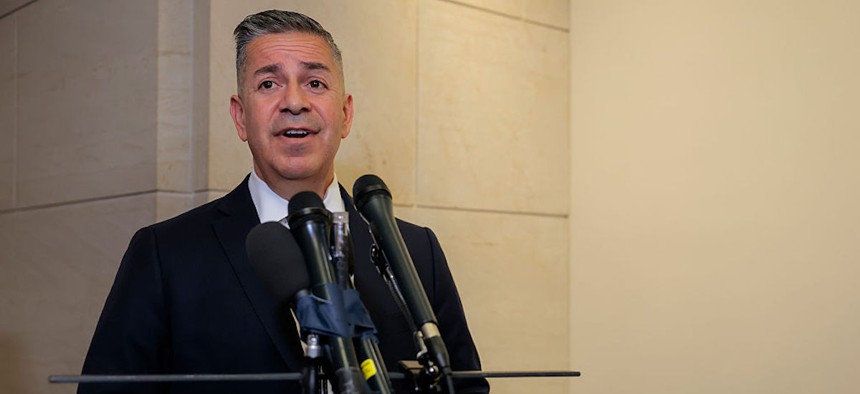
Sen. Ben Ray Lujan (D-NM) speaks with press at the U.S. Capitol ahead of a roundtable discussion on President Donald Trump's economy on February 26, 2026 in Washington, DC. Senate Minority Leader Chuck Schumer (D-NY) hosted a roundtable with organizations and advocates examining the rising cost of groceries and household essentials and the impacts on American farmers. Heather Diehl/Getty Images





Republican Rep. Pat Harrigan of North Carolina said he expects political headwinds for emerging technologies, while Democratic Sen. Ben Ray Luján of New Mexico urged Congress to work together to sustain U.S. leadership in quantum.
Rep. Pat Harrigan, R-N.C., and Sen. Ben Ray Luján, D-N.M., called for bipartisan cooperation to advance emerging technologies Tuesday, though they emphasized their differing priorities for maintaining U.S. leadership in artificial intelligence and quantum computing.
Speaking at the Special Competitive Studies Project’s AI+ Quantum Summit in Washington, D.C., the lawmakers both stressed the importance of getting tech policy right in the next Congress.
Harrigan advocated for a hands-off approach to emerging technologies, while acknowledging that political disagreements over the government's role could create significant challenges after elected officials are sworn in on Jan. 3.
“To be totally honest, I expect a lot of headwinds in the next Congress,” Harrigan said, adding that conservatives will likely be “playing defense next year.”
The Republican pointed to the election of moderate Democrats in both chambers as a potential opportunity for bipartisan cooperation, saying he hopes lawmakers can find common ground to keep government “hands off nascent and emerging technologies as much as possible.”
In a separate conversation at the event, Luján stressed that Congress must work together to advance quantum policy and ensure federal policies support scientific progress.
“Compromise is not a bad word,” he said. “We have to work together to find some commonality here as well.”
“Policy can get in the way,” Luján added. “Is policy going to support future scientific advancements and discoveries, or is policy going to get in the way?”
Luján’s remarks came as the Commission on U.S. Quantum Primacy, convened by the Special Competitive Studies Project, released a report Tuesday that identified sustained federal investment in foundational quantum research as a near-term priority. The commission is co-chaired by Luján and Sen. Todd Young, R-Ind.
Luján said upcoming federal funding decisions will help determine the country’s direction in quantum, noting that there will be another continuing resolution vote soon. The current continuing resolution funds the government through Dec. 11.
“Budgets are a reflection of our priorities, and in the United States, are we going to make substantial investments and lift up our national labs, the ecosystem around how we can strengthen and advance quantum in the United States, or not?” Luján said. “I really believe that that is going to determine what we will do here.”
Similarly, Harrigan said Washington needs to support the people and organizations building emerging technologies, including quantum and AI.
“Congress needs to do a better job of making sure our research investments translate into something useful, and that's going to take a commitment that lasts longer than anyone in Congress or this administration,” Harrigan said.
“We’ve got to give our national laboratories, our universities and private industry some consistency while holding ourselves accountable to the results,” he added. “I don’t think that this is something that ought to divide Republicans and Democrats.”