
IBM, Oak Ridge and Cleveland Clinic unveil quantum-powered novel fusion energy research
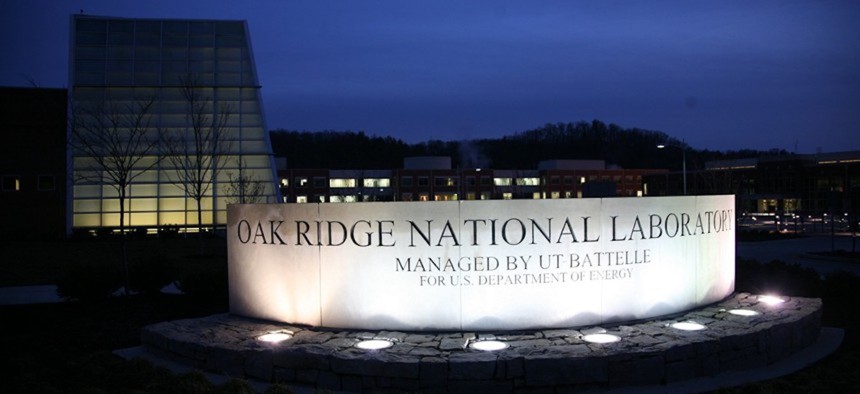
Oak Ridge National Lab



A joint effort from IBM, Oak Ridge National Laboratory and the Cleveland Clinic offers new perspectives into the near-term scientific applications for quantum computing systems.
IBM, Oak Ridge National Laboratory and the Cleveland Clinic on Monday unveiled the first known molecular simulation created with the help of quantum computing, an achievement that contributes to goals outlined in the Trump administration's Genesis Mission.
Using IBM’s 156-qubit Heron quantum processor chip and ORNL’s supercomputing infrastructure, scientists developed nine molecular configurations of a liquid salt that has the potential to produce tritium, a necessary fuel for fusion energy production. The simulation contributes to Trump administration goals set out in the Department of Energy’s Genesis Mission and represents a new step in the near-term application of quantum information systems.
“We're going to see quantum applications accelerate because of this type of work,” IBM Director of Research Jay Gambetta told Nextgov/FCW.
The molecular models in the research simulate interactions between tritium, a rare isotope of hydrogen that is key in producing fusion energy, and atom clusters in molten salt to support tritium breeding and management. Cultivating a robust supply of tritium and stabilizing it has been a challenge for experts working to deploy fusion energy as a cleaner power source, as the material is extremely rare in nature. Fostering nuclear power is a major goal for the Trump administration’s Genesis Mission.
Tom Beck, the section head of science engagement at ORNL, told Nextgov/FCW the entire effort was aimed at demonstrating the research and development capabilities within the Genesis Mission initiative.
“Essentially, the problem of tritium is … making these reactors stable,” Gambetta said. “With quantum computers you can start to simulate it.”
Beyond quantum, the process also leveraged a hybrid computing system, which draws on components of both classical and quantum computers, to achieve these advanced molecular simulations. While this feat isn’t considered quantum supremacy — where the quantum computing system completely outpaces classical computers — it demonstrates the benefit to merging today’s quantum information technology with artificial intelligence and high-performance computing.
Integral to this research’s success was a data processing technique previously pioneered by researchers at the Cleveland Clinic that resulted in similar molecular modeling. The fragmenting of large volumes of scientific data proved effective in simulating biochemically-relevant protein complexes, a task classical computers struggled to process as the molecules grew in size.
“What's really cool is [researchers] use some AI methods to come up with the fragments from the data that experts at Oak Ridge have, and then [researchers] fed those into a quantum-plus-classical simulation where they used our quantum computer, and then the supercomputers the DOE at Oak Ridge has access to, to iterate on this sort of hybrid algorithm that allowed them to calculate these large fragments accurately,” Gambetta said.
With quantum computing technologies still struggling to scale to a fault-tolerant level, their addition to other powerful computing systems is part of IBM’s focus in spearheading quantum-supported supercomputing as a more feasible application of current quantum information systems to ongoing problems.
“Think of it as taking the latest, best quantum computers, but more importantly injecting them as a subroutine in large HPC clusters to look at problems of interest,” Gambetta said.
Hybrid computing architectures have captured industry interest as a practical and more market-ready solution for the delivery of quantum computing capabilities.
IBM is not the only company betting on the combination of quantum and classical computing solutions. In 2024, Microsoft released Azure Quantum, which uses its own quantum computing technologies as well as those from partners Atom Computing and Quantinuum to offer customers access to quantum computing capabilities via its Azure cloud architecture.