
VA’s early uses of robots have shown mixed success, but excitement remains
Malte Mueller/Getty Images





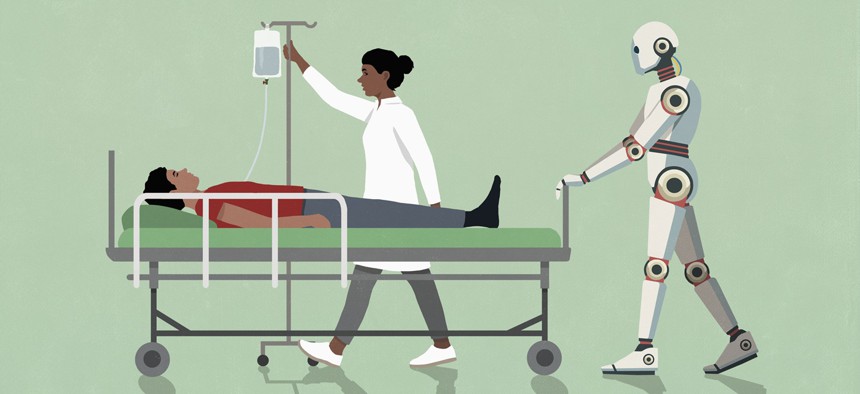
Early uses of robots across VA hospitals have highlighted the promises and drawbacks of the technologies, but they have also shown the capabilities these tools can offer clinicians, according to Acting Chief Innovation Officer Beth Ripley.
LAS VEGAS — It may sound like science fiction, but robots are beginning to play a role in the delivery of healthcare services across the U.S.
Within the Department of Veterans Affairs’ network of medical facilities, clinicians and providers have started to use these technologies to automate some of their daily tasks. Although the actual benefits provided by these robots have been mixed, frontline providers and others across VA’s medical system have reportedly been supportive of further adoption of these assistive tools.
During a Monday session at the HIMSS conference in Las Vegas, Beth Ripley — acting chief innovation officer in VA’s Office of Healthcare Innovation and Learning — said the conventional thinking about using robots is that they tackle “the three Ds”: jobs that are dull, dirty or dangerous. All of those areas, she noted, are present in hospital settings, with robots also providing an opportunity to address other problems, like chronic understaffing.
“So we have an administration priority — and all of you probably have the same — which is that we would love to have our staff working the top of their license, doing what they need to do, what they're trained to do, not schlepping things around,” Ripley said. “And what we realized when we started talking to people in VA is that a lot of workforce shortages were leading to people that shouldn't be doing these kind of simple tasks that we have.”
To better understand current uses of robots across its network, Ripley said VA undertook “a data call” of its medical facilities. Of the 90 facilities that responded to the request, 65 of them reported local uses of the advanced tech.
In total, Ripley said these sites reported 121 deployed uses of robots. Of those, 37 uses were delivery robots — which transport things such as medical supplies and in-patient veteran meals — while 35 were used for pharmaceutical mixing and packaging and another 31 were used for facility cleaning services.
Among the rarer applications, 14 were listed as “other,” two were for rehabilitation and care and two were for veteran medical interaction and facility navigation.
These deployed robots share more in common with the Roomba robotic vacuum than more advanced technologies, but early adoption shows that more work still needs to be done to hone their capabilities.
Follow-up visits by VA personnel to a subset of the responding facilities identified mixed benefits from using robots, although there was strong excitement from hospital staff about the potential these technologies have to offer.
In one instance, Ripley said personnel followed a robot for 96 minutes “to do something they can walk in three minutes.” In other cases, she said “they were working well,” although she also added that “a lot of the robots were sitting in closets or are kind of dead in the hall somewhere.”
Ripley cited the Michael E. DeBakey VA Medical Center in Houston as VA’s “most successful robot implementation across the country because [the site] was purpose-built for robots, which is fantastic,” although she said that hospitals do not have to be rebuilt to accommodate uses of the technologies.
One main takeaway from the Houston VA site, she noted, is that the facility has trained its staff “to be able to take care of the robots,” rather than having to rely on the original equipment manufacturers to come in and make any necessary mechanical repairs.
But issues identified at VA medical facilities — like hospital staff having to spend time chasing down wayward robots, or the tools not transporting medications where they are supposed to go — have highlighted the drawbacks of a broader reliance on these technologies at this time. Ripley said the department is aware of these challenges and is working to smooth out problems.
“So, our ideal state is that robots automate routine tasks, minimize error and allow staff to focus on patient interactions,” she said. “Our current state, as I said, is not quite there. There are serious gaps that we need to overcome, but we can get to those now.”
Despite some of these robots not being ready for primetime, Ripley said feedback from clinicians about using the technologies “was overwhelmingly positive.”
She said the department found that “people want to do robots,” with one effusive respondent telling VA personnel that “nurses need to do direct care; everything else should be robots.”
Ripley added that “a lot of them are saying: ‘Make it easier for us, figure out how to do it better.’”
Other surveys and multi-step interviews VA conducted with veterans, caregivers and hospital staff also found widespread interest in adopting robots for targeted uses moving forward. All three surveyed groups identified daily living and needs assistance-focused robots as their top use case for the tools.
Streamlined adoption of robots across VA’s network of more than 170 medical facilities, however, is still a ways off. Ripley noted that none of the sites that responded to the department’s data call had developed local policies or practices, procurement frameworks or working groups for the use of robots.
In response to an audience question from Nextgov/FCW about implementing a policy framework and requirements for broader adoption of robots across VA’s medical network, Ripley noted that the department is already working to bring experts and the broader VA community together to find safe ways of harnessing uses of advanced capabilities, such as through the creation of the proving ground and innovation incubator X_Labs at the VA Puget Sound Health Care System.
“The next thing that we started to do is build out playbooks and some — not to policy yet — but guidance for the field and what that looks like,” she added. “Another thing that we're working on right now is starting to think about larger contracting mechanisms, so that we're not leaving each VA alone to try to figure out what would work and what [would] not.”
Ripley said VA is also working to address questions around the deployment of robots and is also looking to industry for guidance. Some of the department’s criteria for prioritization of these tools includes whether the robots will restore or preserve veterans’ independence, if they relieve pain points for clinicians and caregivers and if there is a clinical validation or pathway to using the tech.
“Robots are a little in the future, but if we don't think about it now and start to set the policies, I think we will regret it,” Ripley said.
NEXT STORY: The man who built the web wants to fix it