
White House launches AI-powered ‘America.gov’ digital front door
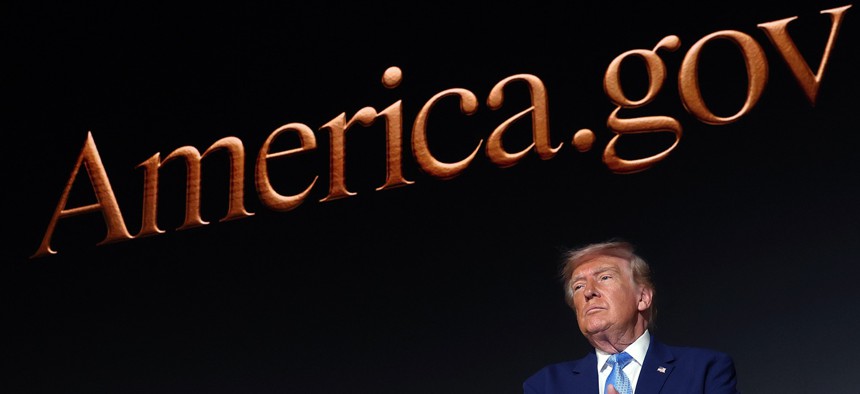
President Donald Trump applauds on stage during the America.gov launch event at Andrew W. Mellon Auditorium on September 29, 2026 in Washington, DC. Kevin Dietsch/Getty Images



The president signed an executive order at the event requiring agencies to integrate many of their services with the new website.
The Trump administration launched an artificial intelligence-powered one-stop shop for citizens interested in federal services and information on Tuesday with the help of former Department of Government Efficiency employees.
The website currently allows users to ask a chatbot questions about everything from qualifying for Medicare to finding a job to renewing a passport, without ever creating an account. Users receive AI-generated answers derived only from official federal sources.
America.gov, which sifts through 29,000 websites to pull responses, states it is free to use and “never includes ads, and keeps your privacy protected.”
Phase two of America.gov, which is set for early 2027, will allow Americans to apply for, enroll in and track progress of benefits such as Social Security directly within the chatbot.
“One of the most revolutionary product launches of all time. It really is,” President Donald Trump said at a launch event in Washington, D.C., on Tuesday. “We’re putting power and control back into the hands of the people, right where it belongs,” he added.
At the event, Trump signed an executive order mandating that agencies ensure public-facing services integrate directly with America.gov as soon as possible.
A fact sheet on the order states that services integrating with America.gov will “include public-facing federal services that serve more than 100,000 users in a 12-month period and can be accessed or applied for online. Tax filing services provided by the Internal Revenue Service and national-security-sensitive services provided by the Department of War and the Intelligence Community are excluded.”
The order also directs the head of the Office of Management and Budget to issue guidance to agencies on implementing their covered services into America.gov.
America.gov does not include web-tracking technologies, save conversations or use specific locations to share information, according to its privacy page.
The National Design Studio, a Trump administration creation that includes former DOGE employees, designed and engineered America.gov. The General Services Administration is operating the website amid a major shakeup to its web design system staff.
Approximately 40 million people visit government websites each day, Joe Gebbia, the National Design Studio’s chief design officer, said at the event.
Under phase two, Americans will be able to upload and send marriage certificates to federal agencies of their choice through the chatbot, according to a presentation Gebbia shared at the launch event.
Gemini and Grok models are powering America.gov, Gebbia told CNBC Tuesday morning. Grok has faced backlash for creating millions of sexualized deepfakes of women and children last year, Nextgov/FCW previously reported.
Americans will also be able to use login.gov to digitally verify their identities and send that information to agencies such as the Centers for Medicare and Medicaid Services, the Social Security Administration and the Department of Veterans Affairs, according to a presentation CMS Administrator Mehmet Oz shared at the event.
Oz touted America.gov’s ability to show verified users the locations of doctors near them who accept Medicare and enables them to schedule medical appointments. The website also allows users to pull information about drugs they take, compare medication costs and find local pharmacies that carry the medications.
Oz argued the new website will be more useful than informational Medicare packets CMS sends Americans each year, costing approximately $100 million. Oz previously flirted with using AI to help Medicare beneficiaries find health plans and doctors.
“For 165 million Americans, you get Medicare, Medicaid, Obamacare. We want these systems eventually to integrate and be able to help so many Americans,” Oz said of America.gov.
Oz told reporters he is pushing for CMS to be as transparent “as possible” about Medicare plans highlighted on America.gov and “make it hard” for insurance companies “to game” information.
Secretary of State Marco Rubio showed that Americans can apply for a passport after signing in with login.gov. The service will launch in December 2026, according to a presentation Rubio gave at the event. The State Department already has an online passport renewal platform that has issued millions of passports.
“By the end of 2027, our goal is for the vast majority of Americans to be able to apply for a passport or passport card on America.gov,” Rubio said.
Rubio also unveiled the 2028 U.S. passport, which he said the State Department created alongside the National Design Studio.
Two civic technologists cautioned that America.gov has not yet proven itself to be the watershed website that Trump administration officials heralded.
“This isn't any big leap forward over the other ‘one-stop shops’ that have been tried before. What remains to be seen is how it could be integrated with any agency program,” Mikey Dickerson, former administrator of the U.S. Digital Service and senior advisor to Democratic-aligned Tech Viaduct, told Nextgov/FCW.
“My first read [of America.gov] is that like many other [National Design Studio] websites, the real functionality is ‘coming soon’ — I tested a VA disability claim and it directs me to the VA site. It claims to be able to do that in 2027, but that’s a significantly heavier lift than building an LLM wrapper,” Christopher Whitaker, executive director of the Alliance of Civic Technologists and a Tech Viaduct contributor, posted on social media.
Other top Trump administration officials, including Defense Secretary Pete Hegseth, General Services Administrator Edward Forst, Interior Secretary Doug Burgum and former Federal Chief Information Officer Greg Barbaccia, attended the launch event.
Private sector leaders, including former DOGE leader Elon Musk and NVIDIA CEO Jensen Huang, are set to speak Tuesday afternoon.
Trump thanked Musk for “initially envision[ing] the transformation of government with technology” during his remarks, despite squabbling with the former DOGE leader in 2025.
Trump argued that America.gov highlights the need for the SAVE America Act, a federal bill requiring voters to provide photo ID at the time of voting that has stalled in Congress.
Trump said he will soon sign an executive order changing the name of AI to “super intelligence,” a new term he has recently coined; he claimed that Chinese President Xi Jinping supports the renaming. The America.gov order Trump signed refers to AI as super intelligence.
“We don't want to hear artificial because it's not artificial. It's very powerful. It's very brilliant,” Trump said.
The Washington Sun first reported on plans for America.gov earlier this month.
Editor's note: This article has been updated to include additional info about the models powering America.gov.