
MAHA advocates eye federal partnerships with state orgs to advance research agenda
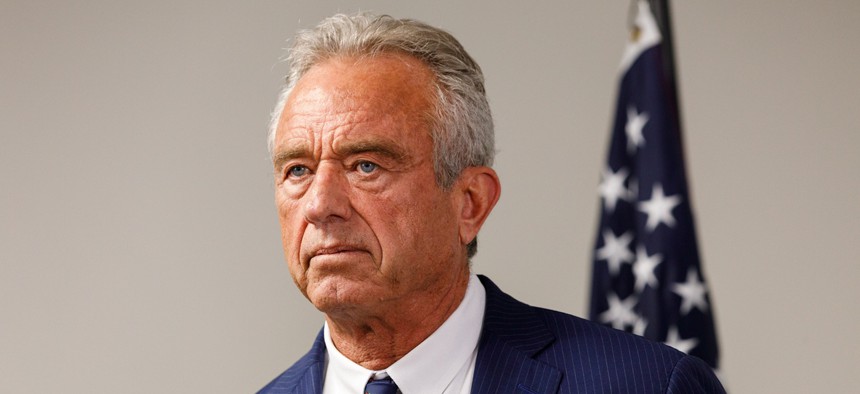
Health and Human Services Secretary Robert F. Kennedy Jr. speaks at a presser announcing grants for dental services for patients with neurodevelopmental disorders at Neighorhood Healthcare in Escondido on Wednesday, Sept. 23, 2026. Kristian Carreon/ The San Diego Union-Tribune via Getty Images




Federal health agencies under the Trump administration are working with the state-level groups on research projects of interest to the movement.
Supporters of the “Make America Healthy Again” movement are urging federal health agencies to work with health information exchanges, or HIEs — state-based organizations that help move Americans’ medical records and other health data between medical providers, insurers and public health institutions — to study chronic diseases and vaccines.
“We are advocating for joint state-federal cooperation, which leverages the state health information exchanges to provide data to federal agencies. This model of state-federal cooperation is already bearing fruit,” Mark Gorton, president of the MAHA Institute, said Monday at the MAHA Institute Open Data Summit.
Gorton said that the National Institutes of Health and Nebraska are running a pilot to produce data to study chronic diseases. The initiative “serves as a proof of concept for the state-federal hybrid model, but this model has only been able to be a success because of the investments that Nebraska has made in data governance,” he said.
The Health and Human Services Department did not respond to a request for clarification on the partnership by the time of publication.
The MAHA movement’s interest in HIE data follows President Donald Trump’s August executive order requiring an HHS task force to develop a plan for “improving vaccine research and options for American patients.” HHS Secretary Robert F. Kennedy Jr. has also sought to reorient federal health research toward apparent root causes of autism and chronic disease, both of which are of interest to MAHA supporters.
With data from HIEs; consolidated, in-house, real-world data sets; medical claims; electronic health records; and wearable devices, NIH could create a “truly comprehensive multimodal data superset that will allow us to actually start to understand chronic disease,” said Nicole Kleinstreuer, NIH deputy director for program coordination, planning and strategic initiatives, at the event.
“If you don't have that data measured and captured in a longitudinal fashion, then we will never get to the multivariate susceptibility signatures that will allow us to actually prevent and treat chronic disease much more effectively,” Kleinstreuer said.
Kennedy himself is interested in using medical record data from HIEs to study a link between autism and vaccines, which medical experts widely reject, KFF Health previously reported.
An unnamed former Centers for Disease Control and Prevention official told the outlet that CDC money was supporting Nebraska-based HIE CyncHealth’s ability to provide Kennedy with health data for his project. About $2.4 million in CDC funding has gone to CyncHealth to study acute and chronic illnesses, an organization spokesperson told the outlet.
Other HIEs, such as the Maryland-based CRISP Health, decided not to share data with HHS, according to the report.
Jaime Bland, who served as CyncHealth CEO and president last year while the HIE corresponded with HHS, became the MAHA Institute’s Chief Data Strategist earlier this year.
Kennedy reaffirmed his interest in HIE data at the Monday event by heralding the potential of health data utilities, or HDUs — state-based organizations that are similar to HIEs but touch more types of data, such as social services and community organizations.
“State health data utilities can connect immunization records, clinical data, laboratory results, pharmacy information and claims to create a more complete picture of a patient's health over a long period of time, and we're already using all these data to answer some of our most important questions,” Kennedy said.
Dr. Donald Rucker — the National Coordinator for Health Information Technology under the first Trump administration — encouraged CDC to use HIE data, calling the agency’s failure to do so “one of the glaring errors of COVID.”
“We'll have some great optimism there as CDC hopefully shifts from mandated reporting to using health information exchange data, much richer, much more powerful, much more accurate, because of the longitudinal enterprise master patient indices,” Rucker said. Those indices connect patient identities across different health care providers and store them in a database, according to health technology company Lifepoint Informatics.
Many HIEs could answer vaccine safety research questions if immunization registries were linked to the state-based organizations, according to Rucker.
MAHA advocates concede there are other challenges with using HIE data for research.
“There's a lot of variable understanding around what is legally appropriate” for providers to share with HIEs, said Ben Tyrell, CEO of the Montana-based HIE Big Sky Care Connect, at the event.
“Our health information exchange data cannot be used, even de-identified, for research or grants without individual consent [obtained] by the provider. And so, this is a real barrier,” said Jonathan Ketcham, who was the chief healthcare economist at the White House until this past May, at the event.