
DOGE is about making government services easier to access, its head says
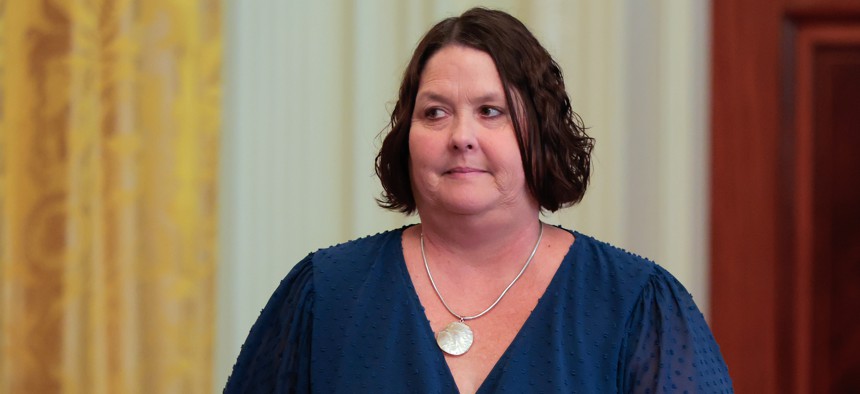
Acting Administrator of the United States Department of Government Efficiency Amy Gleason arrives for an event on Health Technology in the East Room on July 30, 2025 in Washington, DC. Anna Moneymaker/Getty Images





 By
Natalie Alms
By
Natalie Alms
In a rare public speaking appearance in which DOGE was discussed, its acting administrator Amy Gleason painted a different vision of its work than that pursued during the government-slashing efforts last year.
Department of Government Efficiency acting Administrator Amy Gleason says that efficiency — the tagline billionaire Elon Musk heralded during his involvement in the early days of DOGE — is about making accessing the government easier.
Although that message ties back to much of the history of the Obama-era office that President Donald Trump reshaped into DOGE, the U.S. Digital Service, it diverges somewhat from what DOGE has made itself known for, like dismantling the U.S. Agency for International Development, pressing for unprecedented, high-level access to sensitive government data and pushing thousands of government employees out of their jobs.
Musk and his allies also emphasized reducing government spending as part of their mission, although they were ultimately largely unsuccessful.
Gleason told an audience at a government IT industry event Wednesday that the group’s priorities today are improving government services, modernizing government systems, combating fraud and hiring tech talent after the administration pushed 20,000 technology-focused government employees out of their jobs last year.
“I think of efficiency really as reducing that friction, administrative burden, both from our public users as well as our federal workforce, and even state users that we're working with,” she said. “Our citizens have come to expect their government experience to feel like the private sector experience, where it's modern and easy to use.”
When Trump moved back into the White House last year, he quickly transformed USDS — set up in the wake of the botched healthcare.gov launch to prevent future such failures — into the U.S. DOGE Service.
Many of those on the existing team were laid off or resigned in protest. Some stayed and continued to work on the types of citizen-facing projects the Obama-era team was known for, although experts have told Nextgov/FCW that DOGE made these types of good-government projects more difficult by souring what the public thinks about when it hears the words “government modernization.”
Gleason herself was relatively unknown to the broader public when the White House named her acting administrator of DOGE last spring, after Trump evaded the question of who was in charge for weeks. She previously worked at DOGE’s precursor during Trump’s first term and during the Biden administration.
Despite her title, it’s not clear how much sway Gleason had over DOGE during its zenith. Some on Musk’s government-cutting team have since said that she never led a DOGE meeting they attended, and that they didn’t know what her job was.
DOGE’s social media still appears to be rooted in the Musk days. Recent posts on the team’s X account include images of a doberman on the White House lawn with the text, “DOGERMAN.” Another post simply reads, “America loves DOGE.”
Public polling from last year says otherwise, with more Americans opposing DOGE than rating it positively.
Gleason, who also works at the Centers for Medicare and Medicaid Services, spoke Wednesday about her inspiration working in the healthcare tech space because of the experience of her daughter, who was diagnosed with a rare disease when she was 11. Gleason said she wants to improve the access patients have to their own healthcare data.
Asked to expound on the biggest challenges in government AI, Gleason said that trust is the “biggest thing.”
“We have to figure out how to overcome the trust barrier,” she said.
If you have a tip you'd like to share, Natalie Alms can be securely contacted at nalms.41.
NEXT STORY: Senators ask watchdog to probe IRS Free File program