
Senators demand to know the IRS’ path forward following the end of Direct File
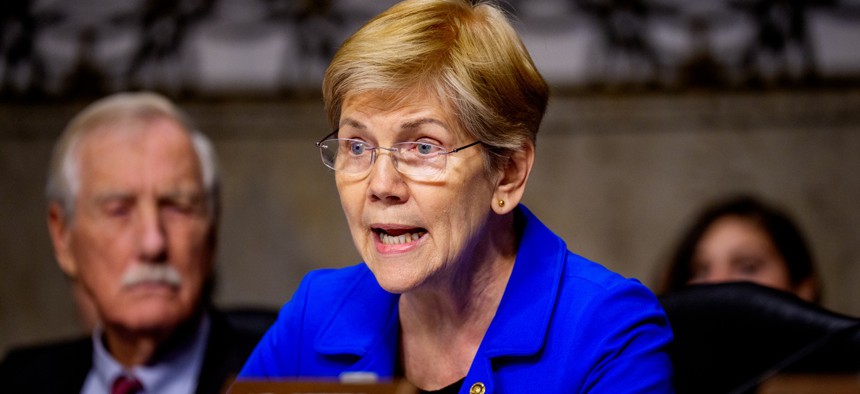
Sen. Elizabeth Warren (D-MA), accompanied by Sen. Angus King (I-ME) (L), speaks at a Senate Committee on Armed Services hearing on Capitol Hill on December 11, 2025 in Washington, DC. Andrew Harnik/Getty Images





 By
Natalie Alms
By
Natalie Alms
The IRS ended the online, direct-to-government filing program last fall and is doubling down on the free tax filing options it offers through tax prep companies in a partnership called Free File.
Sens. Elizabeth Warren, D-Mass., and Angus King, I-Maine, are opening an investigation into the Trump administration’s decision to end the Biden-era free online tax filing program, Direct File.
They penned a letter to Scott Bessent, Treasury Secretary and acting IRS Commissioner, on Friday asking for more information about the IRS plan to double down on Free File, which relies on tax prep companies, in the absence of Direct File, which allowed users to file online directly with the government.
The IRS officially canceled Direct File last fall after offering it to taxpayers in 25 states with relatively simple tax situations the year prior. It first piloted the service in 2024.
The creation of Direct File was a big change from the IRS’ longstanding practice of relying on private tax software companies to offer free, online options for most Americans to file their taxes under Free File.
In their letter, Warren and King ask Treasury for details on how it promoted Direct File and Free File, whether it has implemented previous watchdog recommendations and how it will oversee Free File moving forward.
“Instead of letting Americans file their taxes online and for free with the IRS, the Trump administration is pushing a tax prep company program that has a history of misleading taxpayers into paying more,” Warren told Nextgov/FCW in a statement. “Trump's attempts to replace Direct File with Free File is just another Trump scam.”
In November, the IRS said it was planning a “targeted communications campaign” around Free File and other free options the IRS offers, including the largely in-person VITA program offered to low-income taxpayers.
A lack of promotion and marketing of Free File has long been a problem for the program.
David Ransom, counsel for the Free File Alliance, the nonprofit coalition of tax software companies that provide free options via Free File, told Nextgov/FCW over email that, “the companies which do participate are able to handle any usage, and have continually urged the IRS (and the Congress, which appropriates funds) to more effectively promote the program.”
He also added that usage of Free File has increased over the last several years, and the IRS itself noted in 2024 that 7.4% more people filed using the service that year than the year prior. But that uptick still represented a relatively small number of those eligible.
According to a 2024 report from the Treasury Inspector General for Tax Administration, just 3% of those eligible to use Free File did so in 2024, a slight increase from the 2% that made use of it in the two years prior. That report also found that the number of those eligible for the service has gone down from 108 million in 2021 to just 85 million in 2024.
Over 14 million people eligible for Free File may have paid to file their return with tax software companies that were part of that service in 2020, according to the Treasury Inspector General for Tax Administration, which urged the IRS to create its own free, direct e-file system in 2023. The Government Accountability Office also recommended in 2022 that the IRS offer free, online options other than Free File.
Heavy hitters including Intuit, which runs TurboTax, and H&R Block left the program in 2021 and 2020, respectively. TurboTax also reached a settlement with a coalition of state attorneys general in 2022 for having pushed people toward products they’d have to pay for, even when they could’ve used free options, and H&R Block entered a settlement with the Federal Trade Commission in 2025 for deceptive advertising.
“This is just a rehash of a seven-year-old story,” Ransom said when asked about the settlements and departure of some participating companies.
The senators also point to a 2020 Senate investigation that found that TurboTax and other companies were hiding their free options from search engines. According to ProPublica, the companies removed the code that was suppressing Free File in search engines after ProPublica reported on the issue in 2019.
Ransom told Nextgov/FCW that the issue was remedied by the Free File participants and the IRS.
Warren and King also want to know about how companies in Free File use taxpayer data that they have access to. The IRS watchdog has reported that the tax agency doesn’t have sufficient oversight of Free File to ensure that data isn’t disclosed in an unauthorized way, something several companies have been sanctioned for by the Federal Trade Commission.
Treasury pinned the decision to end Direct File on its cost — $41 million during the 2025 filing season, or $138 per accepted return — and low participation rates. Many Republicans had opposed Direct File, and tax prep companies also lobbied against it.
Only about 1% of those eligible for Direct File used the product in 2025, which was also limited to those with relatively simple tax situations in certain states. Approximately 30 million people were eligible for the tool during the 2025 tax season, compared to Free File, which also supports more complicated returns if taxpayers have an adjusted gross income no higher than $89,000.
Direct File’s last season in operation was also hampered by speculation about whether the tool would continue to exist for the 2025 filing season and beyond. Billionaire Elon Musk added to the confusion — and a drop in Direct File use — when he posted on X that the team powering Direct File was “deleted” in early February. Direct File supporters also say it had relatively little promotion from the IRS.
Supporters of Direct File argued that the IRS has a duty to offer its own free option, and pointed to high marks from those that used it.
“This report should help clarify the Direct File debate. It’s not about whether the product worked well or not. It’s not about whether it’s cost prohibitive,” Danny Werfel, former IRS Commissioner, told Nextgov/FCW last year of an internal report outlining those high marks from users.
Nominated by Biden, he oversaw the beginnings of Direct File, and stressed at the time that it was an additional option for taxpayers, not a replacement of Free File.
“It’s simply about whether you believe a free option where you file directly with the IRS should be on the menu for taxpayers or not,” said Werfel.
If you have a tip you'd like to share, Natalie Alms can be securely contacted at nalms.41 on Signal.
NEXT STORY: Trump’s nutrition website directs users to Elon Musk’s Grok