
More AI tools coming in days or weeks, Pentagon R&D chief says
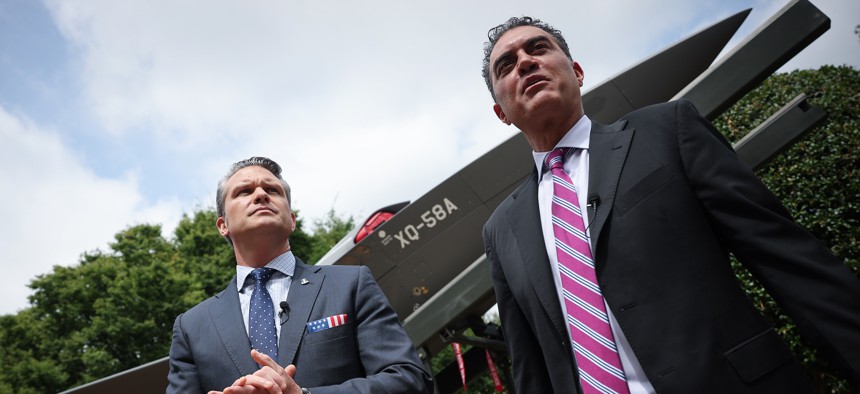
Defense Undersecretary (Research & Engineering) Emil Michael, right, briefs Defense Secretary Pete Hegseth on the XQ-58A Valkyrie drone at the Pentagon on July 16, 2025. Win McNamee/Getty Images





Wide deployment of artificial intelligence now sits atop Emil Michael’s critical priorities.
Updated Dec. 9, 10 a.m. ET:
The Pentagon will widely deploy new AI tools for logistics, intelligence analysis, and combat planning in days or weeks, its research-and-engineering chief said Monday, adding that wide deployment of artificial intelligence now tops his list of “critical technologies.”
The department has chosen Gemini for Government as the platform that will support DOD’s first department-wide rollout of AI tools, Google and defense officials announced Tuesday morning.
The moves come after the Defense Innovation Unit, the Chief Digital and Artificial Intelligence Office, or CDAO, and others were combined under Emil Michael, defense undersecretary for research and engineering, in a bid to accelerate deployment of AI and other technologies. He said that he will likely reduce the number of technology areas that DIU is working on as well.
The advent of large-language-model tools such as ChatGPT, Claude, and Gemini have made it possible—and necessary—to develop AI tools faster, Michael told reporters at the Defense Writers Group on Monday.
“The explosion of capabilities has been enormous, and we're just catching up to that,” he said. “Now we can take CDAO and actually try to use it to push the capability into the Department for actual use cases.”
He said that expands the usefulness of CDAO, which was largely managing in-house analytic tools like Advana and exploring data assets within the military.
The explosion of ChatGPT and other consumer tools makes that necessary, Michael said Saturday during the Reagan Defense Forum in California.
“For a department of 3 million people, we're vastly under-utilizing AI relative to the general population,” he said.
On Monday, Michael said Russia’s war on Ukraine and Ukraine’s response serves as a key lens on future conflict.
“You have a robot on robot frontline now, which we've never seen before,” he said.
And China’s military buildup of the past 10 to 15 years—“the most significant” in world history, he said— also “requires a kind of a different mindset.”
Michael said China is working to reverse-engineer advanced chips and to develop its own.
“China is absolutely trying to indigenize their own TSMC. If you look at the supply chain of the ASML, TSMC, and Nvidia, [China is] trying to replicate that capability with their own domestic sources,” he said.
Michael said he is seeking help from foreign countries such as Australia and South Korea, searching for more sources for chips, access to test ranges for hypersonic weapons, and more.
Last month, he pared the list of critical technology areas that his office would pursue from 14 to six. (“14 priorities, in truth, means no priorities at all,” he said in a Nov. 17 video.) On Monday, he said that wide AI deployment would be his top priority.
“I'm going to put the capability in front of you so you can start learning, using it. We'll have training. We'll have support for deployed engineers, all that. And then you'll see innovations come from there.”
He said his office would soon announce acquisition changes along the lines of the Pentagon’s broader November announcement.
Michael made his remarks days after the White House released a National Security Strategy that declared an intention to refocus the U.S. security and strategy toward the Western Hemisphere. He deferred policy questions to people “abiove his pay-grade’ but said that he was still “focused much more on other parts of the world”—particularly China, the potential adversary whose capabilities are closest to the Pentagon’s.