
Trump acknowledges FBI crime database hack as scope remains unclear
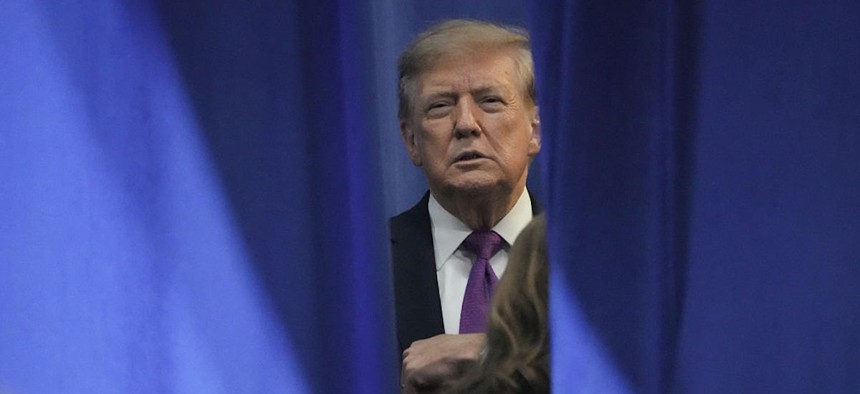
U.S. President Donald Trump waits backstage before speaking at the Justice Department in Washington, D.C., on November 23, 2026. Ken Cedeno / AFP via Getty Images




The president suggested the intrusion could reveal information about investigations he has criticized. Police nationwide use the system to track wanted people, missing persons and stolen property.
President Donald Trump acknowledged a hack of the FBI’s national crime database Saturday, calling it “not good” but suggesting the intrusion could reveal information about bureau investigations he has long criticized.
CNN first reported the breach Friday, citing two people with knowledge of the matter who said the FBI was investigating. It’s unclear who the hackers are or what may have been accessed.
Nationwide law enforcement agencies use the National Crime Information Center, or NCIC, to share information about wanted and missing people, protection orders and stolen property.
State, local, tribal and territorial law enforcement personnel — the users and contributors of information to NCIC — have not received formal communication from the FBI about the intrusion, according to a law enforcement representative who was granted anonymity to discuss the matter.
Trump talked about the breach during a phone interview with Fox News host and former White House press secretary Kayleigh McEnany, suggesting that “maybe we’ll learn things that we would have never learned otherwise.”
He revisited his grievances about the Russia investigation and his first impeachment and repeated unsubstantiated claims about voter fraud. He offered no evidence that the breach would uncover information supporting those claims, saying he preferred to put a “positive spin” on events.
Megan Noland, executive director of the Major County Sheriffs of America, directed questions about the breach to the FBI, which has not returned a request for comment from Nextgov/FCW.
Gary Barlet, public sector chief technology officer at Illumio, said investigators must consider whether hackers could have changed records, alongside the possibility that they stole sensitive information.
“Law enforcement must be able to trust that the information it acts on is accurate,” he said. “If an attacker were able to alter, delete or manipulate records, the consequences could quickly escalate from a cybersecurity problem to an operational and potentially public-safety problem.”
“We don’t yet know whether anything like that occurred here, and we shouldn’t assume it did,” he added.
The breach adds another chapter to the FBI’s cybersecurity troubles this year. Prolific cybercrime group ShinyHunters claimed responsibility for a separate hack involving bureau personnel data in September.
And earlier this year, hackers breached an FBI surveillance system in an intrusion investigators suspected involved China.
The latest disclosure also follows technology outages across government and industry that administration officials attributed to technical problems and maintenance.