
Tech companies brace for AI-driven election misinformation
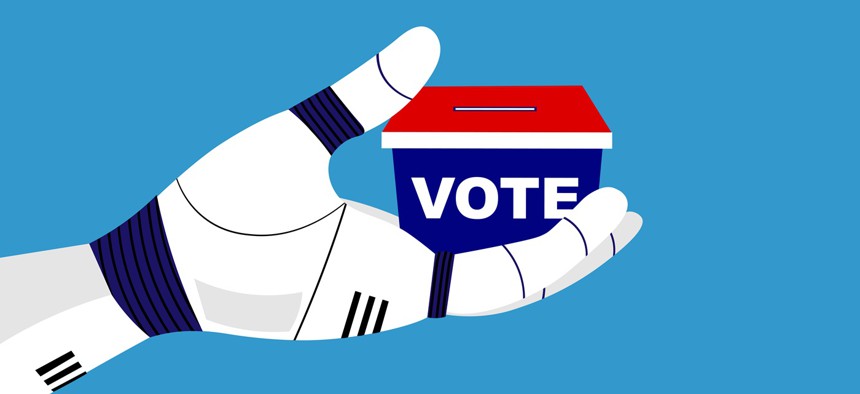
Alfieri/Getty Images





As more Americans turn to the advanced technology for information, companies are under pressure to protect election integrity.
As Americans head to the polls on Tuesday, major technology companies are taking action to ensure their artificial intelligence models provide accurate information about the midterm elections.
AI companies OpenAI and Anthropic have set up dedicated “war rooms” to monitor their platforms for misuse, according to exclusive reporting from Politico and Semafor. OpenAI and Anthropic did not respond to Nextgov/FCW’s requests for comment.
The war rooms are meant to provide users with reliable voting information and prevent the spread of misinformation, particularly through the generation of misleading AI-generated images.
Similarly, a Meta spokesperson pointed Nextgov/FCW to a company blog post noting that the social media company had activated its Election Operations Center in the week leading up to Election Day.
“Our Election Operations Center is a command center we have used for dozens of elections around the world in recent years,” Meta wrote. “It brings together subject matter experts from across the company … for real-time monitoring so that we can address potential abuse across our platforms.”
An Oct. 22 report from the Brennan Center found that, of six AI image generators analyzed, ChatGPT “significantly improved its protections against the creation of election disinformation” since May, while several other platforms remained willing to generate realistic fake election images.
For instance, when given a potentially harmful election prompt, ChatGPT will not create a realistic-looking image. The platform now returns a “cartoonish image” that would not be mistaken for a real photo.
The analysis looked at OpenAI’s ChatGPT, Google’s Gemini, Meta AI, Black Forest Labs’ Flux, Runway and SpaceXSI’s Grok.
“It is promising to hear that leading AI technology companies are working hard to ensure their platforms provide accurate information about our midterm elections and immediately detect and interrupt abuse attempts,” Sen. Mark Warner, D-Va., said in a statement to Nextgov/FCW.
“As more Americans turn to AI and social media for important information, our leading technology companies have a responsibility, which many of them acknowledged in 2024, to protect the integrity of our elections and support free, fair and secure midterms,” he added.
Warner and several of his Democratic colleagues wrote to leading technology companies last month urging them to ensure their platforms help protect the integrity of the midterm elections.
Among their requests, the lawmakers encouraged the companies to ensure their AI-generated content responds to election-related questions by only pulling from “highly authoritative sources,” rather than social media platforms.
In a statement to Nextgov/FCW, Microsoft said it is continuing to make improvements to Copilot as Election Day nears.
“Helping people find accurate, reliable election information has long been a priority for Microsoft,” a company spokesperson said. “We have made improvements to how Copilot responds to election-related questions, and we’re continuing to test and refine them with a focus on consistently delivering reliable information.”
The spokesperson also directed Nextgov/FCW to a company blog post that said “malicious deepfakes of candidates and election officials are disallowed on Microsoft platforms, and targeted individuals can report them directly.”
The company said it is also working to “point voters to accurate information directly from state and local election officials.”
Still, independent testing suggests that tech companies have more work to do. The Brennan Center found that, while ChatGPT improved its safeguards, Google’s Gemini and Meta AI became more willing to generate convincing fake election images, and the other tools showed little change.
Google did not respond to Nextgov/FCW’s request for comment, nor did Perplexity.