
Commerce Department moves to close AI chip loophole
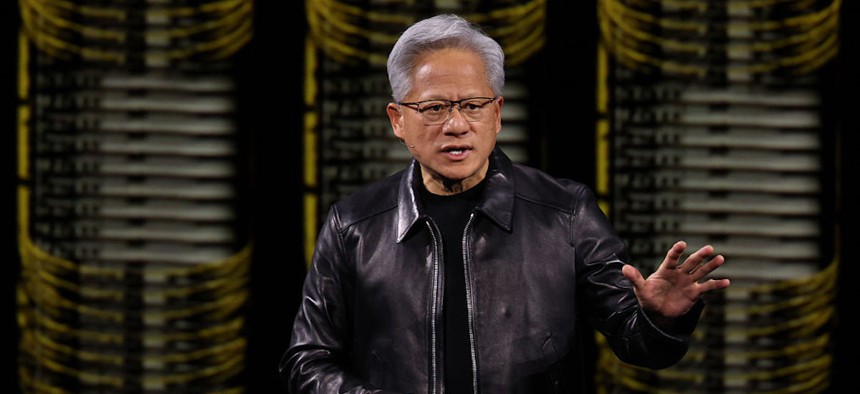
Jensen Huang, former CEO of NVIDIA, presents new NVIDIA Vera Rubin DSX Pod Full-Stack Modular AI Factory as he gives a keynote address at the Berlin GPU Technology Conference (GTC) on October 21, 2026 in Berlin, Germany. Sean Gallup/Getty Images




The newly released interim final rule marks the first policy response to the scandal involving former Nvidia CEO Jensen Huang.
The Commerce Department on Monday moved to close a loophole that has allowed Chinese companies to access advanced artificial intelligence chips remotely through data centers located in other countries.
Commerce’s interim final rule marks the Trump administration’s first policy response to a scandal involving former Nvidia CEO Jensen Huang. Huang resigned last week amid reports of two affairs, including with a woman suspected of being a Chinese spy.
U.S. export controls generally prohibit Chinese companies from purchasing Nvidia’s most advanced AI chips directly. However, some China-based companies have been able to get around those restrictions by renting computing power from data centers in Southeast Asia.
The new rule, issued by Commerce’s Bureau of Industry and Security, would require licenses for advanced chip exports to Indonesia, Malaysia, Singapore, Thailand and Brazil.
It would also require data centers to obtain a license before providing remote access to companies headquartered in China or other restricted destinations. Data centers already serving those companies will have 90 days from the rule’s effective date to get a license.
The rule also formally rescinds regulations implementing the Biden administration’s AI Diffusion Rule, which the Trump administration has previously said it would not enforce.
In a press release, the department said the new rule was “written by and at the direction of the Department of Treasury and the National Security Council.”
It also comes after Treasury Secretary Scott Bessent criticized Commerce Secretary Howard Lutnick on Friday for not doing enough to restrict chip purchases by Megaspeed, the company at the center of the Nvidia scandal. Huang reportedly had a relationship with a business executive linked to Megaspeed, a Singapore-based cloud computing provider.
Commerce published the rule one day after Sen. Maria Cantwell, D-Wash., sent a letter to Lutnick calling for him to take immediate action to stop the flow of advanced AI chips to companies with ties to China. Cantwell is in line to chair the Senate Commerce, Science and Transportation Committee in the next Congress.
“These companies are exploiting a loophole in U.S. export controls by using advanced American chips in foreign data centers even when those chips are restricted from the [People’s Republic of China],” she wrote.
Cantwell added that Lutnick’s failure to implement sufficient export controls “has undermined America’s national security.”
Comments on the interim final rule are due in 60 days.