
Nvidia spying allegations test Washington’s defenses against tech espionage
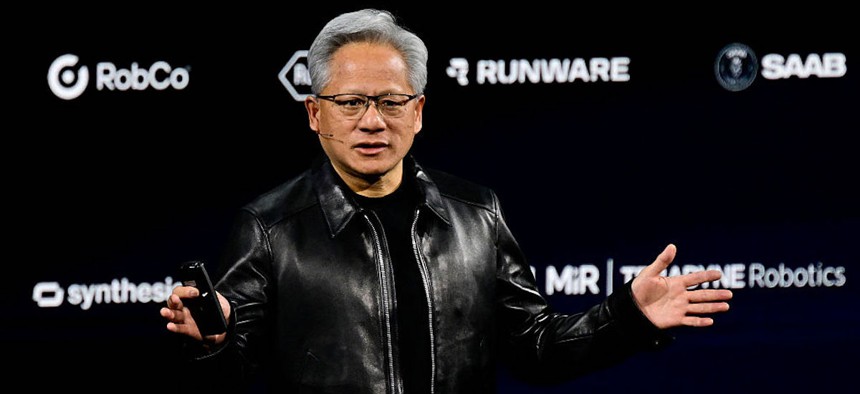
Co-founder, President and CEO of US technology company Nvidia, Jensen Huang delivers his keynote speech during the Nvidia GTC Berlin 2026 Artificial Intelligence conference, on October 21, 2026 in Berlin. John MACDOUGALL / AFP via Getty Images




Military investigators say they are helping companies guard against foreign spies. Some executives say that assistance is often one-sided.
Allegations that Chinese intelligence targeted Nvidia’s chief executive are raising questions about how American technology companies can protect themselves from foreign spies and whether Washington is doing enough to help.
Military investigative agencies told Nextgov/FCW they brief commercial AI firms, review research funding proposals for security risks and share warnings with defense contractors. But interviews with executives and current and former U.S. officials also highlight that government counterintelligence assistance is often uneven and one-sided, leaving businesses involved in economic and national security work to recognize threats they may be ill-equipped to detect.
Some members of Congress expect to examine counterintelligence risks to the AI and tech industry next year, according to a Capitol Hill aide granted anonymity to discuss the planning.
Scrutiny of the U.S. counterintelligence posture comes on the heels of Nvidia CEO Jensen Huang’s relationship with Alice Huang, a business executive linked to Nvidia customer Megaspeed. The New York Times and others reported that U.S. intelligence believes she gathered information for Beijing through their relationship.
The intelligence was derived from intercepted communications between the Nvidia chief and the Megaspeed executive, according to a U.S. official familiar with the matter. Spy agencies cannot domestically surveil U.S. citizens, but information about Americans intercepted incidentally can be disclosed through a process known as “unmasking” under certain national security exemptions.
Nvidia, a kingmaker in the global tech industry, has been central to advanced AI development and to the competition between the United States and China over the fast-evolving technology. The company is also deeply involved in infrastructure that supports quantum computing efforts.
Huang acknowledged an affair Sunday and pledged to cooperate with an independent investigation launched by Nvidia’s board. The board said it had “no reason to believe that either national security or NVIDIA secrets were compromised.” China has denied the espionage allegations.
President Donald Trump said Monday that the FBI was looking into the matter. The Republican chairs of the House intelligence, foreign affairs and China committees have also requested a closed-door briefing with Huang about the relationship and Nvidia’s safeguards against foreign espionage.
Rep. Pat Harrigan, R-N.C., who serves on the House Armed Services Committee’s Intelligence and Special Operations Subcommittee, said getting lawmakers up to speed should be an immediate priority.
“How could you become so lackadaisical in your perspective of what our adversaries are really trying to do?” he said in an interview, adding that, for a long time, he thought Huang was compromised.
Harrigan sharply criticized Huang’s permissive stance on chip sales to China, stating that the spying allegations validated his long-standing concerns over how the company views U.S. export restrictions.
“I don’t know how you can have a perspective that we should be sharing our most capable chips with the Chinese Communist Party,” he said. “That makes absolutely no sense to me.”
Counterintelligence — identifying and stopping foreign spies from stealing secrets or gaining access to sensitive people and information — is among some of the most exciting but difficult work in the world of espionage, the current U.S. official said.
Intelligence services may approach a target through several people, some removed from the service itself. Friends, business contacts or other intermediaries can provide access and help corroborate information collected through another relationship, making it harder for investigators to pin down those responsible for targeting senior executives.
It’s likely multiple people have targeted Huang, associates and family members close to him, and that more revelations about these dynamics could emerge, the official speculated. The official added that they expect intelligence agencies to increasingly brief more corporate leaders on specific threats to their companies and help them establish training for employees likely in espionage crosshairs.
“When the CEO of the most valuable company in the world is tied to a counterintelligence investigation because of a personal relationship, every board in America should be paying attention,” said Andy Challenger, chief revenue officer at executive coaching and outplacement firm Challenger, Gray & Christmas.
“It’s not just a question of romance or morality anymore. It’s a question of judgment, national security exposure, shareholder trust and whether the person at the top can be relied on to protect the enterprise,” he said.
A former CIA analyst with experience in technology security and trade issues said the problem is far-reaching, and goes beyond the most advanced AI and tech firms to a broader corporate culture that undervalues security, especially in Silicon Valley.
“People are oriented towards the profit model, not necessarily national security first,” said the former analyst, who requested anonymity to candidly discuss their views of the Nvidia incident.
“Expecting executives to recognize a honey trap on their own is also the wrong model,” they added, referring to the technique of developing a romantic or salacious relationship to gain access or influence. “Security and counterintelligence teams must identify suspicious approaches, assess exposure and build safeguards before access becomes compromised.”
One executive of a venture capital firm that invests in national security companies described at least dozens of anomalous attempts over the last year made by individuals seeking access to corporate secrets. Every job posting associated with the firm or its portfolio companies draws at least one applicant flagged as unusual, the executive said, adding that North Korean operatives are often suspected.
Some people passed background checks and were hired before asking to be paid in Bitcoin or appearing to work from an unexpected location, the executive added. Companies revoked their access after those concerns arose.
Some precautions extend into travel and everyday business discussions, this executive added. Their portfolio companies’ leaders do not travel abroad with work devices, avoid using certain foreign-made equipment in their conference rooms and have been advised to be more careful about what they reveal in photographs of their hardware, factories and presentations to investors.
This executive said their firm already has relationships with government agencies but had received no new top-down guidance from feds in the last week amid headlines focused on Nvidia, adding they want clearer channels for bringing concerns to officials, and vice-versa.
Sensitive conversations have already figured in a separate case at an AI lab. Last month, prosecutors accused a Saudi OpenAI engineer of planting a recorder in an executive conference room used to discuss research, product plans and government engagements.
A second technology executive familiar with U.S. counterintelligence strategies said government officials are typically responsive and collaborative when companies approach them, but the executive has not seen proactive outreach.
“The threat actors are getting increasingly aggressive in the tech arena,” this second executive said. “I’m not aware of practices or training other than the defaults as a part of the clearance process,” they said, referring to the process that government contractors go through to be approved for clearances to view classified information. A more robust counterintelligence standard “hasn’t been a part of the playbook to date and corporations are pretty much left to fend for themselves, and even the more mature ones are still hard at work to keep pace,” they added.
Austin Gray, co-founder and chief strategy officer of autonomous ship developer Blue Water Autonomy, described receiving basic counterintelligence training and awareness support from the Naval Criminal Investigative Service and local law enforcement.
“This is a partnership but most of the responsibility for day-to-day threats is our responsibility,” Gray said. “The government owes us help understanding more advanced threats that only it has the capability to understand, track and defend against.”
The current U.S. official questioned the FBI’s ability to provide that level of support, contending that firings of bureau counterintelligence personnel earlier this year has reduced the government’s capacity to track tech espionage threats.
The FBI declined to answer questions about its counterintelligence posture, referring Nextgov/FCW to a webpage describing its work to protect emerging technologies, including AI and quantum science.
The CIA and the Office of the Director of National Intelligence did not respond to a request for comment.
Military investigative agencies, meanwhile, described multiple lines of effort meant to reach companies before their technology is incorporated into weapons or other defense systems.
The Air Force Office of Special Investigations said its agents and analysts have briefed executives and security teams at commercial AI and quantum firms, including companies that are not cleared to handle classified information. The agency regularly evaluates its threat briefings and works with both small and large businesses supplying technology to the military, a spokesperson said.
But there are limits to that assistance. The Air Force agency said it provides counterintelligence guidance and training, but does not conduct personnel vetting for companies’ insider-threat programs.
NCIS said its work is ongoing and independent of any particular private-sector incident. It prioritizes helping contractors detect foreign intelligence activity, and shares threat advisories with companies supporting the Navy and Marine Corps.
And the Army Counterintelligence Command’s Security Vetting Office examines all Army Research Lab proposals for fundamental research grants, a spokesperson said.
The vetting office “works to prevent compromise in the earliest stages of development while other elements are protecting models, systems, and platforms,” added the spokesperson. “It is of no use protecting advanced tech if you allow the adversary to sit in the lab and watch, if not be paid to participate in, its development.”
A Defense Department official defended the administration’s approach to supporting the AI industry, but noted that protection from foreign exploitation requires both the government and companies.
“We must, however, protect American ingenuity from exploitation by adversaries, which requires the full power of both the public and private sectors working together,” the official said.
But the former CIA analyst said those efforts depend on company leaders accepting scrutiny of their own behavior and relationships.
“Teams need buy-in on monitoring and briefings, and leadership has to model the reporting behavior themselves,” the former analyst said. “Otherwise the policy exists on paper while the real culture rewards silence.”
Sen. Ben Ray Luján, D-N.M., a member of the Senate Commerce Committee and co-chair of the Commission on U.S. Quantum Primacy, said Nvidia’s Huang needs to give investigators a full account.
“What’s most important right now is he needs to be honest about what he shared and what he disclosed, so that the United States can react properly,” Luján told Nextgov/FCW. “If you’re in a position of power in the United States and influence, especially — and this should reflect on all of us — don’t be stupid.”