
‘No question’ data centers will be considered critical infrastructure, top House intel Dem says
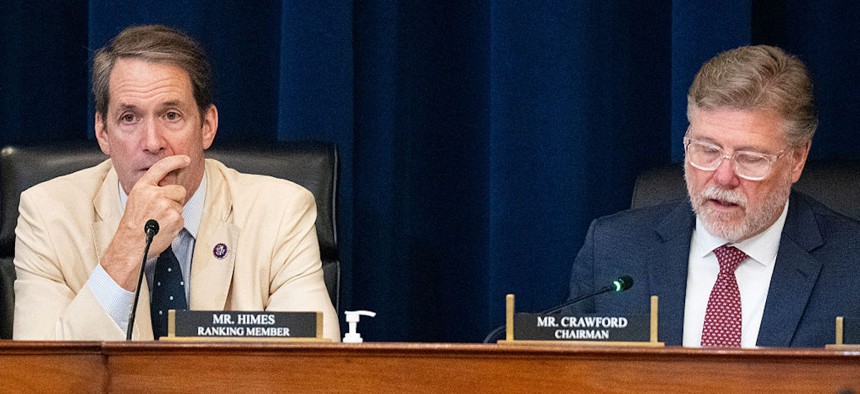
Ranking member Rep. Jim Himes, D-Mass., left, and chairman Rep. Rick Crawford, R-Ark., conduct the House Select Intelligence Committee hearing on "25 Years After 9/11: Confronting the Next Generation of Threats" on Tuesday, July 21, 2026. Bill Clark/CQ-Roll Call, Inc via Getty Images





Rep. Jim Himes, D-Conn., said the AI-focused facilities are going to be even more critical than their traditional data center counterparts because “so much more functionality is going to rely on their health and existence.”
The growing web of data centers across the United States that are needed to power artificial intelligence technologies is destined to be deemed critical infrastructure, according to the top Democrat on the House Intelligence Committee.
During an event at the Brookings Institution on Wednesday, Rep. Jim Himes, D-Conn. — the powerful House panel’s ranking member — said “I think there’s no question” that data centers will be considered critical infrastructure in the future, adding that “they're going to be even more important than the network data centers that we've been living with for 40 years now because so much more functionality is going to rely on their health and existence.”
U.S. critical infrastructure services are currently divided into 16 sectors, which range in size and scope from water and wastewater facilities to IT infrastructure and financial services. The Cybersecurity and Infrastructure Security Agency oversees the security of these sectors, which have been deemed so vital to U.S. interests that their destruction could have national security or other serious repercussions.
Although AI data centers already underpin some of the critical infrastructure, they are not yet deemed to be a standalone sector. Ongoing global conflicts, however, have highlighted the importance of these new data centers, with the facilities increasingly becoming military targets.
In March, Iran hit Amazon Web Services data centers in the United Arab Emirates and a third commercial data center in Bahrain with drones as Tehran moved to target U.S. tech companies’ regional interests as part of the war. In recent weeks, Russia and Ukraine have also traded strikes on data centers within each country.
Himes said securing U.S. data centers will ultimately result in the need for a “robust compute infrastructure,” with technologies likely having to “fragment and disperse” key services so that “critical functions are redundant and protected.”
“They haven't had to think in those terms quite yet because this is a new thing,” he added. “But as more and more of the agents, and as more and more of the commercial economy depends on these things, they will start to look more like JP Morgan's resilience centers than they look like today's data centers.”
JPMorganChase launched its $1.5 trillion, 10-year Security and Resiliency Initiative last year to help drive investments in industries deemed critical to U.S. national and economic security interests. The firm announced on Monday that it has invested $5 billion in startups over the first year of its effort, although it did not disclose most of the recipients of those funds.
AI data center construction has become increasingly controversial, with some Americans and lawmakers criticizing the facilities’ power use and water consumption.
Although the House overwhelmingly passed bipartisan legislation, known as the Ratepayer Protection Act, last month that would push the companies building data centers to pay for their electrical use, Himes said the measure “wasn't meaningful or substantive” and noted that it hasn’t been voted on yet in the Senate.
Himes said data center backlash is “driven by an eminently solvable problem,” which is addressing the underlying question of, “‘How do we equitably divide up the costs of building the compute?’”
He added, however, that continuing data center construction is inevitable, saying that “the experts tell me that the underlying demand for compute still looks infinite, and as long as that is a true fact, the build will happen.”